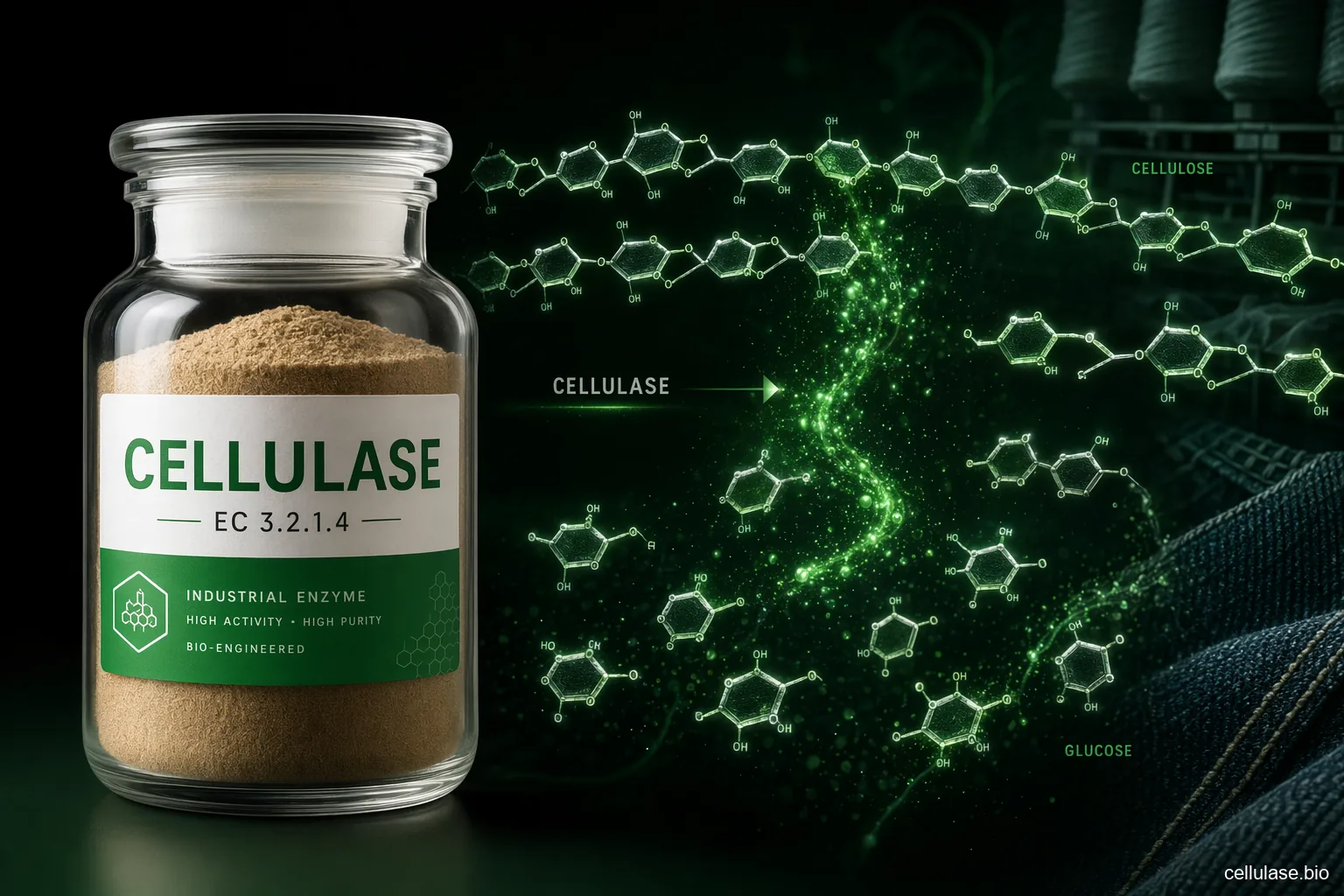
Cellulase Enzym for Textile Biopolishing Buyers
Source cellulase enzyme for textile biopolishing with pH, temperature, dosage, QC, COA/TDS/SDS, pilot validation and supplier checks.
Short answer
Cellulase for textile biopolishing is an industrial enzyme that hydrolyses the loose surface microfibrils on cotton, so fabric leaves the machine smoother, less prone to pilling and brighter in shade. Mills buy it in bulk as powder or liquid, in acid or neutral grades, and choose between them on the bath pH window and backstaining risk rather than on price per kilogram.
| Enzyme Name | Cellulase (EC 3.2.1.4 / EC 3.2.1.91 / EC 3.2.1.21) |
|---|---|
| Activity | Multiple grades (powder & liquid) |
| Optimal pH | 4.0 – 6.0 |
| Optimal Temperature | 45°C – 60°C |
| Appearance | Light brown to brown powder or liquid |
| Source | Trichoderma reesei / Aspergillus niger |
| Shelf Life | 12 months (sealed, cool, dry place) |
| Packaging | 25 kg drums (powder) / 30 kg jerricans (liquid) |
| MOQ | 25 kg |
| Certifications | ISO 9001, HALAL, KOSHER, Food Grade |
Updated · cellulase.bio
A practical B2B guide for mills, laundries, and formulators evaluating cellulase enzyme supply for cleaner fabric surfaces, controlled weight loss, and repeatable finishing results.
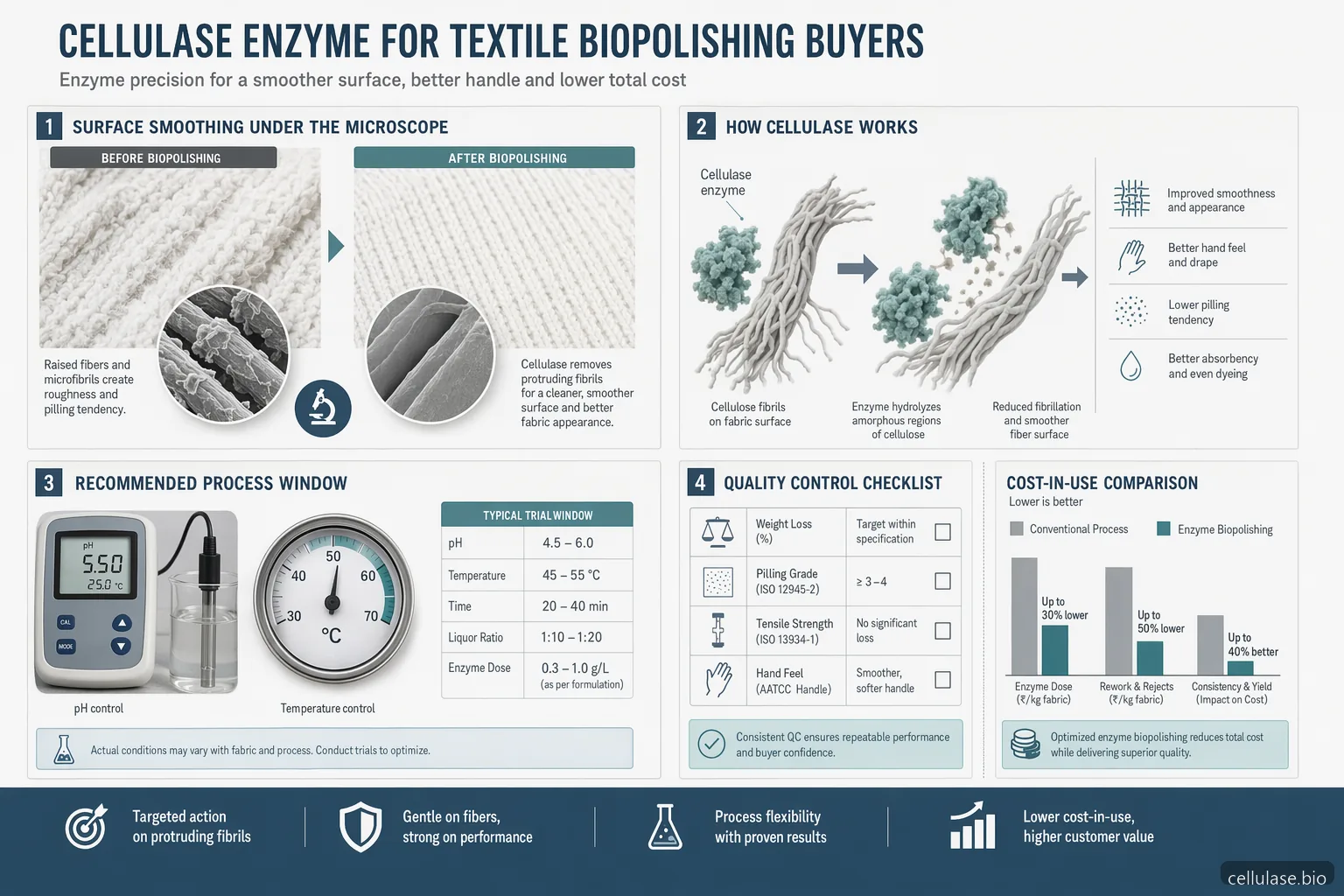
How does cellulase work in textile biopolishing?
Cellulase enzyme is used in textile biopolishing to hydrolyze exposed cellulose fibrils on cotton, viscose, lyocell, and blended cellulosic fabrics. The goal is not aggressive fiber degradation; it is controlled surface modification that can reduce fuzz, improve softness, enhance fabric clarity, and support a cleaner appearance after repeated laundering. For garment washing, enzyme cellulase can also contribute to controlled abrasion effects on denim when selected and dosed correctly. Industrial buyers should define the substrate, construction, pretreatment history, dyestuff sensitivity, equipment type, liquor ratio, and desired hand feel before requesting a quote. A supplier offering cellulase enzym kaufen or enzym cellulase kaufen inquiries should be able to translate these process details into a practical trial plan, not only provide a generic activity number. The best-fit product depends on pH window, temperature tolerance, backstaining risk, inactivation method, and compatibility with auxiliaries.
Primary substrates: cotton, viscose, lyocell, modal, and cellulosic blends. • Typical benefits: reduced pilling tendency, smoother surface, improved drape, and cleaner fabric face. • Key risk: excessive strength loss if dosage, time, or mechanical action is not controlled.
See cellulase for biopolishing and denim biostoning for the full picture.
See how cellulase works for the full picture.
What process window should I run cellulase trials in?
Safe starting conditions depend on the cellulase type and the mill process. Acid cellulase often performs around pH 4.5–5.5 and 45–55 °C, while neutral cellulase is commonly trialed around pH 6.0–7.0 and 45–60 °C. Some alkaline-compatible grades are formulated for detergent or special wet-processing conditions, but they still require verification with actual bath chemistry. Initial dosage can be screened in the range of 0.1–1.0% owg or according to supplier activity units, with 20–60 minutes contact time as a typical pilot window. Higher mechanical action increases fibril removal but also raises the risk of weight and tensile loss. Trials should include enzyme kill steps such as temperature elevation or pH shift where recommended in the TDS. Do not assume one cellulase enzym setting transfers directly across fabric weights, dye classes, or machines.
Run at least three dosage points plus an untreated control. • Record pH at start and finish, not only dosing tank pH. • Confirm whether softeners, dispersants, or surfactants inhibit activity.
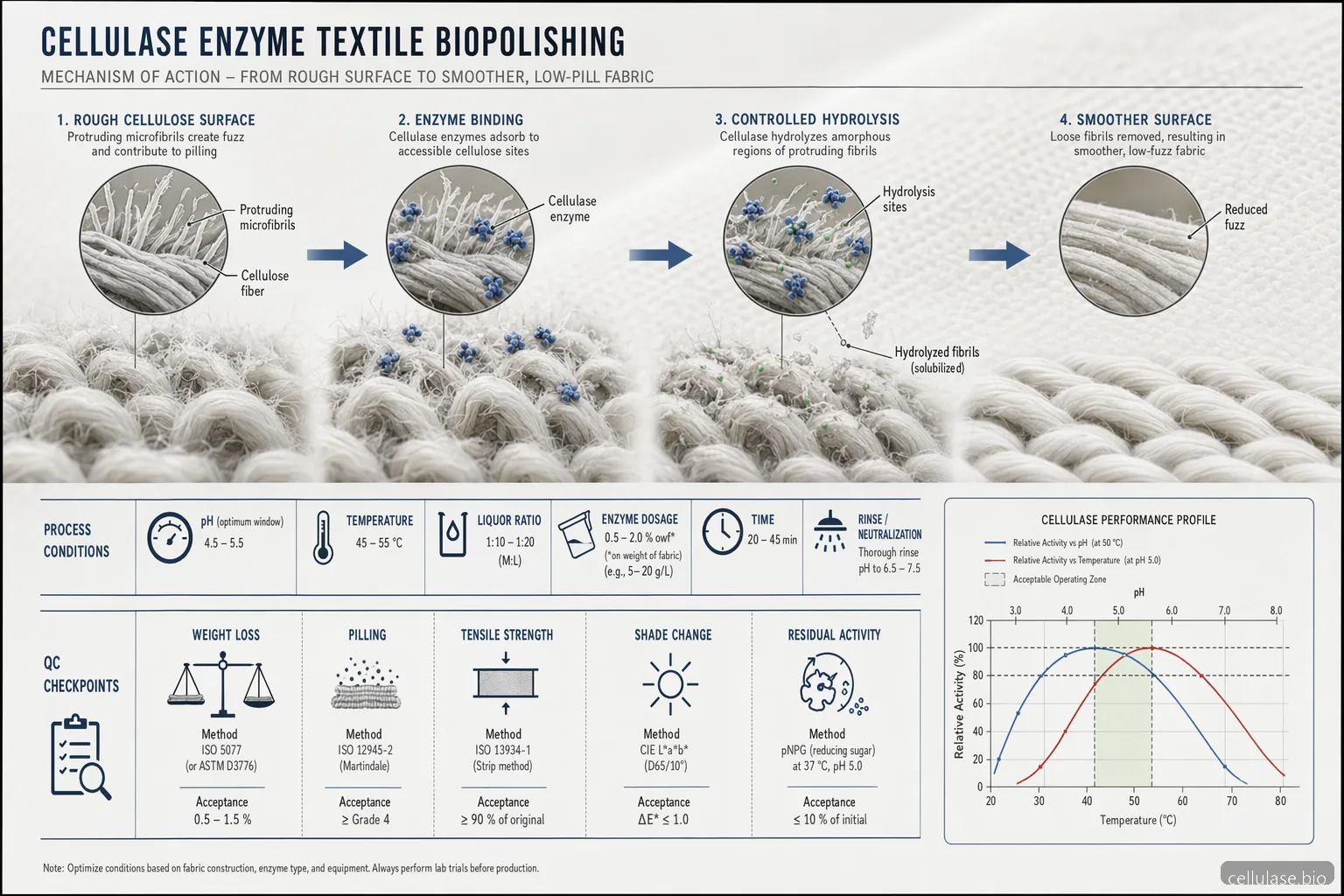
Which QC checks protect production quality?
A professional cellulase supplier should provide a COA for each batch, plus a TDS and SDS before plant use. The COA should state product name, batch number, activity or potency method, appearance, date of manufacture or retest, and storage conditions. Because cellulase activity methods vary, buyers should avoid comparing units across suppliers without understanding the assay substrate and conditions. During mill trials, QC should track fabric weight loss, pilling grade, tensile or tear strength, shade change, absorbency where relevant, and residual fuzz under standardized visual review. For dyed goods, include staining or backstaining checks, especially in garment processing. For liquid cellulase enzyme products, monitor viscosity, odor, phase separation, and storage stability. For powders or granulates, assess dust handling, dissolution behavior, and dosing accuracy. Good QC turns enzym cellulase purchasing into a repeatable specification rather than a one-time sample approval.
Require batch-to-batch retain samples for production investigations. • Use the same wash-off and drying route for all trial comparisons. • Document fabric damage thresholds before approving scale-up.
Why does cost-in-use matter more than price per kilogram?
For B2B buying, cellulase enzyme cost should be evaluated by performance per finished kilogram of fabric, not only supplier quote per kilogram or liter. A concentrated enzyme may cost more per unit but require lower dosage, shorter time, less rework, or fewer rejected lots. Build a cost-in-use model that includes dose, activity stability during storage, bath reuse policy if applicable, energy demand, cycle time, neutralization or inactivation cost, wastewater impact, and final garment value. Pilot validation should compare at least two candidate products under realistic machine loading and mechanical action. Include operators and QC personnel in the assessment because handling and process robustness affect total cost. If a supplier cannot support pilot design, troubleshooting, and interpretation of results, the lowest offer may become expensive during scale-up. The target is a qualified cellulase enzym that delivers consistent appearance with controlled strength retention.
Calculate enzyme cost per kg of fabric and per acceptable finished lot. • Include reprocessing, shade correction, and rejected fabric in the economics. • Assess shelf life under your warehouse temperature range.
See how cellulase is priced for the full picture.
How do I qualify a supplier of industrial cellulase?
When sourcing cellulase enzyme, qualify both the product and the organization behind it. Ask for COA, TDS, SDS, allergen or handling statements where relevant, recommended PPE, packaging options, minimum order quantity, lead time, and change-notification practice. Confirm whether the supplier can provide technical service for textile biopolishing, not only detergent, animal feed, or biofuel applications. Search terms such as cellulase, cellulase enzym kaufen, enzym cellulase kaufen, and cellulase textile may bring mixed results, including consumer topics like waschmittel ohne enzym cellulase, hat mensch cellulase enzym, or enzym komplex amylase pankreatin cellulase ec lactase pzn. Those are not industrial textile procurement criteria. For mill purchasing, prioritize lot consistency, documentation quality, storage stability, local logistics, and application know-how. A reliable supplier should be willing to support lab screening, pilot runs, and commercial ramp-up without making unverifiable performance guarantees.
Request a pre-shipment sample from the same grade proposed for supply. • Confirm packaging compatibility with your dosing equipment. • Define a written specification before first commercial order.
See how to vet a cellulase supplier for the full picture.
What should I check before buying cellulase?
What do buyers usually ask about cellulase?
The best cellulase enzyme depends on fabric, pH, temperature, dye system, and target effect. Acid cellulase is often used for cotton and garment effects under mildly acidic conditions, while neutral cellulase may be preferred where shade preservation and lower backstaining risk are priorities. The correct choice should be validated in lab and pilot trials before bulk purchasing.
Begin with a control and at least three dosage levels, such as 0.1%, 0.3%, and 0.6% owg, or use supplier activity-unit guidance. Keep time, pH, liquor ratio, and mechanical action consistent. Measure weight loss, pilling grade, strength, shade, and hand feel. Final dosage should be based on acceptable quality and cost-in-use.
For industrial textile use, request a certificate of analysis, technical data sheet, safety data sheet, activity method, storage recommendation, batch number, shelf-life or retest date, and packaging information. The supplier should also explain the operating pH and temperature range, deactivation method, compatibility limitations, and any practical precautions for enzyme handling in the mill.
Sometimes, but it should not be assumed. Denim washing often involves higher mechanical abrasion and stronger visual effects, while knitted cotton biopolishing may prioritize softness, surface smoothness, and strength retention. The same enzyme can behave differently with fabric construction, dye, liquor ratio, and machine action. Separate pilot validation is recommended for each fabric category.
No. This page addresses B2B industrial cellulase for textile biopolishing. Consumer questions such as hat mensch cellulase enzym or products described as enzym komplex amylase pankreatin cellulase ec lactase pzn relate to nutrition or supplements and require different regulatory and safety considerations. Textile buyers should focus on industrial documentation, process performance, and supplier qualification.
See cellulase in laundry detergent for the full picture.
Cellulase for Research & Industry
Need Cellulase for your lab or production process?
ISO 9001 certified · Food-grade & research-grade · Ships to 80+ countries
Frequently Asked Questions
Related: Cellulase for Industrial Production and Activity Control
Turn This Guide Into a Supplier Brief Request a textile cellulase sample, COA/TDS/SDS package, and pilot trial recommendation for your fabric and process conditions. See our application page for Cellulase for Industrial Production and Activity Control at /applications/cellulase-production-activity/ for specs, MOQ, and a free 50 g sample.
Get a Free Sample & Quotehello@mail.cellulase.bio