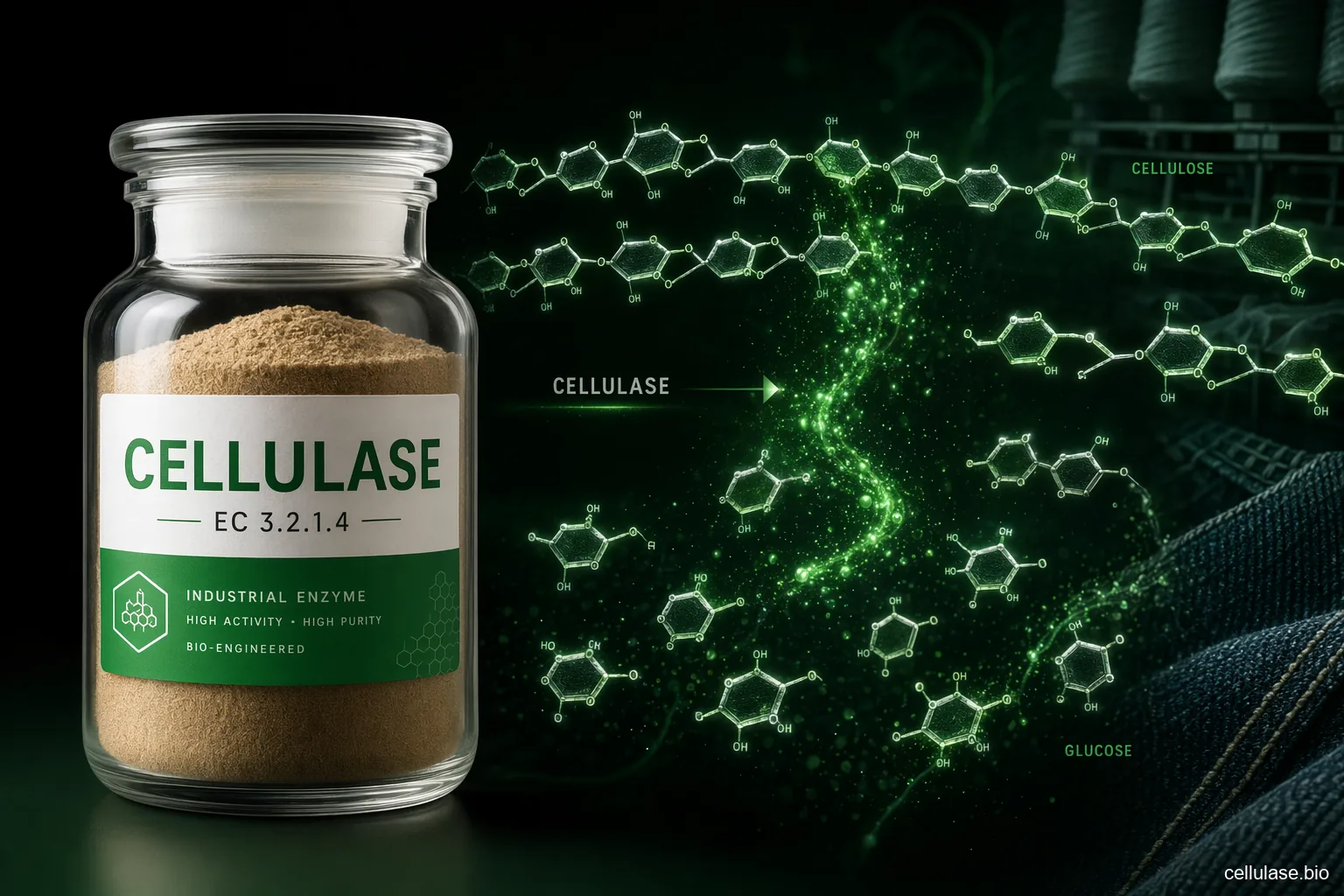
Cellulase for Textile Biopolishing: Industrial Process Guide
Use enzyme cellulase for textile biopolishing with practical pH, temperature, dosage, QC, pilot, and supplier qualification guidance.
Short answer
In textile biopolishing, cellulase hydrolyses the protruding cellulose microfibrils on cotton yarn, which removes fuzz and pilling propensity and brightens shade without mechanical sanding. The process is a controlled trade-off: more visible effect also means more fabric mass removed and lower tensile strength, so mills fix dose, pH, temperature and time against an agreed ceiling on how much fabric mass may be lost.
| Enzyme Name | Cellulase (EC 3.2.1.4 / EC 3.2.1.91 / EC 3.2.1.21) |
|---|---|
| Activity | Multiple grades (powder & liquid) |
| Optimal pH | 4.0 – 6.0 |
| Optimal Temperature | 45°C – 60°C |
| Appearance | Light brown to brown powder or liquid |
| Source | Trichoderma reesei / Aspergillus niger |
| Shelf Life | 12 months (sealed, cool, dry place) |
| Packaging | 25 kg drums (powder) / 30 kg jerricans (liquid) |
| MOQ | 25 kg |
| Certifications | ISO 9001, HALAL, KOSHER, Food Grade |
Updated · cellulase.bio
A practical B2B guide for mills, laundries, and textile chemical formulators evaluating enzyme cellulase for cleaner fabric surfaces, controlled weight loss, and repeatable biopolishing results.
What Is Cellulase Enzyme in Textile Biopolishing?
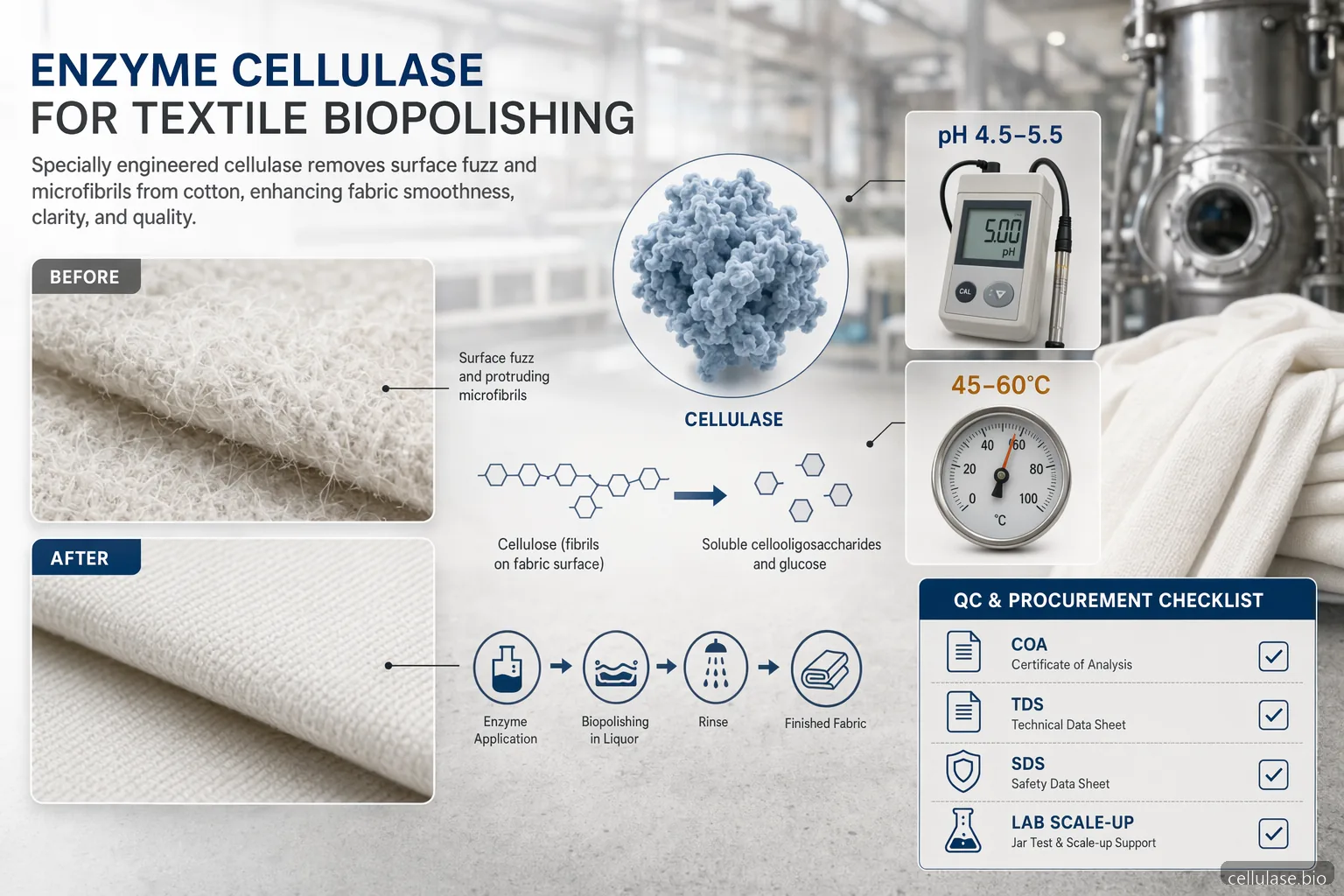
Cellulase enzyme is a group of enzymes that hydrolyze cellulose, the main structural polymer in cotton, viscose, lyocell, linen, and other cellulosic fibers. In textile biopolishing, enzyme cellulase acts mainly on loose microfibrils at the fabric surface rather than on the full fiber body when the process is correctly controlled. This selective action helps create a cleaner surface, softer hand, improved color clarity, and reduced tendency to pill. For B2B buyers, the key question is not simply “is cellulase an enzyme?” but which cellulase system, activity profile, formulation, and process window fit the mill’s fabric mix and equipment. Acid cellulases are widely used for cotton knits and garments, while neutral cellulases may be selected where lower shade change or gentler processing is required. Selection should be based on pilot data, supplier documentation, and repeatable plant performance.
Primary substrates: cotton, viscose, lyocell, linen, and blends with cellulosic content. • Primary effect: controlled removal of surface fuzz and protruding fibrils. • Main risk: excessive strength loss if dosage, time, pH, or temperature are not controlled.
See cellulase for cellulosic ethanol and biomass saccharification for the full picture.
See cellulase for biopolishing and denim biostoning for the full picture.
See what biopolishing is and how it finishes cotton for the full picture.
What are the typical process conditions for cellulase?
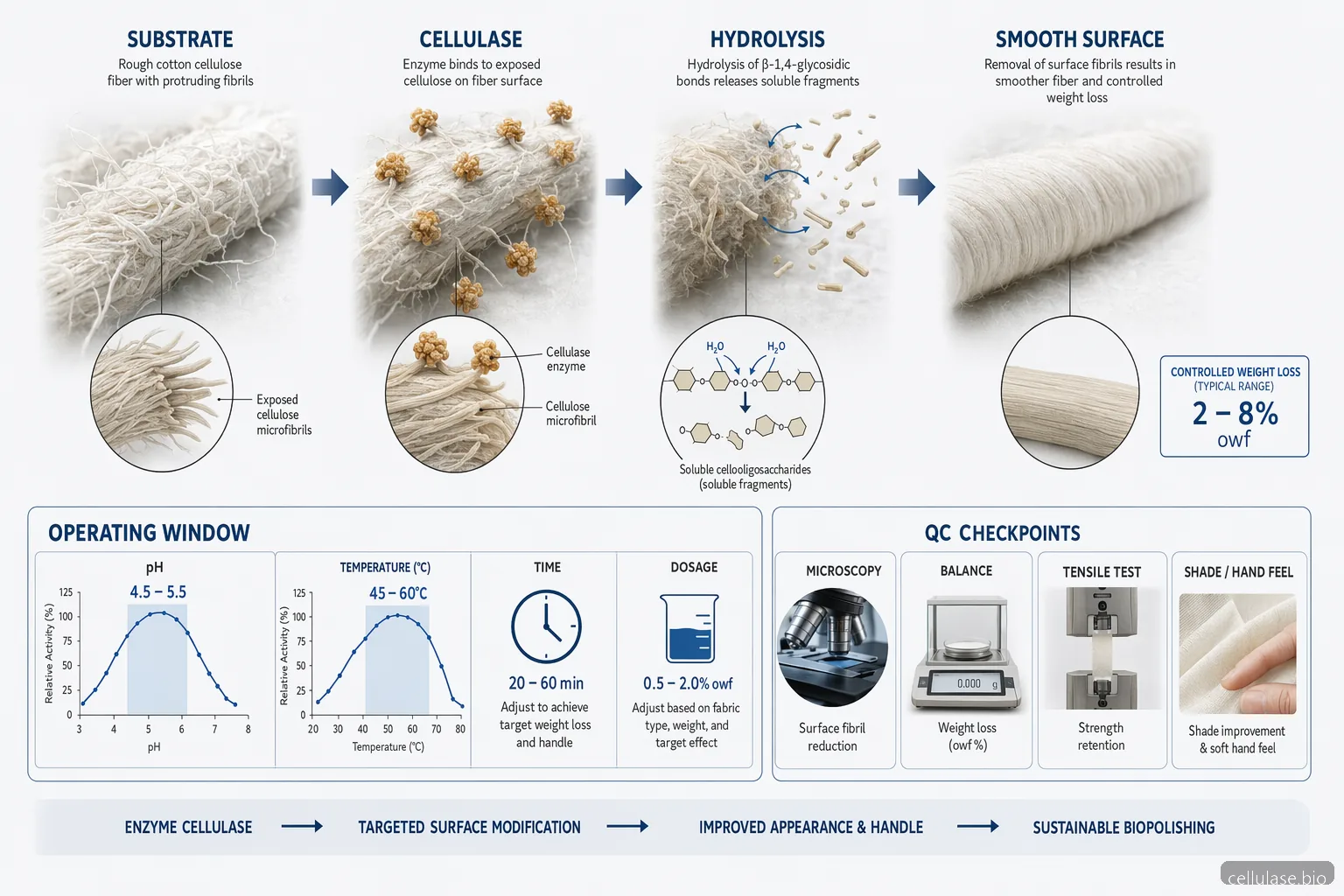
Biopolishing conditions vary by enzyme type, fabric construction, machine agitation, and desired finish. As a practical starting point, many acid cellulase processes operate at pH 4.5–5.5 and 45–55°C for 30–60 minutes. Neutral cellulase systems often operate around pH 6.0–7.0 and 45–60°C. Dosage is commonly evaluated in the range of 0.2–2.0% on weight of fabric or according to the supplier’s declared activity units. Higher mechanical action increases fibril removal but can also raise weight loss and fabric damage. The bath should be buffered where necessary, and pH should be checked at the start and end of the run. After the target effect is achieved, enzyme activity must be stopped through temperature increase, pH shift, washing, or a supplier-recommended deactivation step before subsequent dyeing or finishing.
Starting pH: 4.5–5.5 for many acid cellulases; 6.0–7.0 for many neutral systems. • Starting temperature: commonly 45–60°C, depending on the TDS. • Trial dosage: often 0.2–2.0% owf, then optimized by fabric and activity units. • Treatment time: commonly 30–60 minutes under controlled agitation.
Which QC checks come before scaling from lab to production?
A successful cellulase textile trial should be judged with measurable QC results, not only visual feel. Before scale-up, compare treated and untreated fabric for pilling grade, fuzz level, absorbency, hand feel, dimensional change, shade difference, weight loss, and tensile or bursting strength. Many mills set a maximum acceptable weight loss range, often around 1–5%, depending on fabric quality and end-use requirements. Strength retention is especially important for lightweight knits, viscose, lyocell, and regenerated cellulose fabrics. Color change should be monitored with spectrophotometer readings where shade consistency is critical. Residual cellulase should also be considered when the fabric moves into dyeing, softening, resin finishing, or storage. The best pilot validation includes laboratory beaker trials, sample dyeing or finishing compatibility checks, and a controlled machine trial using realistic liquor ratio, agitation, loading, and rinsing conditions.
Measure pilling grade and surface fuzz before and after treatment. • Track weight loss, tensile strength, bursting strength, and dimensional stability. • Use ΔE or shade comparison when color consistency is important. • Confirm enzyme deactivation before downstream finishing.
What should procurement ask for: COA, TDS, SDS?
Industrial buyers should qualify a cellulase enzyme supplier using technical evidence and batch consistency. Request a current technical data sheet describing recommended pH, temperature, dosage, storage, compatibility, and deactivation guidance. A certificate of analysis should identify product name, batch number, activity or assay reference, appearance, and release specifications. The safety data sheet should support safe handling, storage, spill response, and worker protection practices. Because activity units are not always directly comparable between suppliers, mills should normalize trials by cost-in-use and fabric performance rather than purchase price alone. Supplier qualification should also consider lead time, packaging integrity, shelf-life, cold-chain or ambient stability requirements, sample availability, regulatory documentation relevant to the buyer’s market, and technical support during pilot validation. Avoid relying on broad claims without plant-relevant test data.
Request COA, TDS, and SDS before production purchase. • Compare cost per treated kilogram of fabric, not only cost per kilogram of enzyme. • Confirm storage temperature, shelf life, and packaging size options. • Assess supplier responsiveness during lab and pilot troubleshooting.
How do I optimise cost-in-use?
The business case for enzyme cellulase depends on the total finishing result, not a single input cost. A lower-priced cellulase enzyme may require higher dosage, longer process time, stricter pH control, or additional reprocessing, while a higher-activity product may reduce bath time or improve consistency. Cost-in-use should include enzyme dose, buffer or acid requirement, heating energy, water, machine time, rinse steps, fabric yield loss, rejects, and labor. Optimization usually starts with a designed trial matrix: dosage, time, pH, temperature, liquor ratio, and agitation are adjusted while measuring pilling grade, hand feel, weight loss, strength, and shade. Mills processing multiple fabric types may need separate recipes for cotton knits, denim, viscose blends, and lyocell. The target is a stable operating window that protects fabric value while meeting the buyer’s aesthetic and performance specification.
Build trials around both performance and total process cost. • Separate recipes by fiber type, fabric weight, and machine action. • Monitor rework rates and shade variation after production adoption. • Review enzyme performance periodically as substrates or processes change.
What should I check before buying cellulase?
What do buyers usually ask about cellulase?
The enzyme cellulase breaks down exposed cellulose microfibrils on the surface of cotton and other cellulosic fabrics. In a controlled textile process, it removes fuzz and weak surface fibers to improve smoothness, softness, and resistance to pilling. If conditions are too aggressive, it can also reduce fabric strength, so pH, temperature, dosage, time, and agitation must be validated.
Yes, cellulase is an enzyme system, typically including endoglucanase, exoglucanase, and beta-glucosidase activities that act on cellulose. In industrial textile finishing, suppliers formulate cellulase enzyme products for specific process windows such as acidic or neutral biopolishing. Buyers should evaluate the declared activity method, recommended operating conditions, and fabric results rather than assuming all cellulase products perform the same.
Choose a supplier based on process fit, documentation, consistency, and technical support. Request the COA, TDS, and SDS, then run side-by-side trials on production-relevant fabrics. Compare cost-in-use, not only unit price, and confirm storage stability, batch traceability, packaging, lead time, and troubleshooting support. Supplier qualification should include lab trials, pilot validation, and at least one controlled production run.
Cellulase can be used before dyeing, after dyeing, or in garment processing, depending on the fabric and shade requirements. Pre-dye biopolishing may improve surface cleanliness, while post-dye treatment can enhance hand feel but may influence shade or color clarity. Always check dye compatibility, measure shade change, and confirm enzyme deactivation before softening, resin finishing, or packaging.
Industrial production of cellulase enzyme is typically done by controlled microbial fermentation, followed by filtration, concentration, stabilization, formulation, and QC release. It requires strain control, contamination management, assay methods, and safety systems. Most textile mills do not make cellulase in-house; they qualify enzyme manufacturers and validate commercial products against fabric performance, COA specifications, and process economics.
Not necessarily. Laundry detergent with enzyme cellulase is formulated for consumer or institutional washing conditions, surfactants, builders, and repeated low-dose use. Textile biopolishing cellulase is selected for mill processes with controlled pH, temperature, liquor ratio, agitation, and deactivation. A detergent enzyme should not be substituted for industrial finishing without supplier data, safety review, and pilot validation.
See cellulase for fruit juice yield and clarification for the full picture.
See cellulase in animal feed for fibre digestibility for the full picture.
See how to vet a cellulase supplier for the full picture.
See how cellulase is priced for the full picture.
See process conditions for cellulase for the full picture.
Cellulase for Research & Industry
Need Cellulase for your lab or production process?
ISO 9001 certified · Food-grade & research-grade · Ships to 80+ countries
Frequently Asked Questions
Related: Cellulase for Industrial Production and Activity Control
Turn This Guide Into a Supplier Brief Request a cellulase sample, TDS, SDS, and pilot support for your textile biopolishing process. See our application page for Cellulase for Industrial Production and Activity Control at /applications/cellulase-production-activity/ for specs, MOQ, and a free 50 g sample.
Get a Free Sample & Quotehello@mail.cellulase.bio