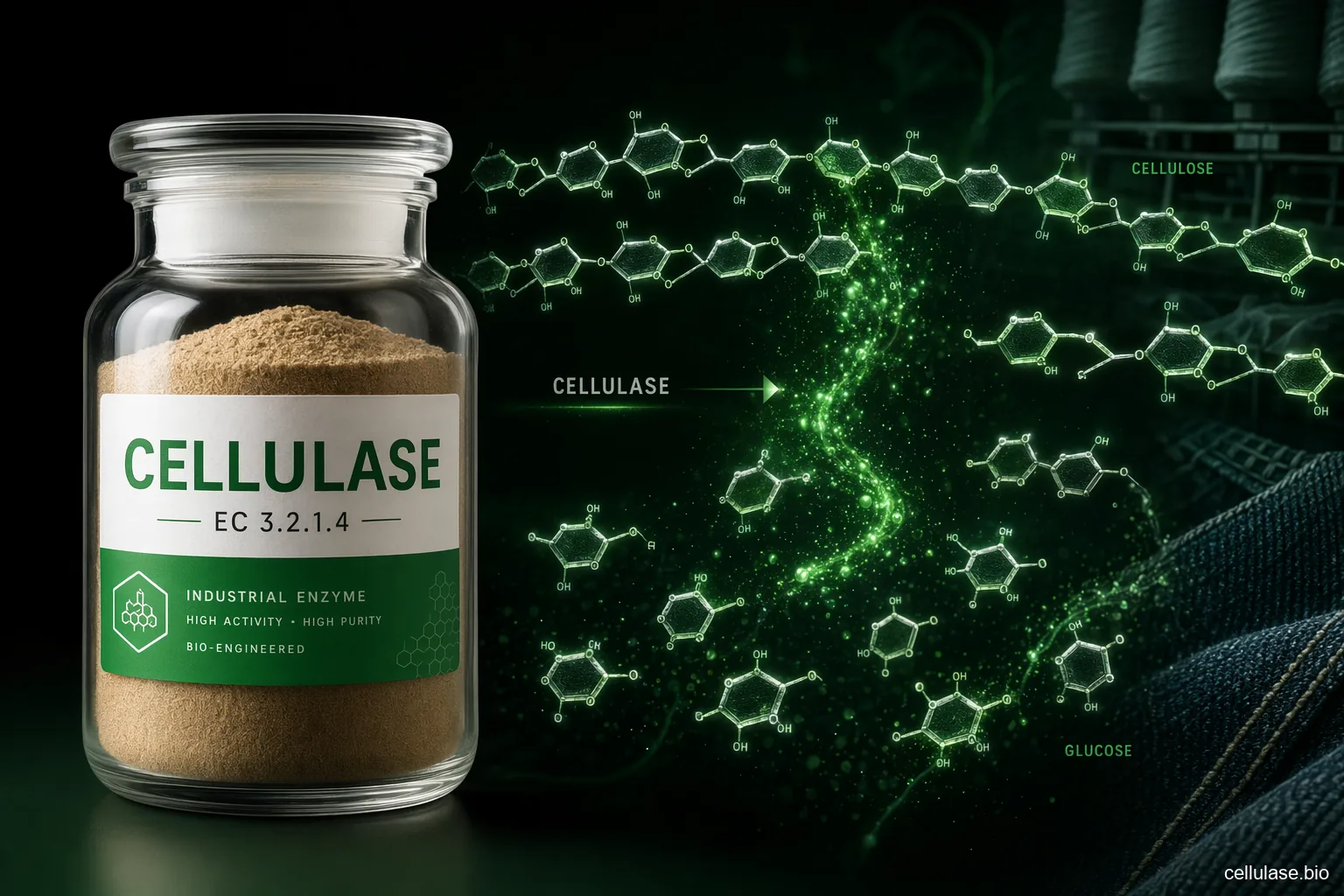
Cellulase Enzyme Powder: How to Use Cellulase in Textile Biopolishing Formulations
Formulate textile biopolishing with cellulase enzyme powder: pH, temperature, dosage, QC, pilot validation, COA/TDS/SDS, and cost-in-use.
Short answer
Cellulase enzyme powder is the dry form of the enzyme, packed in 25 kg drums for mills that dose by weight and want a long, stable shelf life. In biopolishing it is dissolved into the bath, run inside its working pH and temperature window, then deactivated by an alkaline or hot rinse so cellulose modification stops at the target effect.
| Enzyme Name | Cellulase (EC 3.2.1.4 / EC 3.2.1.91 / EC 3.2.1.21) |
|---|---|
| Activity | Multiple grades (powder & liquid) |
| Optimal pH | 4.0 – 6.0 |
| Optimal Temperature | 45°C – 60°C |
| Appearance | Light brown to brown powder or liquid |
| Source | Trichoderma reesei / Aspergillus niger |
| Shelf Life | 12 months (sealed, cool, dry place) |
| Packaging | 25 kg drums (powder) / 30 kg jerricans (liquid) |
| MOQ | 25 kg |
| Certifications | ISO 9001, HALAL, KOSHER, Food Grade |
Updated · cellulase.bio
A practical B2B guide for mills, formulators, and sourcing teams evaluating cellulase enzyme powder for cotton and cellulosic fabric biopolishing. Powder ships in 25 kg drums; send product, quantity and destination for a bulk quote.
What Is Cellulase Enzyme Powder?
Cellulase enzyme powder is a concentrated industrial enzyme preparation that catalyzes the hydrolysis of cellulose, mainly by attacking beta-1,4 glycosidic bonds in cotton and other cellulosic fibers. For buyers asking what is cellulase enzyme or is cellulase an enzyme, the practical answer is that cellulase is an enzyme system, often containing endoglucanase, exoglucanase, and beta-glucosidase activities in different proportions. In textile biopolishing, formulators usually select activity profiles that act on protruding surface fibrils rather than aggressively weakening the fiber core. The goal is controlled surface modification: improved smoothness, lower fuzz, better pilling performance, and a cleaner appearance after dyeing or garment washing. Cellulase enzyme powder is attractive for B2B use because it is easier to ship and store than many liquid products, but it requires careful dispersion, dust control, and validated dosing.
Primary substrates: cotton, viscose, lyocell, modal, and cellulosic blends • Typical objective: reduce fuzz and pilling while limiting strength loss • Format considerations: activity, solubility, carrier, moisture, and dusting profile
See choosing between acid and neutral cellulase for the full picture.
How does cellulase work in textile biopolishing?
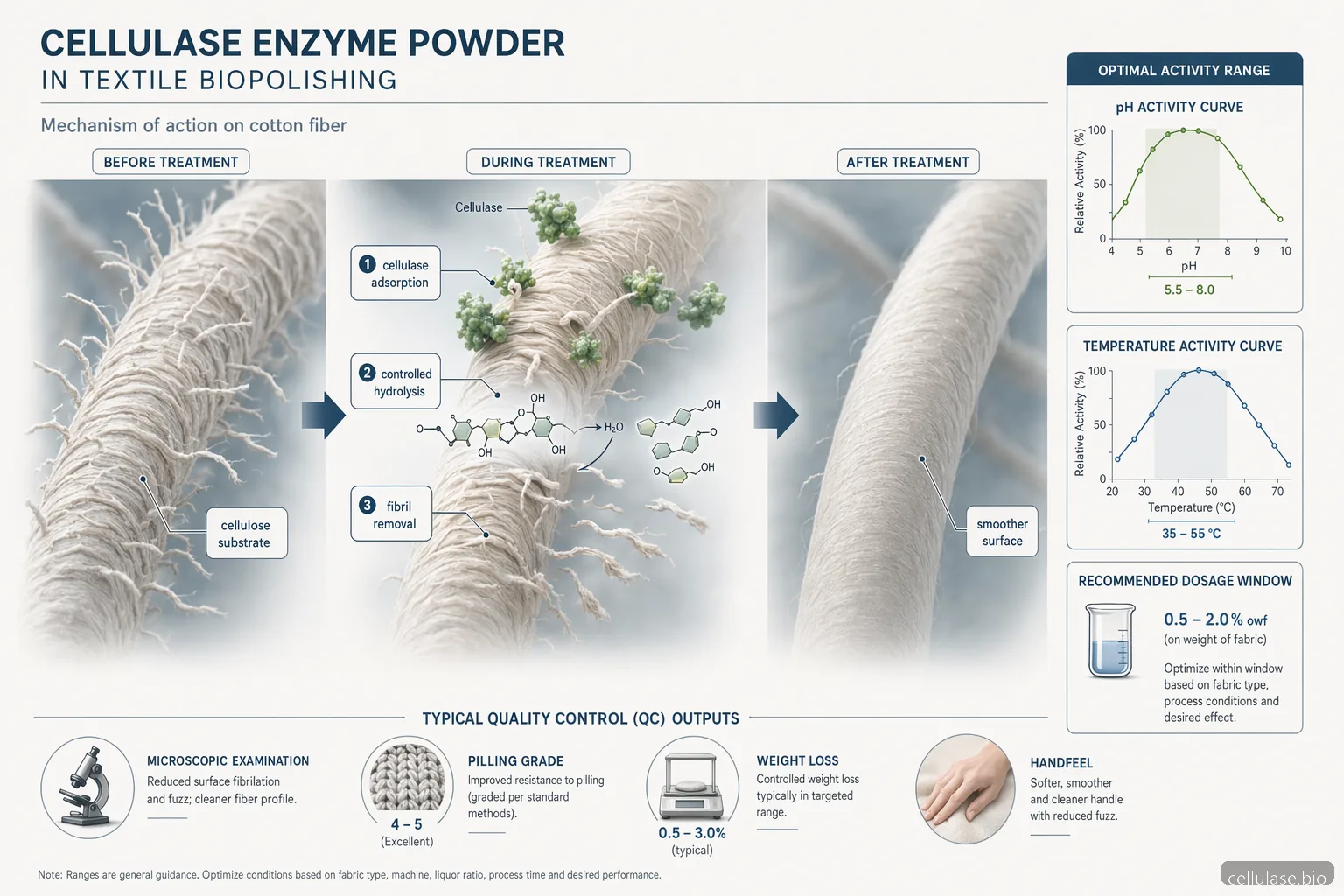
When buyers ask what does the enzyme cellulase do or what does cellulase enzyme do, the textile answer is specific: it selectively weakens and breaks exposed cellulose microfibrils on fabric or yarn surfaces. Mechanical action in the bath then helps detach loosened fuzz. This differs from a laundry detergent with enzyme cellulase, where the formulation must work across household wash conditions, surfactants, and repeated consumer use. In industrial textile biopolishing, the mill controls bath ratio, pH, temperature, liquor circulation, time, and deactivation. Properly controlled enzyme cellulase treatment can improve fabric surface clarity and reduce pilling, but overdosing or long dwell time can cause excess weight loss, shade change, or tensile strength reduction. For this reason, cellulase should be treated as a process chemical with defined operating limits, not as a commodity additive.
Controlled hydrolysis is beneficial; uncontrolled hydrolysis creates quality risk • Mechanical action is part of the biopolishing effect • Different cellulase activity profiles produce different fabric results
See cellulase for biopolishing and denim biostoning for the full picture.
What pH, temperature and dosage should the formulation run at?
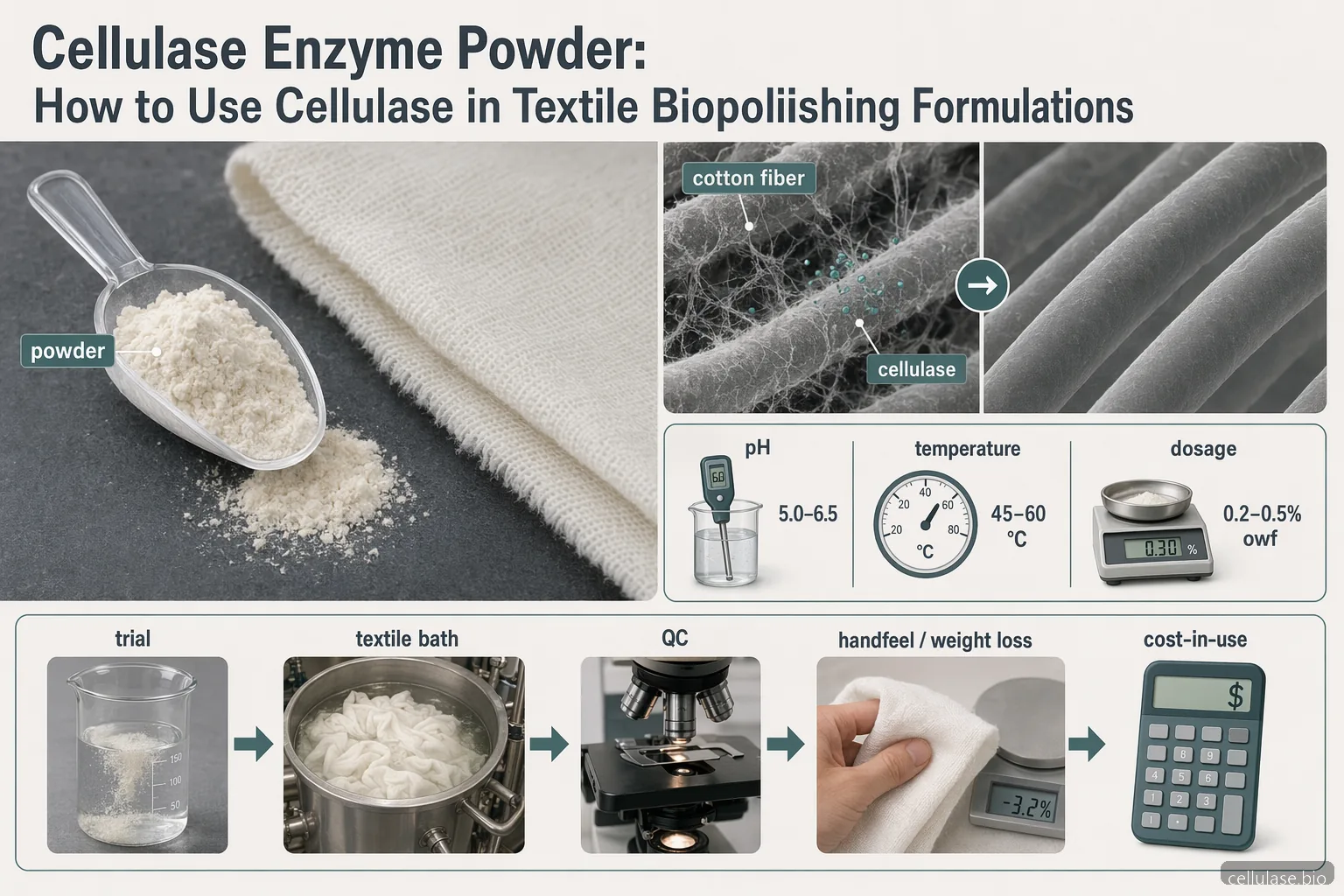
The best formulation window depends on the cellulase enzyme powder grade and the fabric construction. As a starting point, acid cellulase products are often evaluated at pH 4.5-5.5 and 45-55°C, while neutral cellulase products are commonly evaluated at pH 6.0-7.0 and 45-60°C. Dosage is normally optimized by activity, not only by product weight; screening ranges may begin around 0.05-0.50% on weight of goods, or as recommended in the TDS. Treatment time often falls between 20 and 60 minutes, depending on bath ratio, agitation, fabric type, and desired pilling improvement. Avoid assuming that higher dosage improves economics. In many mills, the optimum is the lowest dose that reaches the target pilling grade, hand feel, and appearance without unacceptable weight loss or strength damage.
Acid cellulase starting window: pH 4.5-5.5, 45-55°C • Neutral cellulase starting window: pH 6.0-7.0, 45-60°C • Initial dosage screen: often 0.05-0.50% owg, adjusted by activity and trial results • Typical contact time: 20-60 minutes
See fixing patchy or over-aggressive cellulase dosing for the full picture.
What does a mill trial workflow look like?
A practical pilot validation should begin with a lab dip or small jet sample using the exact fabric, dye class, softener plan, and finishing route intended for production. Prepare a buffered bath, disperse the cellulase enzyme powder fully before adding goods, and maintain consistent liquor movement. Run a matrix that varies dosage, pH, temperature, and time rather than changing all variables at once. After treatment, deactivate the cellulase according to the supplier TDS, commonly by raising pH, increasing temperature, or both, then rinse thoroughly before downstream finishing. Compare treated and untreated controls under the same drying and conditioning conditions. Scale-up should only proceed after the mill confirms repeatability in pilot equipment that approximates production agitation and liquor ratio.
Use the same substrate, shade, and finishing route planned for production • Change one major variable at a time where possible • Confirm complete enzyme deactivation before softening or finishing • Keep untreated and benchmark controls for every trial
Which QC checks confirm biopolishing performance?
Quality control should measure both appearance improvement and fabric integrity. Common checks include pilling grade, fuzz rating, hand feel assessment, fabric weight loss, tensile or tear strength, shade difference, absorbency, and seam or garment appearance after laundering. For dyed goods, shade change can occur because surface fibrils scatter light differently before and after enzyme action; this is not necessarily dye removal, but it must be evaluated against buyer tolerance. QC should also include bath pH verification before dosing and during treatment, temperature logging, and confirmation that the enzyme was deactivated. For incoming cellulase enzyme powder, verify activity units, moisture, appearance, lot number, manufacturing date, recommended retest date, and storage conditions against the COA and TDS.
Performance: pilling, fuzz, hand feel, and surface clarity • Integrity: weight loss, tensile strength, tear strength, and seam behavior • Color: shade difference and visual approval under standard light • Process: pH, temperature, time, and deactivation confirmation
What does cellulase cost in use, and how do I qualify a supplier?
The lowest price per kilogram is rarely the lowest cost-in-use. Industrial buyers should compare cellulase enzyme powder by delivered activity, effective dosage, treatment time, rework rate, fabric loss, and consistency across lots. A more active or better-matched product may reduce dosage, shorten processing, or improve first-pass quality. Supplier qualification should include COA, TDS, SDS, activity assay method, allergen or sensitization handling guidance, packaging details, shelf-life or retest policy, and recommended storage. Ask whether the supplier supports pilot validation and whether representative pre-shipment samples can be tested against the production substrate. For the production of cellulase enzyme, buyers do not need proprietary fermentation details, but they should require batch traceability, documented quality controls, and transparent change notification for material, process, or specification updates.
Compare cost by treated fabric output, not product weight alone • Request COA, TDS, SDS, and activity method before approval • Confirm lot traceability and change notification practices • Validate supplier claims with mill-scale or pilot-scale data
See how to vet a cellulase supplier for the full picture.
See what you are actually paying for in a cellulase quote for the full picture.
What should I check before buying cellulase?
What do buyers usually ask about cellulase?
Cellulase enzyme is used to modify the surface of cotton and other cellulosic fabrics by weakening exposed microfibrils. With controlled mechanical action, those loosened fibrils detach, improving smoothness and reducing fuzz or pilling. The process must be balanced against fabric strength, weight loss, shade change, and hand feel, so mills normally validate dosage and conditions through lab and pilot trials.
Cellulase is an enzyme, not a conventional chemical softener. It catalyzes cellulose hydrolysis under suitable pH, temperature, and moisture conditions. A softener mainly changes surface lubrication and hand feel, while enzyme cellulase changes the fiber surface itself. Many textile finishing routes use both, but cellulase treatment should be completed and deactivated before downstream softening unless compatibility is proven.
A common initial screening range is about 0.05-0.50% on weight of goods, but the correct dosage depends on enzyme activity, fabric type, equipment, bath ratio, target pilling grade, and process time. Always use the supplier TDS as the starting reference, then run controlled trials. The preferred dose is usually the lowest dose that meets appearance targets without unacceptable strength or weight loss.
Yes. Cellulase can change visual shade because it removes surface fuzz and alters light scattering on the fabric surface. In some cases, color appears cleaner or slightly different even when dye removal is not the main mechanism. For dyed goods, compare treated and untreated controls using standard lighting, color measurement, laundering checks, and buyer tolerance limits before approving production use.
Industrial buyers should request a COA for each lot, a TDS with operating conditions, an SDS for safe handling, activity assay information, storage guidance, packaging details, shelf-life or retest date, and change notification practices. For supplier qualification, also ask for pilot support, representative samples, batch traceability, and evidence that the product performs consistently on the intended textile substrate.
See cellulase in laundry detergent for the full picture.
See how cellulase works for the full picture.
Cellulase for Research & Industry
Need Cellulase for your lab or production process?
ISO 9001 certified · Food-grade & research-grade · Ships to 80+ countries
Frequently Asked Questions
Related: Cellulase for Industrial Production and Activity Control
Turn This Guide Into a Supplier Brief Request a cellulase enzyme powder sample, COA, TDS, SDS, and pilot-trial guidance for your textile biopolishing formulation. See our application page for Cellulase for Industrial Production and Activity Control at /applications/cellulase-production-activity/ for specs, MOQ, and a free 50 g sample.
Get a Free Sample & Quotehello@mail.cellulase.bio