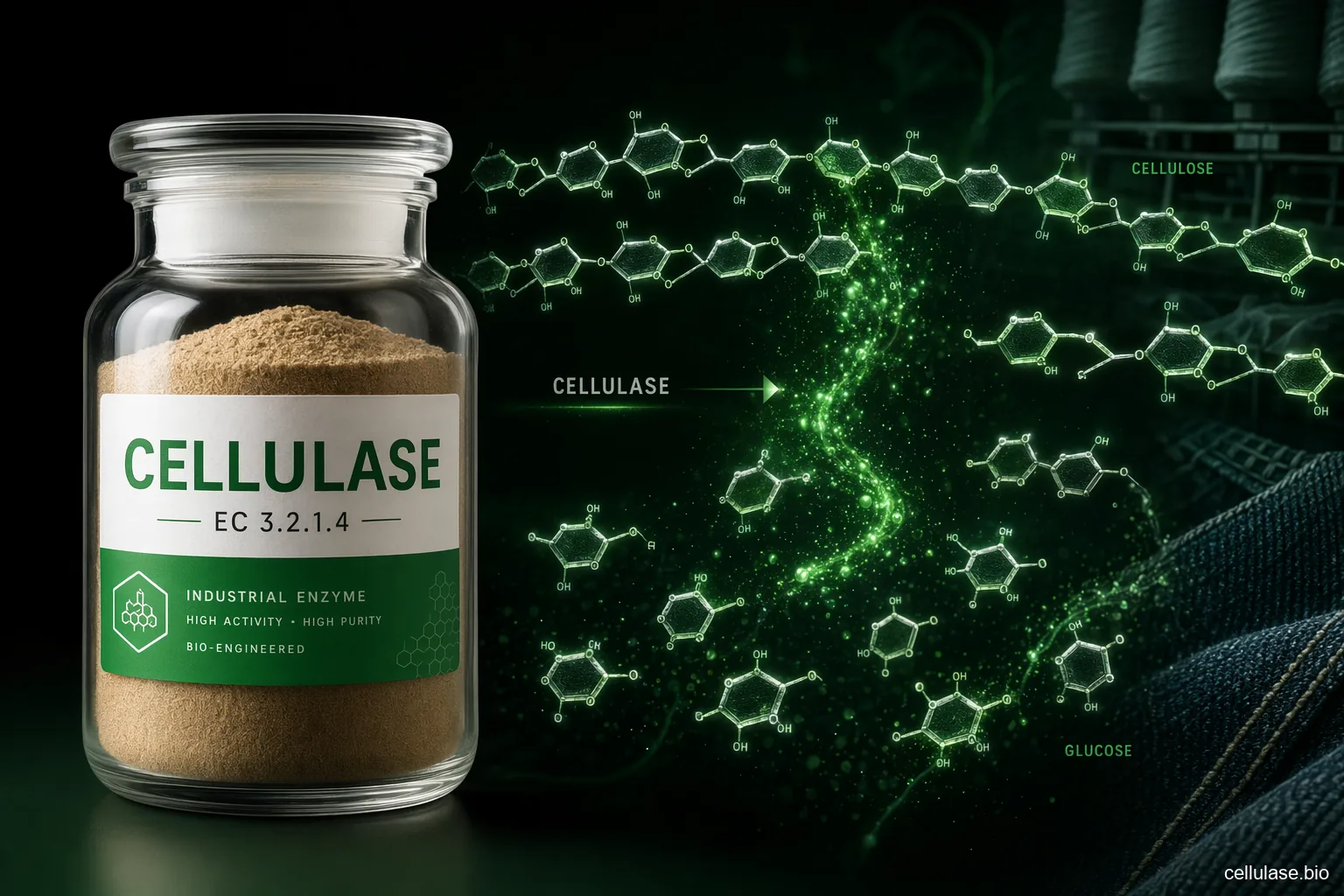
Cellulase Enzyme Detergent: How to Use Cellulase in Detergent Formulations
Formulation guide for cellulase enzyme detergent: pH, temperature, dosage, QC, cost-in-use, pilot trials, and supplier qualification.
Short answer
Cellulase is added to laundry detergent to remove the damaged surface fibres that make cotton look grey and feel rough after repeated washing, restoring colour clarity and softness. Formulators select a grade by the wash pH and temperature the product is designed for, then confirm storage stability in the actual liquid or powder base before scale-up.
| Enzyme Name | Cellulase (EC 3.2.1.4 / EC 3.2.1.91 / EC 3.2.1.21) |
|---|---|
| Activity | Multiple grades (powder & liquid) |
| Optimal pH | 4.0 – 6.0 |
| Optimal Temperature | 45°C – 60°C |
| Appearance | Light brown to brown powder or liquid |
| Source | Trichoderma reesei / Aspergillus niger |
| Shelf Life | 12 months (sealed, cool, dry place) |
| Packaging | 25 kg drums (powder) / 30 kg jerricans (liquid) |
| MOQ | 25 kg |
| Certifications | ISO 9001, HALAL, KOSHER, Food Grade |
Updated · cellulase.bio
A practical B2B guide for detergent formulators selecting, dosing, validating, and sourcing cellulase enzyme for laundry and fabric-care products. Bulk grades are quoted per order: send product, quantity and destination.
Why is cellulase used in detergent?
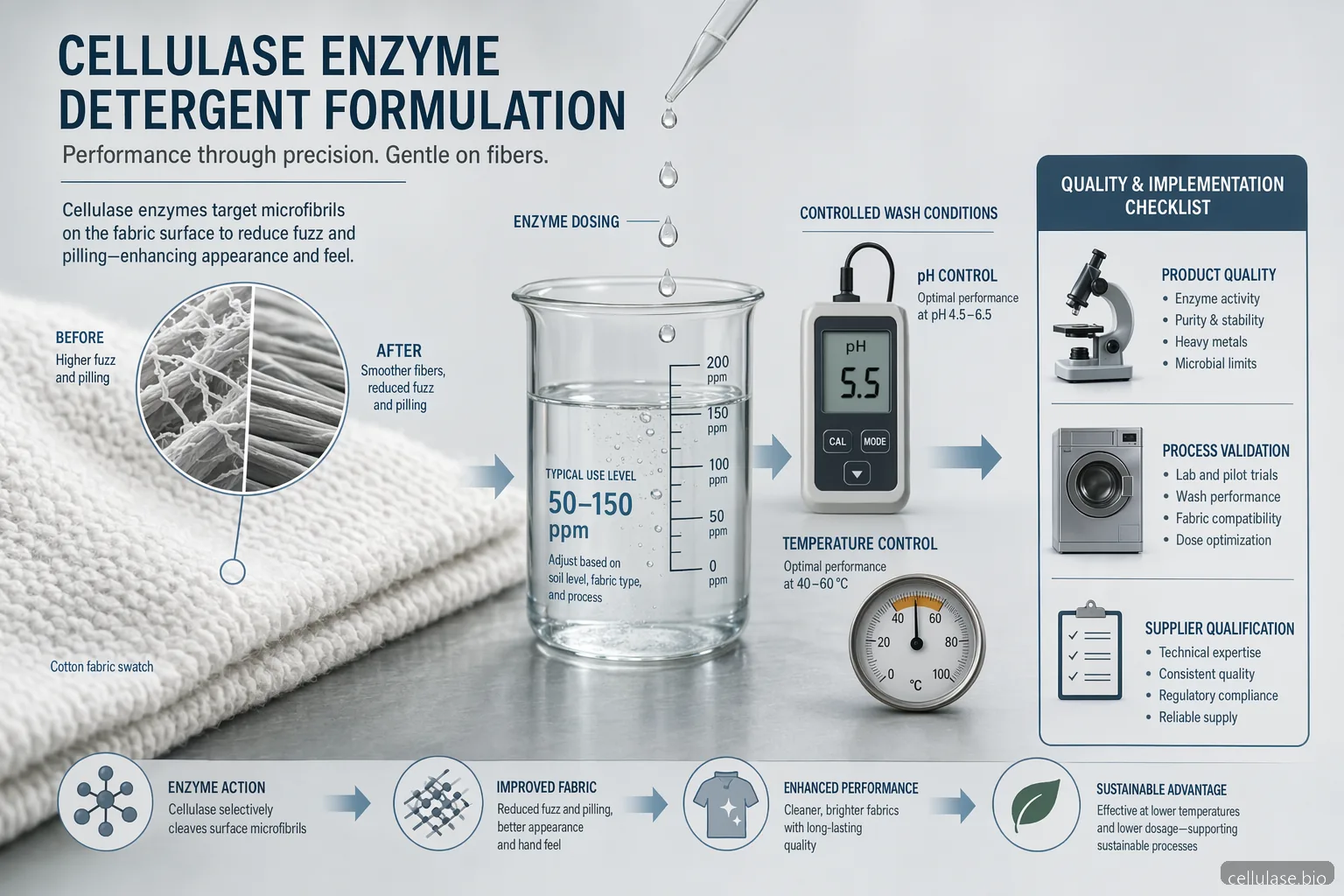
Cellulase enzyme detergent formulations target cellulose-based fibers, especially cotton and cotton-rich blends. During repeated washing and wearing, cotton surfaces can develop microscopic fibrils that trap soil, scatter light, and make fabrics look dull or pilled. A controlled enzyme cellulase action can partially hydrolyze exposed cellulose fibrils on the fabric surface, helping improve smoothness, color clarity, and fabric hand. In B2B detergent development, cellulase is usually positioned as a fabric-care enzyme rather than a primary stain-removal enzyme. It may be combined with protease, amylase, lipase, mannanase, or pectinase depending on the product concept. The key is controlled activity: too little may show no visible benefit, while excessive activity, unsuitable pH, or aggressive wash conditions can increase fabric strength loss. Industrial formulators should therefore evaluate cellulase enzyme laundry detergent performance using realistic textiles, local water hardness, wash temperatures, and shelf-life conditions.
Common use: cotton fabric care and anti-pilling • Typical product formats: liquid laundry detergent, powder, tablet, and unit-dose systems • Primary value: improved fabric appearance over repeated washes
See cellulase for biopolishing and denim biostoning for the full picture.
See how cellulase works for the full picture.
How do I select the right cellulase grade?
Not every cellulase enzyme is suitable for detergent. Suppliers may offer acidic, neutral, or alkaline cellulase preparations, often with different endoglucanase profiles, side activities, and stabilizer systems. For detergent, the enzyme must remain active under wash pH while also surviving storage in the formulated product. Many laundry systems operate around pH 7.0 to 10.5, but actual requirements depend on the market, format, and builder chemistry. Neutral cellulases can be useful in mild liquid detergents, while alkaline-compatible cellulases are often preferred for higher-pH powders or heavy-duty detergents. Ask for a TDS that states recommended pH, temperature, activity assay method, carrier, physical form, and storage guidance. A COA should confirm activity for each batch, and an SDS should support safe handling by production and laboratory teams.
Match enzyme pH profile to the intended wash liquor pH • Review surfactant, builder, preservative, and bleach compatibility • Confirm activity unit definition before comparing suppliers • Request application data, not only catalog specifications
See choosing between acid and neutral cellulase for the full picture.
What starting dosage and process conditions should I use?
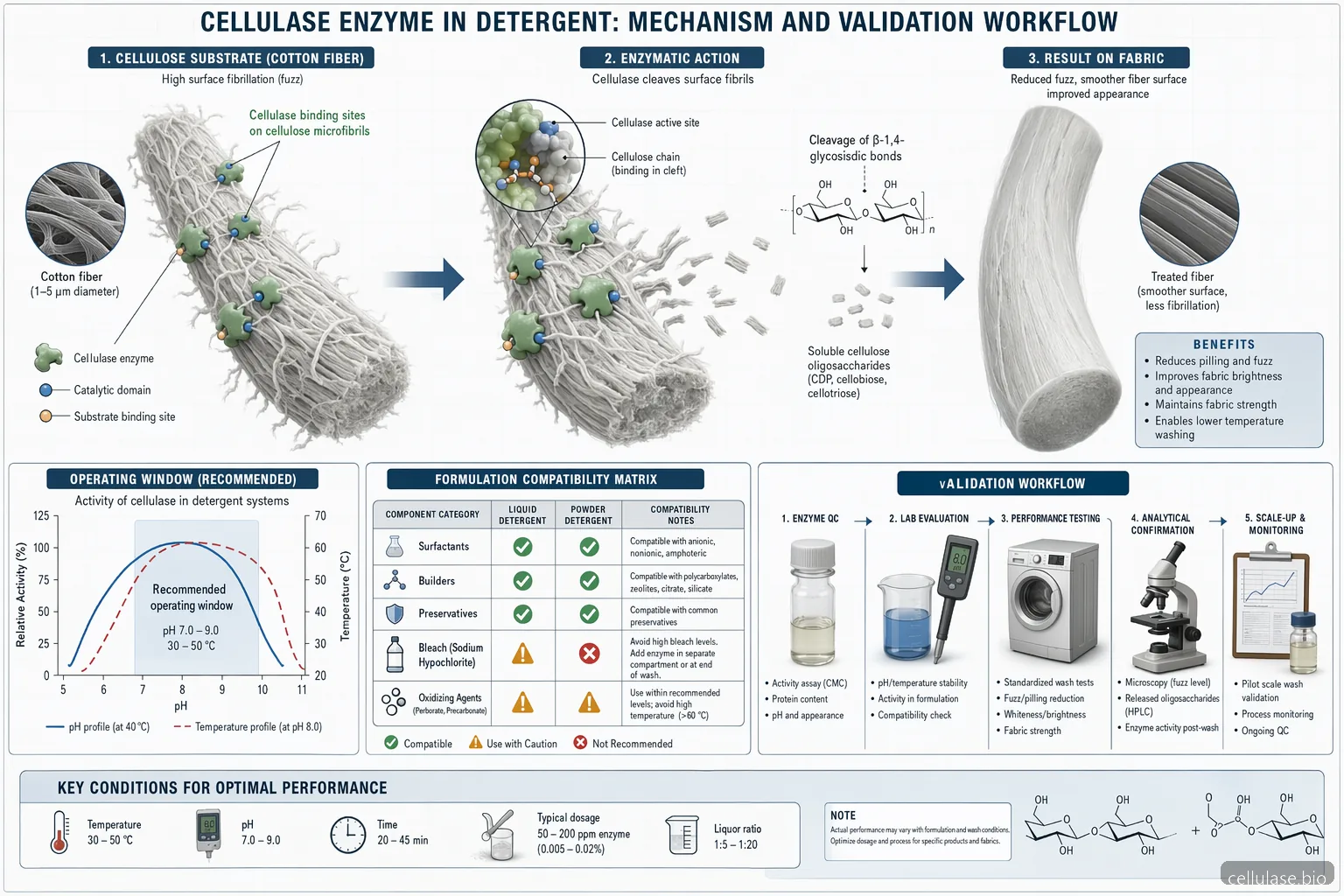
For a new cellulase enzyme detergent project, dosage should be set by activity and validated experimentally rather than copied from another formula. As a screening band, many formulators begin around 0.05% to 0.30% for liquid enzyme preparations or about 0.10% to 0.50% for coated granulates in finished detergent, then adjust according to supplier activity, target claim, and cost-in-use. Typical wash evaluation conditions include 20°C to 60°C, 15 to 60 minutes, and the product’s intended use concentration in local water hardness. The pH window may range from approximately 6.0 to 10.5 depending on enzyme type. In manufacturing, avoid prolonged exposure to high shear, elevated temperature, incompatible preservatives, strong oxidants, or extreme pH before the enzyme is fully dispersed and stabilized.
Screen at low, medium, and high enzyme dose levels • Use supplier-defined activity units for accurate normalization • Evaluate both immediate performance and aged-product performance • Do not assume compatibility with chlorine bleach or strong oxidizers
Is cellulase compatible with liquid and powder formulations?
In liquid detergent with enzyme cellulase, stability is often influenced by water activity, pH, surfactant selection, solvents, preservatives, chelants, and other enzymes. Nonionic and anionic surfactants can be compatible, but the full blend must be tested because small formulation changes may affect residual activity. Polyols, calcium salts, borates where legally and technically appropriate, and other stabilizers may be considered based on supplier guidance and regional restrictions. In powder detergent, coated granules are commonly used to reduce dusting and improve storage stability. Granule strength, particle-size distribution, segregation risk, and post-dosing temperature are important. For unit-dose or high-concentration systems, formulators should test enzyme cellulase detergent stability under accelerated and real-time storage because concentrated surfactants or low-water systems can behave differently from conventional liquids.
Liquid focus: enzyme stability in the complete matrix • Powder focus: granule coating, dust control, and segregation • Unit-dose focus: concentrated chemistry and film compatibility • Always test with the final fragrance, dye, and preservative package
Which QC checks and pilot steps are needed?
Quality control for industrial cellulase enzyme detergent should include both enzyme-specific and finished-product tests. Incoming enzyme lots should be checked against COA activity, appearance, odor, pH where relevant, and packaging integrity. Activity can be measured by supplier-specified methods such as carboxymethyl cellulose hydrolysis, reducing sugar release, or viscosity reduction, but the method must be consistent across batches. Finished detergent testing should track initial activity and residual activity after storage at ambient and accelerated temperatures, commonly 30°C to 40°C for screening. Pilot validation should include repeated-wash fabric panels, color retention, pilling grade, tensile strength or weight loss where relevant, and comparison against a no-cellulase control. The best decision metric is not maximum enzyme dose, but the lowest robust dose that achieves the target fabric-care benefit.
Incoming QC: COA match, activity, appearance, packaging condition • Stability QC: residual activity after real-time and accelerated aging • Performance QC: fabric appearance, pilling, color, and strength checks • Benchmark against a blank formula and current commercial reference
What does cellulase cost in use, and how do I qualify a supplier?
For procurement teams, the lowest price per kilogram is rarely the best measure for a cellulase enzyme supplier for detergent. Compare suppliers by delivered activity, recommended dose, retention during storage, wash performance, handling losses, and technical support. Cost-in-use should be calculated per metric ton of finished detergent and per consumer wash at the validated dosage. Supplier qualification should include review of COA, TDS, SDS, batch-to-batch activity variation, manufacturing change notification process, lead time, packaging options, and documentation for safe industrial handling of enzyme dust or aerosols. A reliable supplier should provide pilot samples, formulation guidance, stability recommendations, and scale-up support without making unsupported performance claims. Before launch, confirm that the selected industrial cellulase enzyme detergent ingredient meets your regional regulatory and labeling requirements.
Calculate cost by effective activity, not only by product weight • Require documentation for every commercial batch • Assess technical support and change-control communication • Validate scale-up before committing to large-volume purchasing
See how to vet a cellulase supplier for the full picture.
What should I check before buying cellulase?
What do buyers usually ask about cellulase?
Cellulase enzyme acts on exposed cellulose fibrils on cotton and cotton-rich fabrics. In detergent, it is mainly used for fabric-care benefits such as surface smoothing, anti-pilling, and improved color appearance after repeated washing. It is not a universal stain-removal enzyme, so formulators often combine it with protease, amylase, lipase, or other enzymes depending on the detergent positioning and target wash conditions.
The best pH depends on the cellulase grade. Detergent-compatible cellulases may be designed for mildly acidic, neutral, or alkaline wash conditions. Many laundry detergents generate a wash liquor between about pH 7.0 and 10.5, but formulators should validate the actual formula. Select the enzyme using supplier TDS data, then confirm performance and stability in the final detergent matrix.
A practical screening range is about 0.05% to 0.30% for liquid enzyme preparations or 0.10% to 0.50% for coated granulates in finished detergent. However, the correct dose must be based on enzyme activity, formulation compatibility, fabric-care target, and cost-in-use. Always run dose-response testing against a no-cellulase control and confirm residual activity after storage.
Yes, cellulase can be formulated with other detergent enzymes when the complete system is compatible. Protease, amylase, lipase, mannanase, and pectinase are common examples, but each enzyme may have different pH, temperature, and stability requirements. Test the final blend for activity retention, cleaning balance, fabric effects, fragrance and preservative compatibility, and performance after accelerated and real-time storage.
Buyers should request a COA, TDS, SDS, activity method, recommended dosage, storage guidance, and application data for detergent use. Qualification should include pilot samples, batch-to-batch activity review, compatibility testing, safe handling assessment, lead-time evaluation, and cost-in-use comparison. The preferred cellulase enzyme supplier for detergent should support scale-up and provide consistent documentation for commercial lots.
See cellulase in washing powder and commercial laundry formulas for the full picture.
Cellulase for Research & Industry
Need Cellulase for your lab or production process?
ISO 9001 certified · Food-grade & research-grade · Ships to 80+ countries
Frequently Asked Questions
Related: Cellulase for Industrial Production and Activity Control
Turn This Guide Into a Supplier Brief Request detergent-grade cellulase samples, COA/TDS/SDS, and formulation support for your pilot trial. See our application page for Cellulase for Industrial Production and Activity Control at /applications/cellulase-production-activity/ for specs, MOQ, and a free 50 g sample.
Get a Free Sample & Quotehello@mail.cellulase.bio