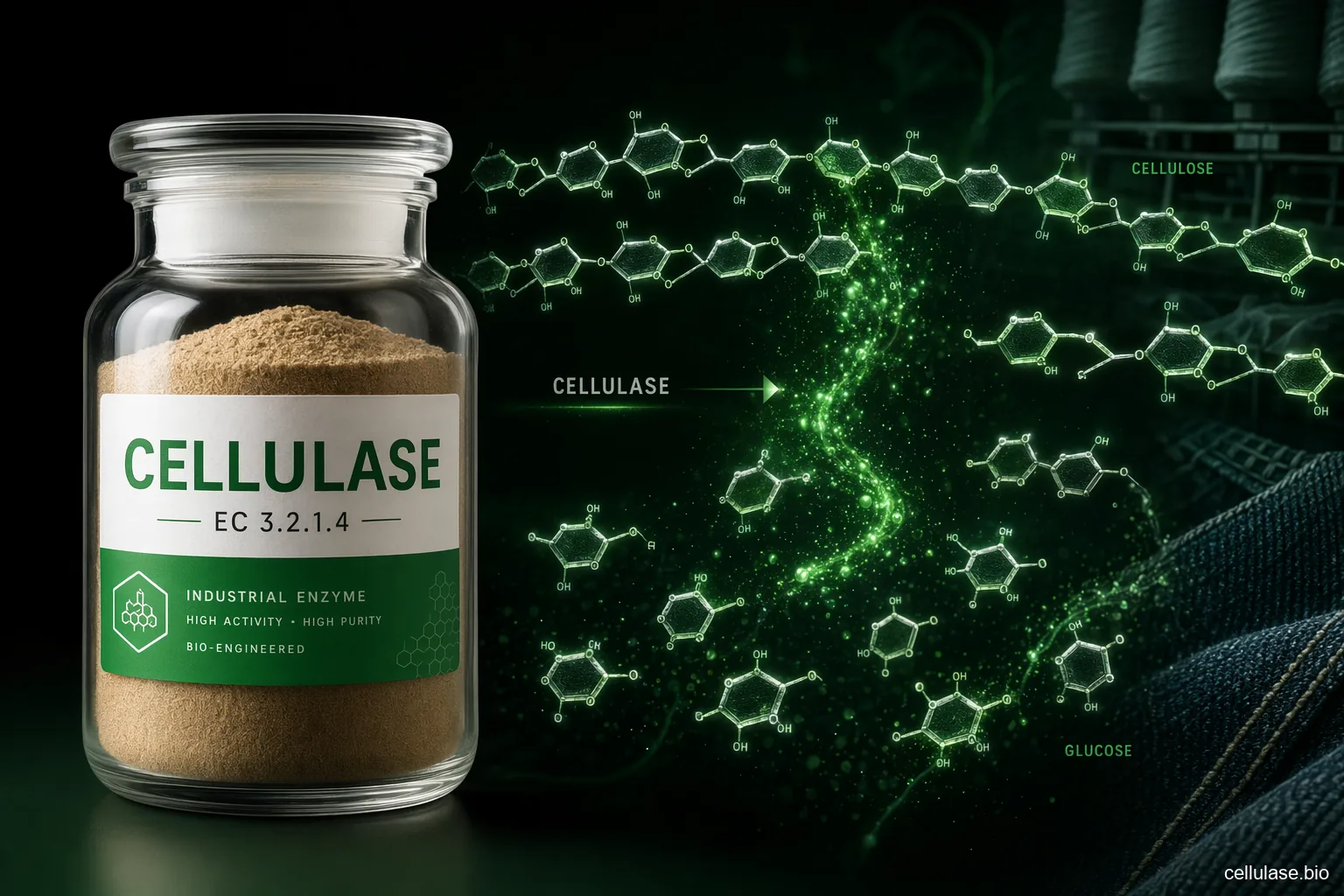
Wholesale Cellulase for Textile Biopolishing: Specification Checklist for Mills and Distributors
Bulk cellulase for textile biopolishing: compare activity, pH, temperature, dosage, COA/TDS/SDS, pilot results and cost-in-use before approving a supplier. Quoted per order.
Short answer
When cellulase is offered in bulk, what decides whether it works in your process is the grade type (acid or neutral), the working pH and temperature window, the form (powder or liquid), packaging, shelf life and the documentation issued with the lot. Request a certificate of analysis, technical data sheet and safety data sheet before sampling, and settle the choice on a mill trial.
| Enzyme Name | Cellulase (EC 3.2.1.4 / EC 3.2.1.91 / EC 3.2.1.21) |
|---|---|
| Activity | Multiple grades (powder & liquid) |
| Optimal pH | 4.0 – 6.0 |
| Optimal Temperature | 45°C – 60°C |
| Appearance | Light brown to brown powder or liquid |
| Source | Trichoderma reesei / Aspergillus niger |
| Shelf Life | 12 months (sealed, cool, dry place) |
| Packaging | 25 kg drums (powder) / 30 kg jerricans (liquid) |
| MOQ | 25 kg |
| Certifications | ISO 9001, HALAL, KOSHER, Food Grade |
Updated · cellulase.bio
Buying cellulase in bulk for fabric biopolishing is a process decision. Mills, finishers and distributors can use this checklist to compare activity, operating window, documentation, pilot performance and total cost-in-use before approving a supplier, then send product, quantity and destination for a quote.
How do I compare cellulase offers on the market?
When evaluating bulk cellulase offers, start with the textile effect you need: reduced fibrillation, smoother surface, improved pilling resistance, softer hand, or controlled denim abrasion. Cellulase is an enzyme that hydrolyzes cellulose, but commercial products differ by enzyme profile, activity assay, pH optimum, temperature tolerance, formulation strength, and stabilizers. A grade becomes expensive in use if dosage is high, treatment time is long, or fabric strength loss is unacceptable. Ask each supplier to explain whether the product is better suited for neutral, acidic, or mildly alkaline biopolishing and whether it is compatible with your wet-processing sequence. For comparison, keep fabric type, liquor ratio, machine action, pH control, temperature, time, and deactivation method constant. This allows purchasing, process engineering, and quality teams to judge the enzyme cellulase by repeatable performance rather than brochure claims.
Compare cost-in-use per kilogram of treated fabric. • Use the same fabric lot and dyeing history for all supplier trials. • Request dosage ranges supported by application data.
What Is Cellulase Enzyme in Textile Biopolishing?
Buyers often ask, what is cellulase enzyme, and is cellulase an enzyme? In industrial textiles, cellulase is a biocatalyst used to selectively break down exposed cellulose microfibrils on cotton, viscose, lyocell, and blended cellulosic fabrics. The goal is controlled surface modification, not bulk fiber destruction. In practical terms, what does the enzyme cellulase do? It attacks accessible cellulose chains, helping remove fuzz and pills while improving surface smoothness and perceived softness. What does cellulase enzyme do differently from mechanical finishing? It can deliver a cleaner fabric surface at lower mechanical intensity when the process is controlled. However, over-treatment may reduce weight and tensile strength. This is why the enzyme type, dosage, time, and deactivation step must be validated on the specific substrate and shade before routine production.
Typical substrates include cotton knits, cotton wovens, viscose, lyocell, and cellulosic blends. • Key risks include strength loss, shade change, excessive weight loss, and uneven effect. • Biopolishing should be optimized separately from denim abrasion.
Which process conditions should I request before sampling?
A credible TDS should provide operating ranges, not just marketing language. Many acidic cellulases are applied around pH 4.5 to 5.5 at 45 to 55 °C, while neutral cellulases are often used around pH 6.0 to 7.0 at 45 to 60 °C. Some formulations may tolerate wider conditions, but the effective range depends on substrate, liquor ratio, auxiliaries, and machine type. Typical starting dosage can range from about 0.1% to 1.0% on weight of fabric, or a supplier-defined activity unit per kilogram of fabric; pilot trials should refine this. Treatment time commonly ranges from 20 to 60 minutes. Confirm how to stop the reaction, such as raising temperature, increasing pH, thorough rinsing, or using a defined deactivation step. If your line includes dyeing, softening, or washing, check compatibility with salts, surfactants, chelants, peroxide residues, and finishing chemicals.
Request recommended pH, temperature, time, liquor ratio, and dosage band. • Confirm whether pH adjustment is needed before or after treatment. • Validate deactivation to prevent continued fabric attack.
Which documents should a cellulase supplier provide?
For B2B procurement, a cellulase enzyme should be evaluated with the same discipline as any production-critical process aid. Request a current Certificate of Analysis, Technical Data Sheet, and Safety Data Sheet before approving a sample. The COA should identify lot number, activity or potency method, appearance, and any relevant release specifications. The TDS should state application guidance, storage conditions, shelf-life, and handling recommendations. The SDS should support safe storage, transport, and worker handling under your local requirements. Because activity methods for cellulase are not always interchangeable, do not compare units across suppliers unless the assay basis is clearly understood. For supplier qualification, review batch-to-batch consistency, change notification practice, lead time, technical support, sample policy, and ability to provide troubleshooting during pilot and first production runs. Documentation quality often predicts scale-up reliability.
Ask whether activity is measured by CMC, filter paper, or another internal method. • Require lot traceability from sample to production shipment. • Confirm storage temperature and shelf-life under warehouse conditions.
See supplier qualification checklist for the full picture.
How do I compare pilot results and cost-in-use?
Before placing a production order, run a structured pilot that reflects actual factory conditions. Keep fabric weight, machine loading, pH, temperature, time, liquor ratio, and agitation comparable across suppliers. Measure objective and subjective outputs: fabric weight loss, pilling grade, hairiness reduction, hand feel, shade change, absorbency, tensile strength retention, seam appearance, and backstaining where relevant. A laundry detergent with enzyme cellulase is optimized for consumer washing, but textile biopolishing requires a process-specific industrial enzyme and controlled deactivation. Calculate cost-in-use by including enzyme dosage, cycle time, heating, pH adjustment, water, reprocessing risk, quality rejects, and any downstream softener adjustment. The production of cellulase enzyme can vary by fermentation strain and formulation approach, so supplier data should be validated on your fabric rather than assumed equivalent. Approve the product only after repeatable pilot results and documented operating limits.
Use at least one control run without enzyme. • Compare minimum effective dosage and over-treatment tolerance. • Document acceptable ranges for shade, strength, and weight loss.
What should a bulk inquiry include?
Product or application, quantity per order and per year, and destination country. If you want a grade recommended before sampling, add fabric type, machine type, bath pH and temperature, and the effect you need (lower pilling, smoother hand, or controlled abrasion).
Powder is packed in 25 kg drums and liquid in 30 kg jerricans. The minimum order is 25 kg; larger volumes are quoted per order.
What should I check before buying cellulase?
What do buyers usually ask about cellulase?
Cellulase enzyme is used to modify the surface of cellulosic fabrics such as cotton, viscose, and lyocell. It helps remove protruding microfibrils that contribute to fuzz, pilling, and a rougher surface. In a controlled process, cellulase can improve smoothness and hand feel. The process must be validated because excessive enzyme action may cause weight loss, shade variation, or reduced tensile strength.
The enzyme cellulase hydrolyzes accessible cellulose chains on the fabric surface. In textile biopolishing, this action weakens and removes fine fibrils through enzymatic activity and mechanical movement in the machine. The desired result is a cleaner surface and better pilling performance. The same activity can damage fabric if pH, temperature, dosage, time, and deactivation are not controlled.
Compare bulk cellulase offers by performance under your actual process conditions. Ask for COA, TDS, SDS, activity method, dosage guidance, pH and temperature range, shelf-life, and lot traceability. Then run side-by-side pilot trials using the same fabric lot and process settings. Final selection should be based on cost-in-use, quality results, repeatability, documentation, and supplier technical support.
Many acidic cellulase products are screened around pH 4.5 to 5.5 and 45 to 55 °C, while neutral cellulases are often screened around pH 6.0 to 7.0 and 45 to 60 °C. These are starting points, not universal rules. Always follow the supplier TDS and validate on your fabric, dye system, machine type, and required performance targets.
Laundry detergent with enzyme cellulase is designed for consumer or institutional washing conditions, not necessarily for industrial textile biopolishing. Mill processing needs defined activity, controlled dosage, technical documentation, predictable deactivation, and compatibility with dyes and auxiliaries. For production use, buyers should select an industrial cellulase formulation supported by textile application data, COA/TDS/SDS documentation, and pilot validation on the intended fabric.
See cellulase for biopolishing and denim biostoning for the full picture.
See cellulase for cellulosic ethanol and biomass saccharification for the full picture.
See what cellulase is and how it breaks down cellulose for the full picture.
Cellulase for Research & Industry
Need Cellulase for your lab or production process?
ISO 9001 certified · Food-grade & research-grade · Ships to 80+ countries
Frequently Asked Questions
Related: Cellulase for Industrial Production and Activity Control
Turn This Guide Into a Supplier Brief Request a cellulase specification review, sample, and pilot-trial plan for your textile biopolishing process. See our application page for Cellulase for Industrial Production and Activity Control at /applications/cellulase-production-activity/ for specs, MOQ, and a free 50 g sample.
Get a Free Sample & Quotehello@mail.cellulase.bio