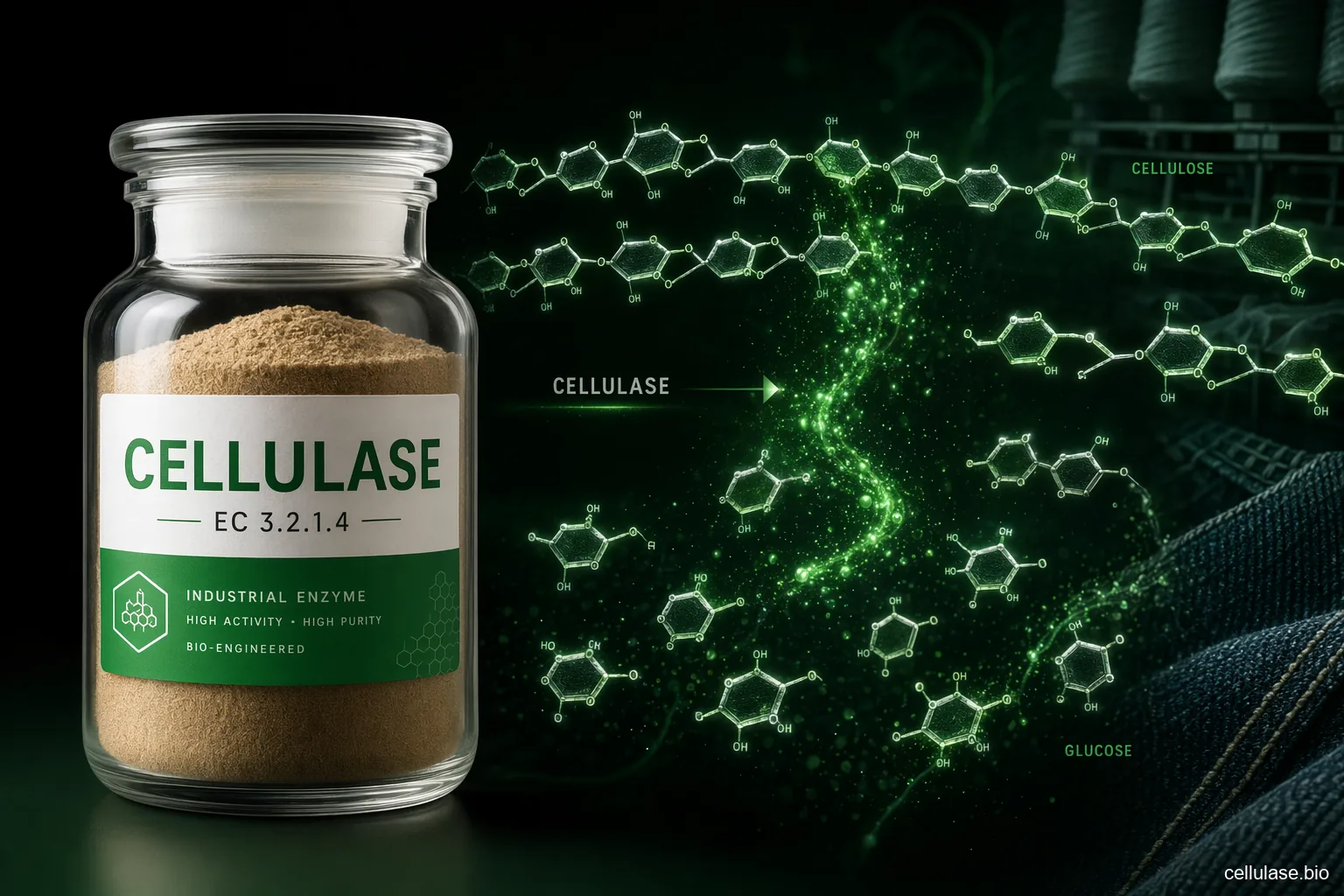
Cellulase Enzyme Supplier Guide for Textile Biopolishing: Bulk Grades for Mills and Distributors
Wholesale cellulase for textile mills, finishers and distributors: grade choice, pH, dosage, COA/TDS/SDS, pilot trials, cost-in-use, and what to send for a bulk quote.
Short answer
Cellulase is a cellulose-hydrolysing enzyme supplied to textile mills in bulk for biopolishing and denim finishing. Acid grades work in mildly acidic baths and act quickly; neutral grades work nearer pH 7 and are gentler on indigo shade. Both are bought against a certificate of analysis, a technical data sheet and a mill trial rather than a headline number; bulk volumes are quoted per order.
| Enzyme Name | Cellulase (EC 3.2.1.4 / EC 3.2.1.91 / EC 3.2.1.21) |
|---|---|
| Activity | Multiple grades (powder & liquid) |
| Optimal pH | 4.0 – 6.0 |
| Optimal Temperature | 45°C – 60°C |
| Appearance | Light brown to brown powder or liquid |
| Source | Trichoderma reesei / Aspergillus niger |
| Shelf Life | 12 months (sealed, cool, dry place) |
| Packaging | 25 kg drums (powder) / 30 kg jerricans (liquid) |
| MOQ | 25 kg |
| Certifications | ISO 9001, HALAL, KOSHER, Food Grade |
Updated · cellulase.bio
For textile mills, garment finishers and the textile-chemical distributors who supply them: how to source cellulase in bulk for cotton biopolishing and fabric surface finishing, which grade to trial, which documents to request, and what to send for a quote (product, quantity, destination).
What Is Cellulase Enzyme in Textile Processing?
Cellulase enzyme is a group of enzymes that hydrolyze cellulose, the main structural polymer in cotton and other cellulosic fibers. For buyers asking what is cellulase enzyme or is cellulase an enzyme, the industrial answer is clear: it is a functional biocatalyst used to modify fabric surfaces under controlled conditions. In textile biopolishing, enzyme cellulase removes microfibrils, reduces fuzz and pilling, improves smoothness, and can support a cleaner appearance after repeated washing. In denim finishing, selected cellulase products can help develop worn-down effects with less mechanical abrasion than traditional stonewashing. The key is controlled action. Over-treatment can reduce tensile strength, change shade, or increase weight loss. A qualified supplier should help match acid, neutral, or specialty cellulase enzyme systems to fiber content, dye class, equipment, liquor ratio, and finishing target.
Primary use: cotton and cellulosic fabric surface modification • Common goals: lower pilling, smoother hand, cleaner appearance • Main risk: excessive strength or weight loss if uncontrolled
See what cellulase is and how it breaks down cellulose for the full picture.
What Does the Enzyme Cellulase Do in Biopolishing?
Buyers often ask what does the enzyme cellulase do, or what does cellulase enzyme do, because performance depends on more than activity units on a label. In biopolishing, cellulase selectively attacks exposed cellulose fibrils on the fabric surface. These weakened fibrils are removed by mechanical action during processing, leaving a smoother surface and reducing the tendency to form pills. Typical operating conditions vary by formulation, but many textile cellulase products run around pH 4.5-6.0 for acid cellulase or pH 6.0-7.5 for neutral cellulase. Common temperature windows are approximately 45-60°C, with treatment times of 20-60 minutes. Dosage may range from 0.1-1.5% owg or a supplier-defined liquid dose, depending on activity, fabric construction, and equipment. Always confirm recommendations against the TDS and through mill trials.
Acid cellulase: often used where stronger surface effect is desired • Neutral cellulase: often chosen for lower shade change and denim control • Process endpoint should be based on fabric tests, not time alone
See cellulase for biopolishing and denim biostoning for the full picture.
Which specifications matter when buying textile-grade cellulase?
A textile-grade cellulase enzyme should be purchased as a process input, not as a commodity chemical. Request a current certificate of analysis, technical data sheet, and safety data sheet for each product and production lot. The COA should identify activity, appearance, batch number, manufacturing or release date, and any relevant quality limits. The TDS should describe pH range, temperature range, dosage guidance, compatibility, deactivation, and storage conditions. The SDS should support safe handling, including dust or aerosol precautions where applicable. Ask how activity is measured, because cellulase assays are not always interchangeable between suppliers. For production planning, confirm shelf life, recommended storage temperature, packaging size, viscosity for liquid products, and whether the formulation is compatible with wetting agents, buffers, dispersants, and denim anti-backstaining systems used in your mill.
Minimum documents: COA, TDS, SDS • Clarify activity method and units before comparing suppliers • Check storage, shelf life, packaging, and handling requirements
How do I pilot cellulase before full-scale mill adoption?
Pilot validation is essential before approving a cellulase supplier for textile biopolishing. Start with a controlled lab beaker or sample dyeing machine trial, then move to a production-style pilot load. Test at least three dosage levels across the intended pH, temperature, time, and liquor ratio. For cotton knits, monitor pilling grade, bursting strength, weight loss, whiteness or shade movement, absorbency, and hand feel. For denim, evaluate abrasion effect, backstaining, contrast, shade reproducibility, tensile strength, and seam damage. Include a blank run without enzyme to separate enzymatic effects from mechanical action. Define a deactivation step, commonly raising pH, increasing temperature, or adding a compatible enzyme stopper according to the TDS. Keep records that connect batch number, dose, process data, and QC results.
Use blank controls and multiple dosage points • Track fabric strength, weight loss, shade, and pilling • Validate enzyme deactivation before downstream processing
See cellulase pH and temperature windows for the full picture.
What does cellulase cost in use, and how do I qualify a supplier?
For B2B purchasing, the kilogram figure alone rarely identifies the best cellulase enzyme. Compare cost-in-use by calculating dose per batch, activity delivered, processing time, rework rate, fabric loss, energy needs, and reject reduction. A concentrated liquid may need a smaller dose and reduce freight, storage, or wastewater burden. Supplier qualification should include documentation quality, lot consistency, technical support, lead time, packaging integrity, and responsiveness during troubleshooting. Ask for representative commercial data, but avoid relying on unverifiable claims. If your team is exploring production of cellulase enzyme or how to make cellulase enzyme, note that in-house enzyme manufacture requires controlled fermentation, downstream recovery, stabilization, assay capability, and biosafety management. Most textile mills benefit from qualified industrial suppliers with validated formulations.
Compare delivered performance per batch of fabric • Include rework, rejects, time, and fabric loss in cost models • Qualify supplier support before scaling commercial volumes
Where else is cellulase used beyond biopolishing?
Although this guide focuses on textile biopolishing, cellulase is also used in other industrial sectors. In animal feed, cellulase can support fiber breakdown in formulated feed systems when selected and registered for that application. In detergents, laundry detergent with enzyme cellulase may help maintain cotton fabric appearance by removing small fibrils during washing, subject to detergent pH, surfactants, builders, and stability requirements. In biomass conversion, cellulase biofuel applications use enzyme cocktails to hydrolyze pretreated lignocellulosic biomass into fermentable sugars. These markets use different product specifications, regulatory expectations, and performance assays. A cellulase textile product should not automatically be assumed suitable for feed, detergent, or biofuel use. Buyers should source application-specific grades and documentation for each intended industrial process.
Textile, detergent, feed, and biofuel grades are not interchangeable • Application-specific stability and compliance checks are required • Assay methods and performance targets differ by industry
See cellulase for pulp, paper and recycled fibre for the full picture.
See cellulase in animal feed for fibre digestibility for the full picture.
How do I request a bulk quote?
Send three things: the product or application (for example an acid or neutral grade for knit biopolishing), the quantity per order and per year, and the destination country. Add fabric type, machine type and target effect if you want a grade recommendation before sampling.
Powder ships in 25 kg drums and liquid in 30 kg jerricans; the minimum order is 25 kg, and larger or repeat volumes are quoted per order.
What should I check before buying cellulase?
What do buyers usually ask about cellulase?
Yes. Cellulase is an enzyme system used in textile manufacturing to modify cellulose-based fibers, especially cotton. In biopolishing, it removes loose surface fibrils that contribute to fuzz and pilling. In denim finishing, selected cellulase grades can support controlled abrasion effects. Textile buyers should choose a grade designed for their pH, temperature, fabric type, and finishing equipment.
A qualified supplier should provide a certificate of analysis, technical data sheet, and safety data sheet for the cellulase enzyme. The COA confirms lot identity and quality results. The TDS gives process guidance such as pH, temperature, dosage, compatibility, and deactivation. The SDS supports safe storage and handling. Buyers should also request activity method, shelf life, and batch traceability.
Compare quotations by cost-in-use per batch of treated fabric. Review recommended dosage, activity units, treatment time, fabric results, reject rate, logistics, shelf life, and technical support. Run side-by-side pilot trials using the same fabric, machine, pH, temperature, and liquor ratio. The better supplier is usually the one delivering repeatable fabric performance with clear documentation and reliable supply.
Not automatically. Cellulase products are formulated for different process environments. A textile biopolishing enzyme is optimized for fabric surface effects and mill conditions, while detergent cellulase needs surfactant and builder stability, and biofuel cellulase targets biomass hydrolysis. Each application may require different assays, stabilizers, documentation, and compliance checks. Source an application-specific grade for each use.
Run controlled trials at several dosages and record pH, temperature, time, liquor ratio, and batch number. Test fabric pilling, hand feel, shade change, tensile or bursting strength, weight loss, and backstaining for denim. Include a no-enzyme control to isolate the enzyme effect. Confirm the deactivation step before dyeing, softening, drying, or garment finishing continues.
See cellulase in laundry detergent for the full picture.
Cellulase for Research & Industry
Need Cellulase for your lab or production process?
ISO 9001 certified · Food-grade & research-grade · Ships to 80+ countries
Frequently Asked Questions
Related: Cellulase for Industrial Production and Activity Control
Turn This Guide Into a Supplier Brief Request textile cellulase specifications, samples, and pilot-trial support for your mill process. See our application page for Cellulase for Industrial Production and Activity Control at /applications/cellulase-production-activity/ for specs, MOQ, and a free 50 g sample.
Get a Free Sample & Quotehello@mail.cellulase.bio