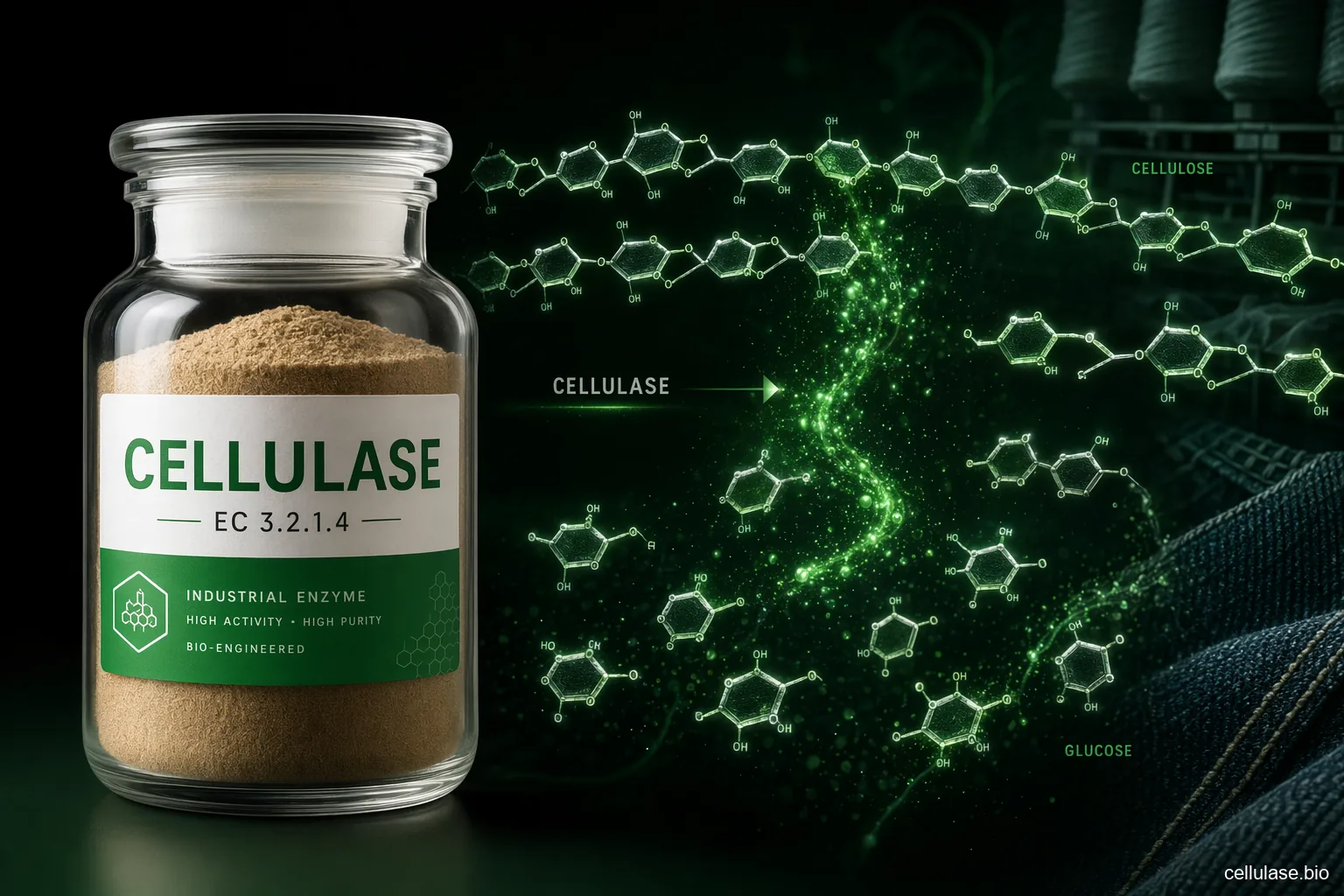
Cellulase Enzyme Production: Practical Controls for Industrial Performance
Cellulase enzyme guide — endo/exo/β-glucosidase activity, optimal pH 4.5–5.5, temperature ranges, dosage by application. QC, pilot validation, supplier checks.
Short answer
Cellulase is produced by submerged fermentation of Trichoderma reesei or Aspergillus niger, then recovered, standardised into a grade and supplied as powder or liquid. What usually fails at industrial scale is not the enzyme but the process around it: bath pH drifting outside the working window, temperature overshoot, and no deactivation step. Control those three before changing supplier.
| Enzyme Name | Cellulase (EC 3.2.1.4 / EC 3.2.1.91 / EC 3.2.1.21) |
|---|---|
| Activity | Multiple grades (powder & liquid) |
| Optimal pH | 4.0 – 6.0 |
| Optimal Temperature | 45°C – 60°C |
| Appearance | Light brown to brown powder or liquid |
| Source | Trichoderma reesei / Aspergillus niger |
| Shelf Life | 12 months (sealed, cool, dry place) |
| Packaging | 25 kg drums (powder) / 30 kg jerricans (liquid) |
| MOQ | 25 kg |
| Certifications | ISO 9001, HALAL, KOSHER, Food Grade |
Updated · cellulase.bio
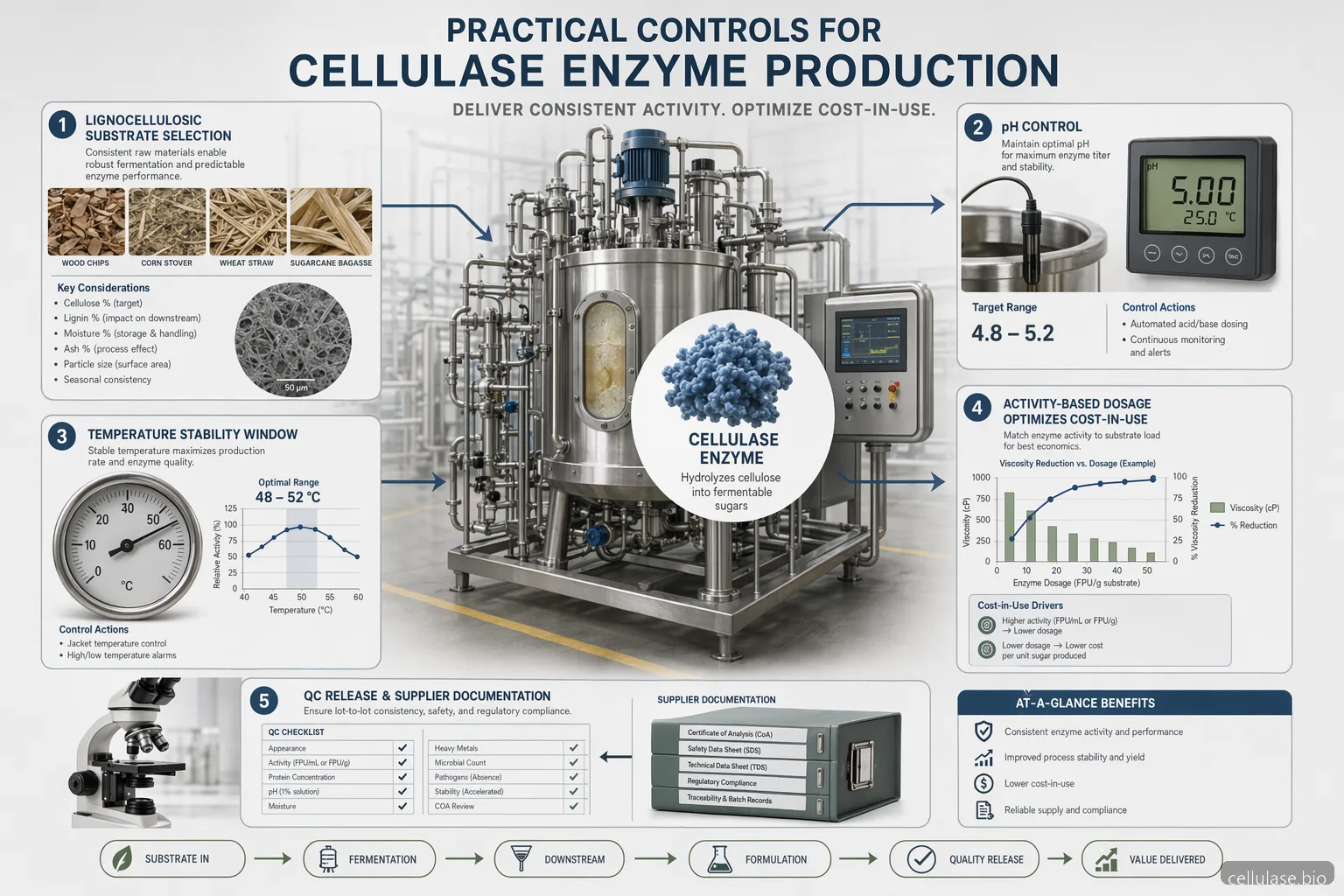
For manufacturers sourcing or applying cellulase enzyme, stable production results depend on the right substrate, pH, temperature, dosage, QC release criteria, and supplier documentation—not generic lab recipes. For bulk supply, send product, quantity and destination for a quote.
Why does cellulase performance fail at production scale?
Cellulase enzyme production and application often look stable in lab trials but underperform in plant conditions. Common causes include variable feedstock quality, incorrect pH control, heat exposure, microbial contamination, and dosage decisions based on volume rather than declared activity. In B2B procurement, the issue is rarely whether enzyme cellulase works in principle; it is whether the selected product performs consistently in the buyer’s process. Textile biopolishing, biofuel saccharification, animal feed treatment, and detergent manufacturing each require different activity balances among endoglucanase, exoglucanase, and beta-glucosidase. Troubleshooting should start with process mapping: substrate type, solids loading, buffer capacity, mixing efficiency, reaction time, and deactivation step. Buyers comparing industrial production of cellulase enzyme pdf, ppt, or slideshare references should use them only as background; final conditions must be confirmed with supplier data and pilot trials.
Check substrate variability before changing enzyme grade. • Verify pH and temperature at the reaction mass, not only at the control panel. • Compare enzyme activity units on the COA, not just product kilograms. • Run pilot validation before commercial purchase commitments.
See how cellulase is produced and supplied at industrial scale for the full picture.
See what cellulase is and how it breaks down cellulose for the full picture.
How does pH control affect cellulase performance in production?
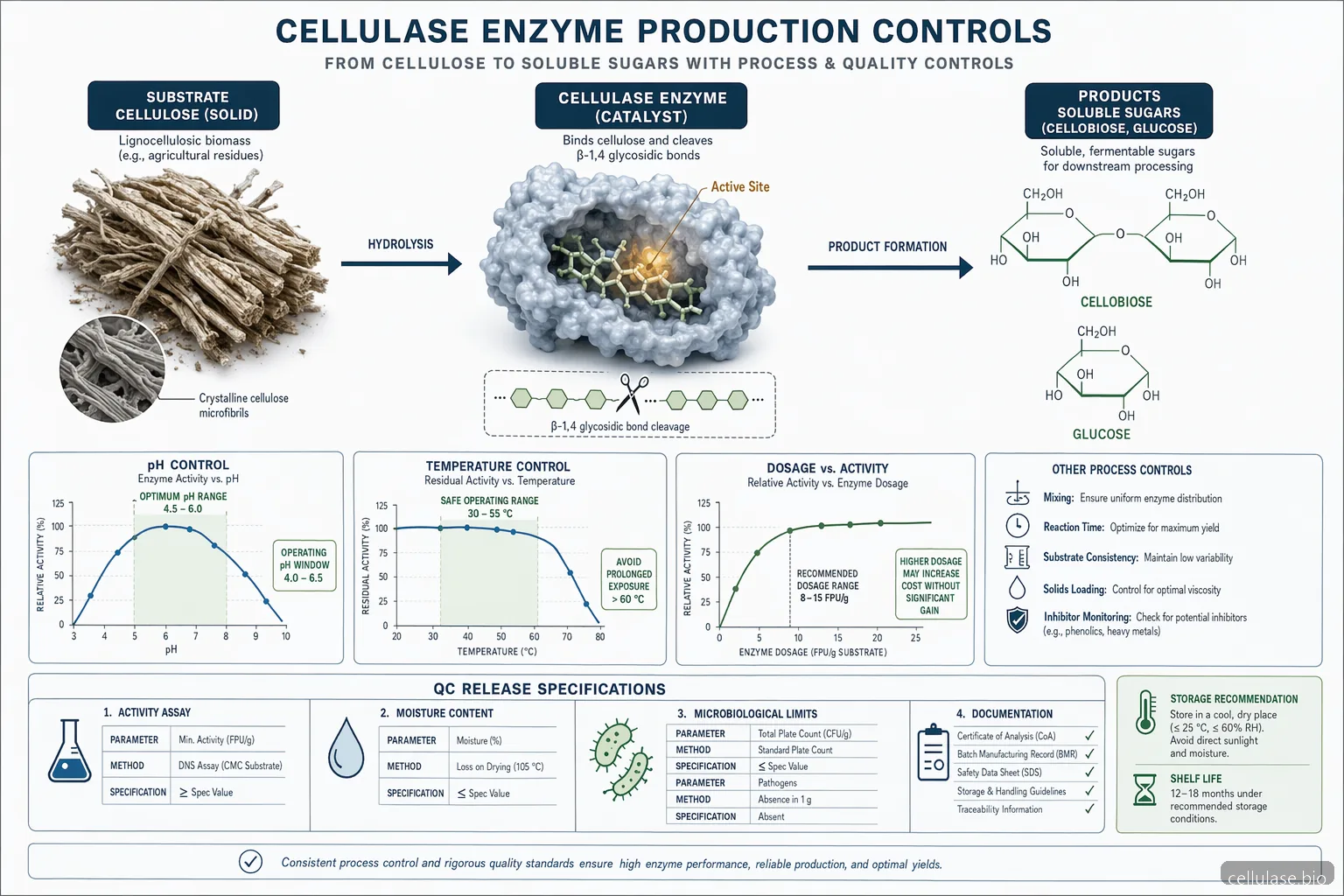
Most commercial cellulase enzyme products perform best in mildly acidic conditions, commonly around pH 4.5–6.0. However, optimal pH depends on the strain, formulation, stabilizers, and application matrix. In biofuel hydrolysis, pH drift can occur as biomass releases organic acids or buffering salts are consumed. In textile cellulase treatment, bath alkalinity from upstream scouring or residual chemicals may reduce activity and increase inconsistent abrasion. In detergent systems, cellulase may be engineered or formulated to tolerate higher pH, but buyers should confirm this in the TDS and application trial. Troubleshooting pH should include calibrated probes, sampling from multiple tank locations, and checking pH at operating temperature. For optimization of cellulase enzyme production, pH screening should be performed in small steps, such as 0.3–0.5 pH units, while holding temperature, dosage, and reaction time constant.
Typical acidic cellulase range: pH 4.5–6.0. • Some detergent cellulases may tolerate neutral to alkaline systems. • Measure pH after substrate addition, not only in clean water. • Document pH drift from start to finish of the reaction.
What temperature window keeps cellulase stable?
Temperature is one of the fastest ways to gain or lose cellulase performance. Many cellulase enzyme products show useful activity between 40 and 55°C, with some thermostable grades operating above this range under defined conditions. Higher temperature can improve reaction rate and reduce viscosity, but excessive heat can denature the enzyme and lower final conversion. In textile biopolishing, temperatures around 45–55°C are often evaluated, while feed and detergent applications may depend heavily on the finished product format and exposure time. For biofuel, the operating temperature must also fit microbial contamination control, equipment metallurgy, and downstream fermentation requirements. Troubleshooting should distinguish between short peak exposure and sustained holding temperature. A batch that briefly reaches 60°C may behave differently from one held there for hours. Always confirm thermal tolerance in the TDS and validate it with a pilot run.
Common evaluation range: 40–55°C for many cellulase systems. • Record actual product temperature during charging and mixing. • Avoid hot spots near steam jackets or heat exchangers. • Confirm whether deactivation is required after reaction.
See cellulase for cellulosic ethanol and biomass saccharification for the full picture.
How should cellulase dosage be set?
A practical cellulase dosage cannot be selected from label weight alone. Industrial buyers should evaluate dosage by declared activity, substrate loading, residence time, desired effect, and total cost-in-use. In biomass hydrolysis, cellulase may be screened as activity units per gram of cellulose or enzyme mass per dry biomass, then adjusted for conversion and sugar profile. In textile cellulase biopolishing, dosage may be expressed as percent on weight of fabric, but the final decision should consider weight loss, pilling reduction, shade change, and hand feel. In animal feed, the target is digestibility improvement under feed processing and storage conditions. For detergent, enzyme dosage must remain stable in the formulation and deliver cleaning or fabric-care benefits after dilution. A dose-response curve is essential; the best dose is often where incremental benefit begins to flatten, not where maximum activity is observed.
Build a dose-response curve with at least three dosage levels. • Normalize comparisons by activity units where possible. • Include yield, quality, rework, and waste in cost-in-use. • Avoid overdosing that causes fabric damage or unnecessary cost.
See fixing patchy or over-aggressive cellulase dosing for the full picture.
Which QC checks apply to industrial cellulase use?
Reliable production of cellulase enzyme depends on incoming and outgoing quality controls. Buyers should request a certificate of analysis for each batch and compare it with the agreed specification. Important checks may include enzyme activity method, appearance, moisture or solids, pH, microbial limits where relevant, heavy metals if applicable to the market, and recommended storage conditions. The technical data sheet should explain application guidance, compatibility limits, and dosing principles. The safety data sheet should cover handling, dust or aerosol precautions, spill response, and storage. For liquid cellulase, monitor viscosity, separation, odor, and activity loss during storage. For powder or granule forms, check flowability, dusting, and moisture uptake. If performance varies, retain samples from each delivery and test against a reference batch under the same assay and application conditions.
Require COA, TDS, and SDS before approval. • Confirm the assay method used for declared activity. • Retain batch samples for comparison testing. • Check shelf-life under real warehouse conditions.
How do I qualify a supplier and validate a pilot?
Supplier qualification should combine documentation review, technical responsiveness, and plant-scale evidence. A credible cellulase supplier should explain activity units, recommended pH and temperature windows, storage stability, packaging options, and application limits without promising universal performance. Before switching suppliers or scaling a new enzyme cellulase grade, run a pilot trial using actual substrate, water, auxiliaries, equipment shear, and residence time. Define success metrics before the trial: sugar yield, viscosity drop, fiber surface effect, feed digestibility indicator, detergent stability, or other measurable outcome. Include negative and reference controls to separate enzyme effect from process variation. Procurement should compare delivered cost, dosage efficiency, freight, inventory life, batch consistency, and technical support. This approach is more reliable than selecting from industrial production of cellulase enzyme ppt summaries or generic price lists.
Set measurable acceptance criteria before the pilot. • Use actual plant materials and water quality. • Compare against a retained reference enzyme. • Qualify suppliers on service and consistency, not price alone.
What should I check before buying cellulase?
What do buyers usually ask about cellulase?
Many industrial cellulase enzyme products operate effectively around pH 4.5–6.0, but the best pH depends on the enzyme source, formulation, substrate, and application. Textile and biofuel processes often use acidic conditions, while detergent cellulases may require neutral or alkaline tolerance. Confirm the supplier’s TDS, then run a controlled pH screen using actual plant materials before finalizing conditions.
A common evaluation window for cellulase treatment is 40–55°C, though some grades are formulated for higher or lower temperatures. The correct choice should balance activity, enzyme stability, substrate behavior, and downstream process needs. Measure the temperature inside the reaction mass and watch for hot spots near heating surfaces. Pilot testing is essential before changing a validated commercial process.
Start with the supplier’s recommended dosage range, then build a dose-response curve using your actual substrate and process conditions. Normalize comparisons by declared activity units when possible, not only by product weight. Evaluate the result by cost-in-use, including yield improvement, quality impact, cycle time, rework reduction, waste, and enzyme cost. The lowest price per kilogram is not always the lowest operating cost.
A qualified supplier should provide a certificate of analysis for each batch, a technical data sheet with activity and application guidance, and a safety data sheet for handling and storage. Buyers may also request batch traceability, shelf-life guidance, packaging information, and sample support for pilot validation. Documentation should be reviewed together with performance testing under the buyer’s real process conditions.
Industrial production of cellulase enzyme ppt, pdf, or slideshare materials can be useful for general learning, but they should not replace supplier specifications or plant trials. Published conditions may use different substrates, strains, assays, and equipment. For scale-up, confirm pH, temperature, dosage, mixing, and QC requirements with the supplier, then validate performance in a pilot run before commercial approval.
Related Search Themes
cellulase enzyme, enzyme cellulase, production of cellulase enzyme, optimization of cellulase enzyme production, industrial production of cellulase enzyme slideshare, industrial production of cellulase enzyme ppt
See choosing between acid and neutral cellulase for the full picture.
Cellulase for Research & Industry
Need Cellulase for your lab or production process?
ISO 9001 certified · Food-grade & research-grade · Ships to 80+ countries
Frequently Asked Questions
Related: Cellulase for Industrial Production and Activity Control
Turn This Guide Into a Supplier Brief Request cellulase samples, COA/TDS/SDS review, and pilot-scale dosage support for your production line. See our application page for Cellulase for Industrial Production and Activity Control at /applications/cellulase-production-activity/ for specs, MOQ, and a free 50 g sample.
Get a Free Sample & Quotehello@mail.cellulase.bio