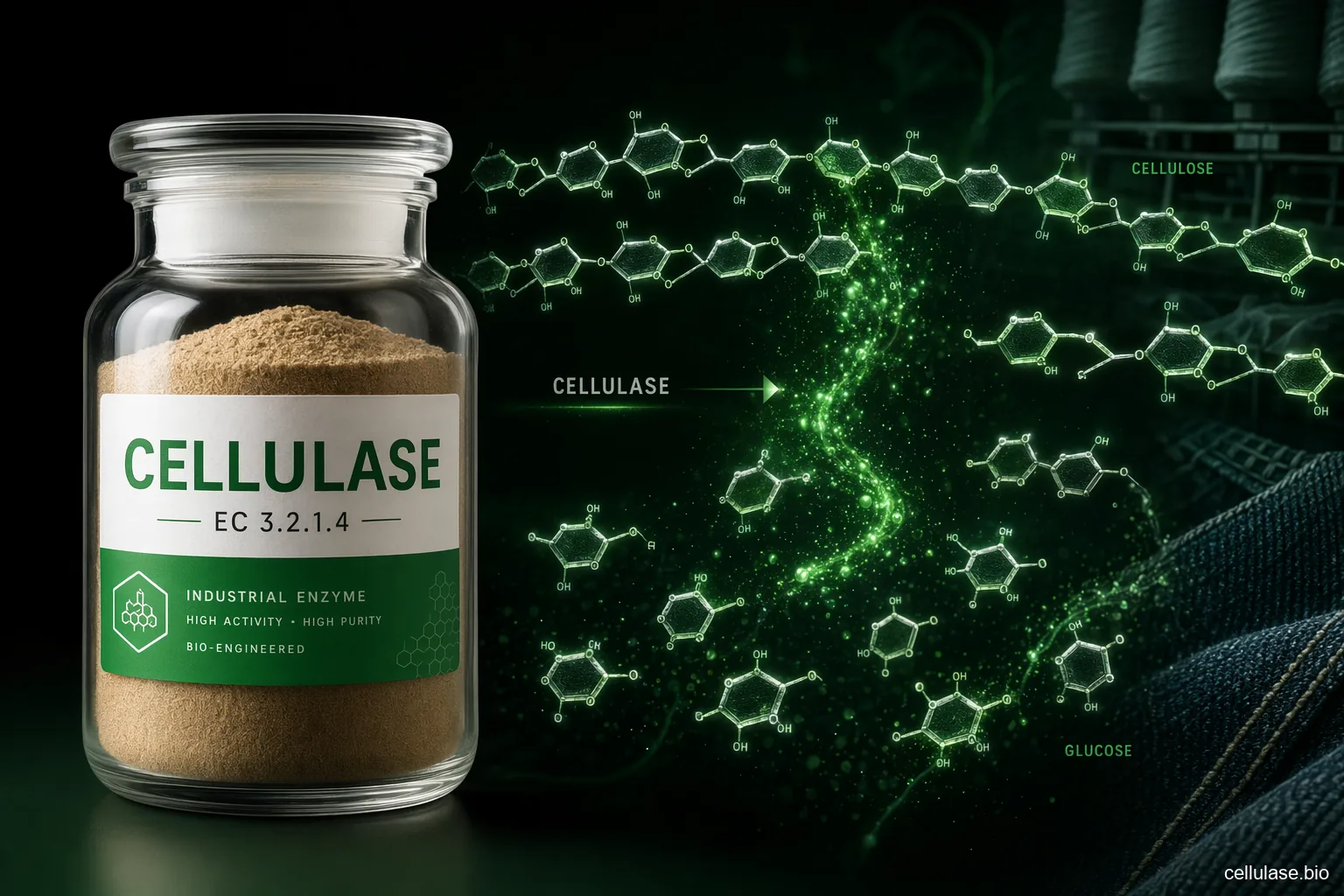
Cellulase Enzyme Suppliers for Textile Biopolishing
Compare cellulase enzyme suppliers for textile biopolishing with specs, process conditions, QC checks, COA/TDS/SDS, pilot validation, and cost-in-use.
Short answer
A cellulase supplier is worth qualifying on four things: lot-to-lot consistency, the documentation issued with each lot (certificate of analysis, technical data sheet, safety data sheet), change control when the grade or process is modified, and the ability to ship your volume on schedule. Price per kilogram is the last of these, not the first.
| Enzyme Name | Cellulase (EC 3.2.1.4 / EC 3.2.1.91 / EC 3.2.1.21) |
|---|---|
| Activity | Multiple grades (powder & liquid) |
| Optimal pH | 4.0 – 6.0 |
| Optimal Temperature | 45°C – 60°C |
| Appearance | Light brown to brown powder or liquid |
| Source | Trichoderma reesei / Aspergillus niger |
| Shelf Life | 12 months (sealed, cool, dry place) |
| Packaging | 25 kg drums (powder) / 30 kg jerricans (liquid) |
| MOQ | 25 kg |
| Certifications | ISO 9001, HALAL, KOSHER, Food Grade |
Updated · cellulase.bio
A practical buyer’s checklist for comparing cellulase enzyme suppliers, validating textile performance, and reducing risk before plant-scale adoption.
Why does supplier comparison matter in textile biopolishing?
For textile mills, the question is not only what is cellulase enzyme, but whether a specific product can deliver controlled surface fibril removal without excessive strength loss, shade change, or reprocessing. Cellulase is an enzyme system that hydrolyzes cellulose; in cotton and cellulose-rich blends, it is used to improve hand feel, reduce pilling, clean fabric surfaces, and support denim effects. However, products sold as enzyme cellulase can differ widely in activity balance, formulation, stabilizers, and operating range. Comparing cellulase enzyme suppliers therefore requires more than price per kilogram. Buyers should evaluate the complete processing fit: fabric construction, liquor ratio, equipment shear, pH control, bath temperature, time, neutralization, and downstream wash-off. The best supplier shortlist should connect enzyme specification to measurable textile outcomes and total cost-in-use.
Prioritize textile-grade technical data over generic enzyme descriptions. • Compare performance under your mill’s actual pH, temperature, and liquor ratio. • Avoid supplier selection based only on quoted unit price.
Which core specifications should I check?
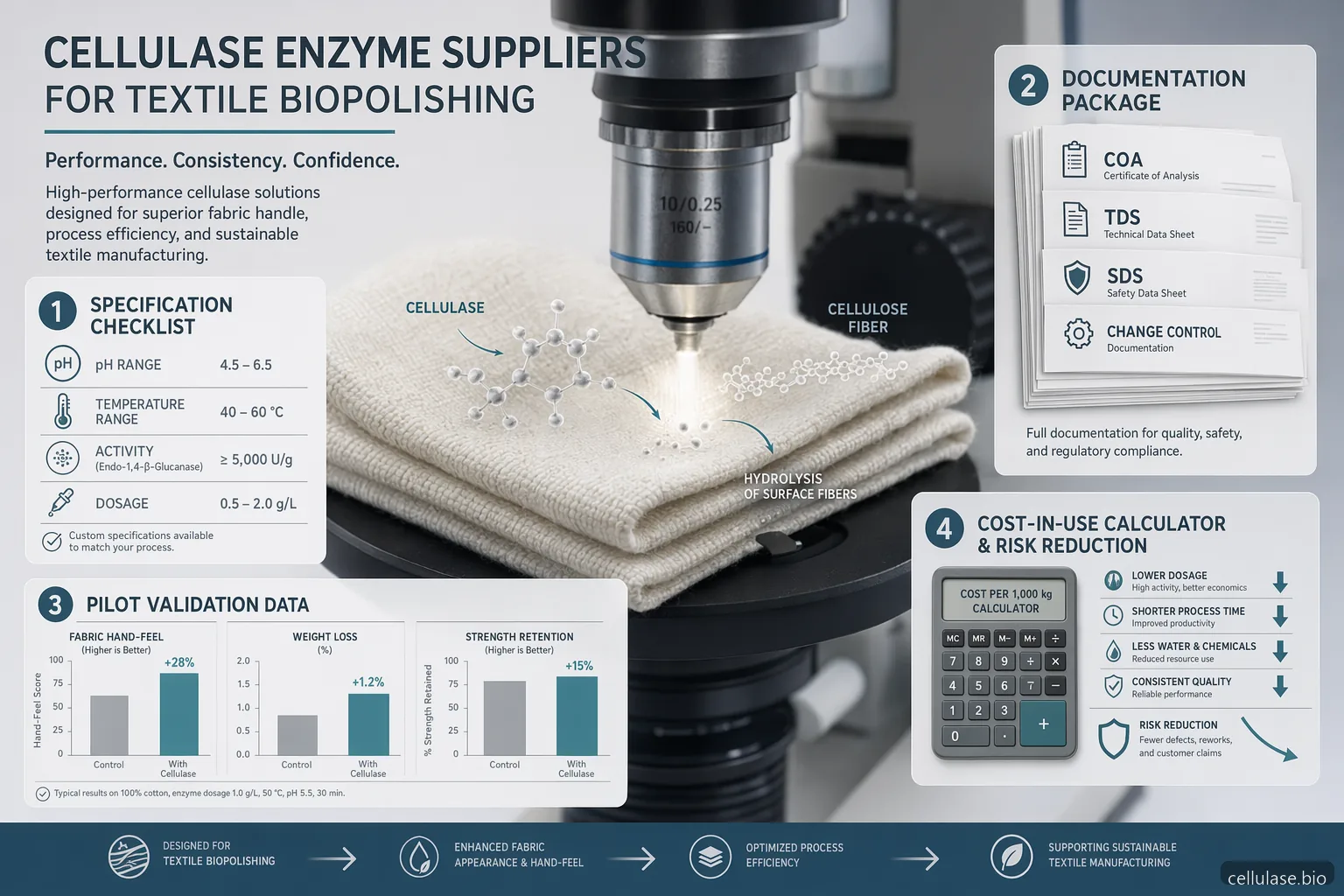
A useful specification should make it clear what does the enzyme cellulase do under defined processing conditions. Ask each supplier to identify whether the product is mainly acid cellulase, neutral cellulase, or a blended cellulase preparation, because each type behaves differently in biopolishing. Acid cellulases often run around pH 4.5 to 5.5 and 45 to 55°C, while neutral cellulases may operate around pH 6.0 to 7.0 and 45 to 60°C, depending on formulation. Typical screening dosages may range from 0.2% to 1.5% owg or approximately 0.5 to 3.0 g/L, but the correct dosage depends on activity, substrate, time, agitation, and desired effect. The supplier should disclose the activity unit, test method, recommended storage, shelf life, and compatibility with buffers, wetting agents, dyes, softeners, and detergents used in your line.
Confirm declared activity and the analytical method used. • Check acid or neutral operating window before plant trials. • Ask for stability data under storage and processing conditions. • Screen dosage by fabric type, not by supplier brochure alone.
Which documents should I request from a cellulase supplier?
Reliable cellulase enzyme suppliers should provide consistent documentation before samples reach production. The Certificate of Analysis should show batch identification, activity result, specification limits, manufacturing or release date, and relevant physical checks such as appearance or density where applicable. The Technical Data Sheet should define application guidance, pH and temperature range, recommended dosage, inactivation conditions, storage, and handling notes. The Safety Data Sheet should cover hazards, personal protective equipment, spill response, transport information, and occupational exposure precautions, especially because enzyme dusts or aerosols may cause sensitization. Buyers should also ask how formulation changes are communicated. Even small changes in enzyme activity, preservative system, or carrier can influence garment feel, shade, foaming, or finishing repeatability. Strong documentation is not a formality; it is part of supplier qualification and production risk control.
Require COA with every commercial lot. • Review TDS against your machine conditions and recipes. • Use SDS to train operators on safe enzyme handling. • Ask for written notice of material formulation changes.
See how cellulase is produced and supplied at industrial scale for the full picture.
How should I pilot cellulase before commercial approval?
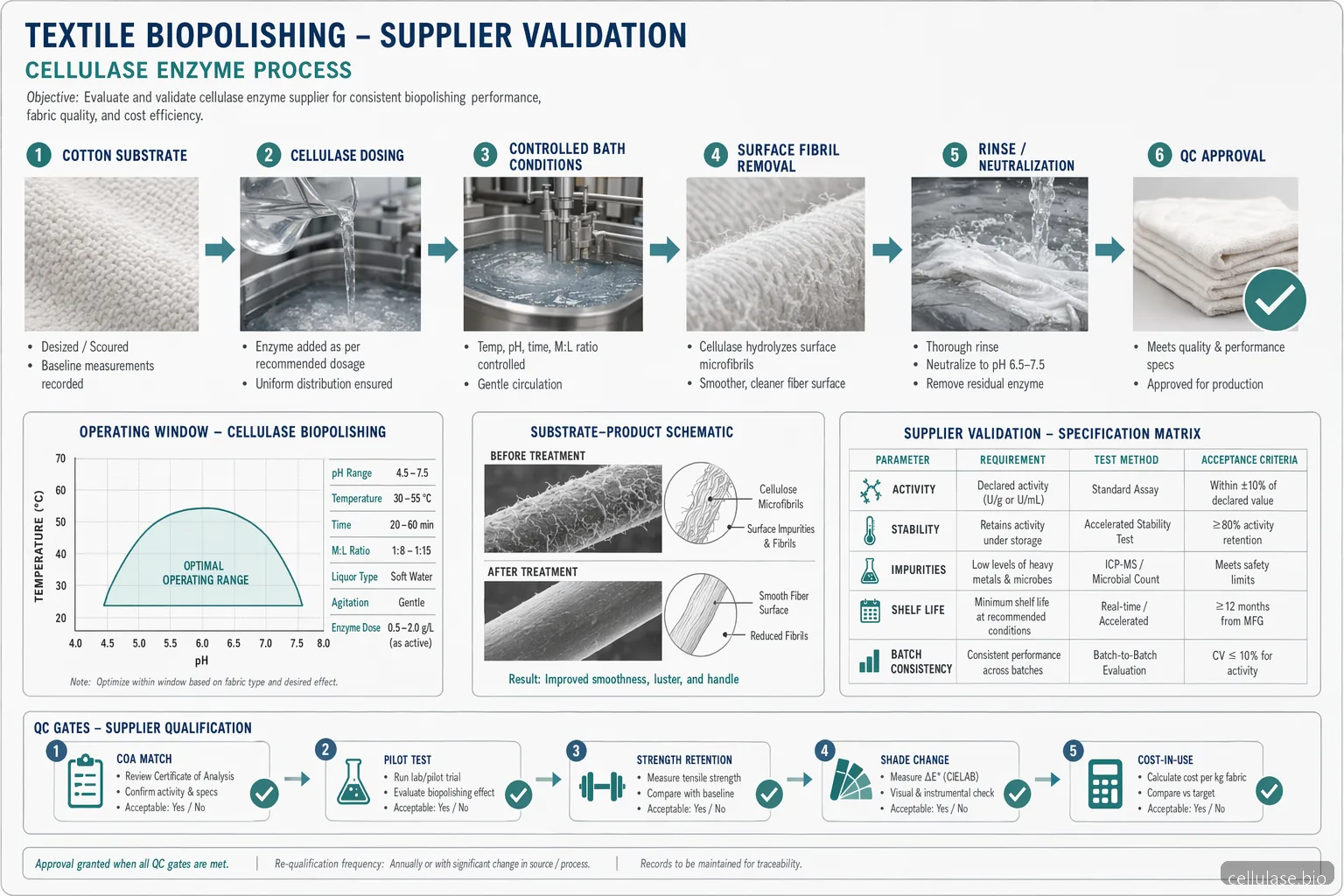
Pilot validation answers what does cellulase enzyme do on your specific fabric, chemistry package, and equipment. Start with a controlled lab beaker or sample dyeing machine trial, then move to a pilot washer, jet, winch, or garment machine that approximates production shear and liquor ratio. Record pH at start and finish, bath temperature, time, dosage, fabric weight, water quality, and auxiliary chemicals. Useful QC checks include weight loss, tensile or tear strength retention, pilling grade, hairiness reduction, absorbency, whiteness or shade delta, backstaining for denim, and hand feel assessment by a trained panel. Inactivation should be verified by heat, pH shift, or wash-off according to supplier guidance, because residual activity can continue to affect cellulose. Approve the enzyme only after repeatable results across at least several lots or representative fabric styles.
Benchmark against the incumbent enzyme or untreated control. • Measure strength retention, not only visual smoothness. • Track shade change and backstaining where relevant. • Confirm enzyme deactivation before downstream finishing.
What does cellulase cost in use, and how do I qualify a supplier?
The lowest offer is not always the lowest processing cost. Cost-in-use should include dosage needed to reach target biopolishing, processing time, bath temperature, pH adjustment, rewash frequency, rejected lots, inventory stability, and operator handling. A concentrated cellulase enzyme may cost more per kilogram but less per finished meter if it reduces dosage or improves first-pass quality. During supplier qualification, compare sample responsiveness, technical support, documentation completeness, lead time, minimum order quantity, packaging, local warehousing, and complaint handling. Ask whether the supplier can support troubleshooting for pH drift, excessive weight loss, poor defuzzing, foam, shade movement, or incompatible auxiliaries. For mills also purchasing enzymes for animal feed, detergent, or biofuel applications, keep specifications separated; laundry detergent with enzyme cellulase and cellulase biofuel products are not automatically suitable for textile biopolishing.
Calculate cost per finished kilogram or meter of fabric. • Include rejects, reprocessing, and cycle time in comparisons. • Evaluate technical support as part of commercial value. • Do not substitute detergent or biofuel cellulase without validation.
See what you are actually paying for in a cellulase quote for the full picture.
What should I check before buying cellulase?
What do buyers usually ask about cellulase?
Yes. Cellulase is an enzyme, or more precisely a group of enzymes, that breaks down cellulose into shorter cellulose chains, cellobiose, or glucose depending on the enzyme system and conditions. In textile biopolishing, the goal is controlled action on surface fibrils of cotton or other cellulosic fibers, not complete degradation. That is why pH, temperature, dosage, and time must be tightly managed.
In textile biopolishing, cellulase enzyme is used to remove small protruding cellulose fibrils from cotton, viscose, lyocell, and related blends. This can reduce fuzz and pilling, improve surface smoothness, and create a cleaner handle. The process must be balanced because excessive hydrolysis can cause unwanted weight loss, tensile strength reduction, shade change, or garment damage.
The enzyme cellulase hydrolyzes cellulose at accessible fiber surfaces. In a biopolishing bath, agitation helps expose fibrils, while cellulase weakens and removes them through controlled cellulose breakdown. The effect depends on enzyme type, activity, pH, temperature, bath time, liquor ratio, and mechanical action. Mills should confirm performance using fabric QC, not only visual inspection.
Qualified cellulase enzyme suppliers should provide a COA for each batch, a TDS with application conditions, and an SDS for safe handling. Buyers should also request activity test method, storage conditions, shelf life, packaging information, and change-control policy. These documents help purchasing, production, quality, and EHS teams evaluate whether the enzyme is suitable for controlled textile use.
Do not compare suppliers by the production of cellulase enzyme claims alone unless the data are relevant, documented, and tied to product performance. For purchasing, it is usually more useful to compare activity method, batch consistency, impurity control, stability, technical support, and pilot results. If the supplier discusses production process, ask how it affects consistency, traceability, safety, and commercial availability.
Laundry detergent with enzyme cellulase is formulated for consumer or institutional washing conditions, not necessarily for mill-scale biopolishing. It may contain surfactants, builders, fragrances, optical brighteners, or other components that affect shade, foam, rinsing, or fabric finish. Textile mills should use a textile-grade cellulase enzyme and validate it under controlled conditions before any production substitution.
Cellulase for Research & Industry
Need Cellulase for your lab or production process?
ISO 9001 certified · Food-grade & research-grade · Ships to 80+ countries
Frequently Asked Questions
Related: Cellulase for Industrial Production and Activity Control
Turn This Guide Into a Supplier Brief Request a textile cellulase comparison checklist, sample evaluation plan, and supplier qualification template for your mill trials. See our application page for Cellulase for Industrial Production and Activity Control at /applications/cellulase-production-activity/ for specs, MOQ, and a free 50 g sample.
Get a Free Sample & Quotehello@mail.cellulase.bio