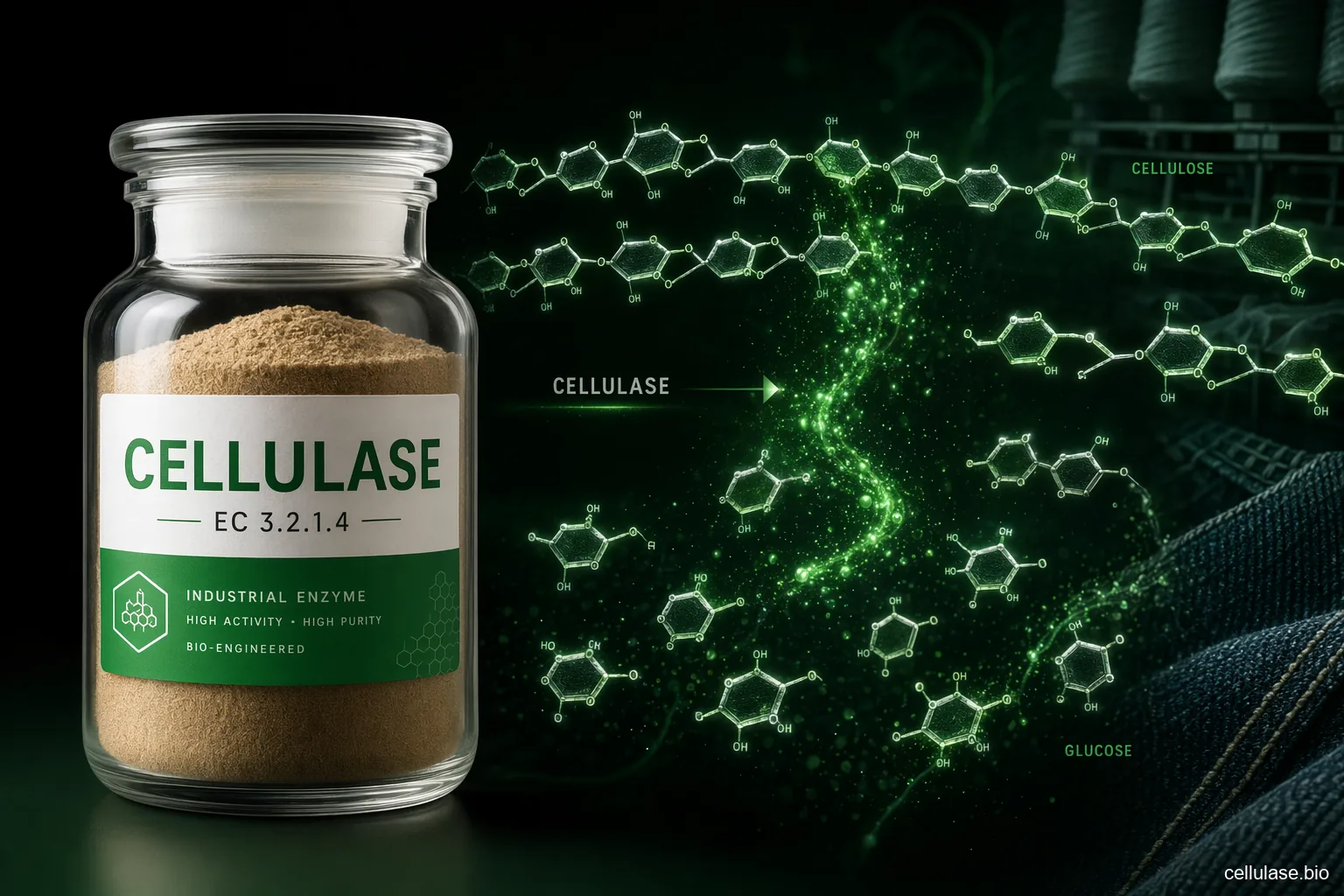
Enzym Cellulase Dosage, pH, and Temperature in Textile Biopolishing
Troubleshoot cellulase enzyme dosage, pH, temperature, QC, and supplier checks for industrial textile biopolishing and cost-in-use control.
Short answer
Cellulase results in textile biopolishing are governed by four variables: dose, bath pH, temperature and time. Run acid grades in a mildly acidic bath and neutral grades nearer neutral, keep temperature inside the grade's stated window, and stop the reaction with an alkaline or hot rinse. Establish the dose with a control plus at least three levels in a lab trial before committing to bulk.
| Enzyme Name | Cellulase (EC 3.2.1.4 / EC 3.2.1.91 / EC 3.2.1.21) |
|---|---|
| Activity | Multiple grades (powder & liquid) |
| Optimal pH | 4.0 – 6.0 |
| Optimal Temperature | 45°C – 60°C |
| Appearance | Light brown to brown powder or liquid |
| Source | Trichoderma reesei / Aspergillus niger |
| Shelf Life | 12 months (sealed, cool, dry place) |
| Packaging | 25 kg drums (powder) / 30 kg jerricans (liquid) |
| MOQ | 25 kg |
| Certifications | ISO 9001, HALAL, KOSHER, Food Grade |
Updated · cellulase.bio
A practical B2B guide for mills and formulators troubleshooting cellulase enzyme performance, fabric strength loss, shade change, and inconsistent biopolishing results.
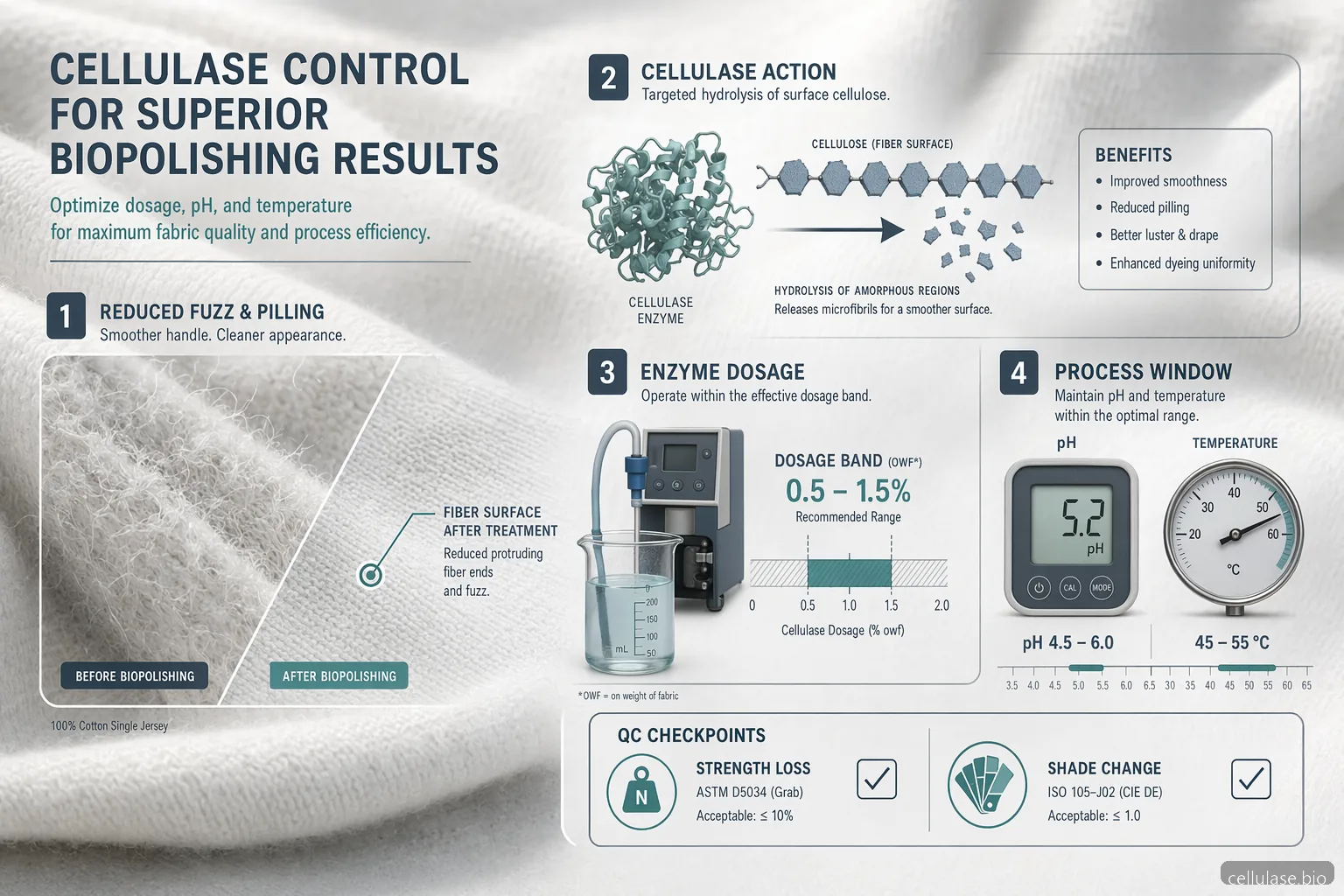
Why do cellulase results vary in textile biopolishing?
In cotton and cellulosic textile biopolishing, enzym cellulase hydrolyzes exposed microfibrils on yarn and fabric surfaces. The intended result is a cleaner hand, reduced fuzz, improved pilling resistance, and a smoother appearance. Troubles usually begin when the same recipe is transferred across fabric constructions, dye classes, machines, or suppliers without revalidation. A cellulase enzyme that works well on lightweight knit cotton may create unacceptable weight loss or shade change on darker reactive-dyed garments. The key is to treat cellulase enzym performance as a controlled process window, not a fixed additive dose. Mills should document enzyme activity, pH, temperature, liquor ratio, mechanical action, treatment time, and deactivation conditions for every trial. This approach makes troubleshooting practical and supports cost-in-use decisions for industrial buyers comparing enzyme cellulase options.
Primary variables: pH, temperature, time, dosage, liquor ratio, and mechanical action. • Common failures: over-polishing, back-staining, strength loss, patchy hand feel, and shade drift. • Do not compare products without normalizing by activity, solids, or validated performance.
See denim finishing with cellulase for the full picture.
What starting dosage and process conditions should I use?
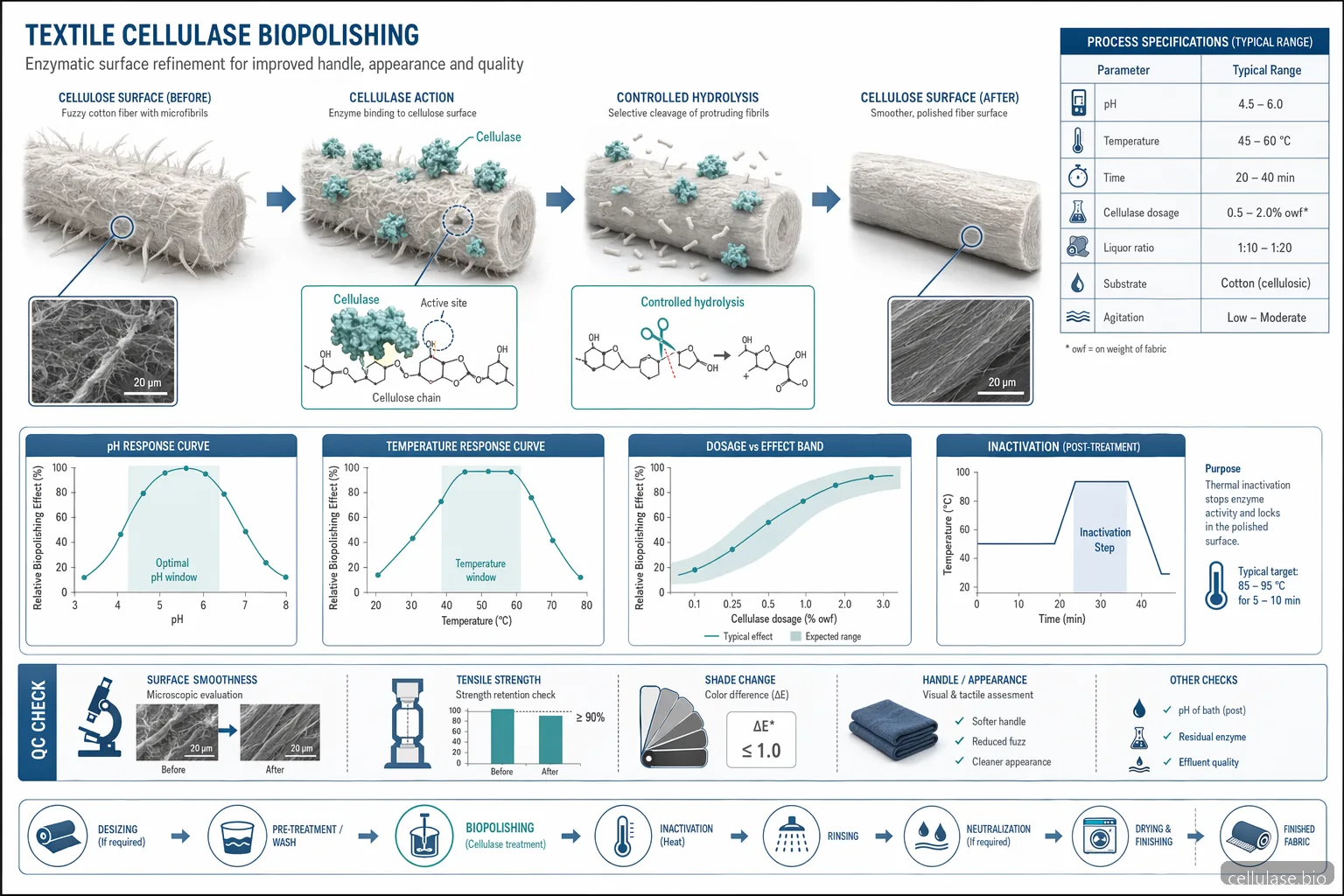
For trial work, many mills begin acidic cellulase biopolishing at 0.1–1.0% owg, or at a supplier-recommended activity dose based on fabric weight. A cautious first screen is often 0.2–0.5% owg for medium-weight cotton knits, followed by optimization. Typical operating conditions are pH 4.5–5.5, 45–55°C, 30–60 minutes, and a liquor ratio suitable for even wetting and fabric movement. Neutral cellulase systems may operate closer to pH 6.0–7.0 and 45–60°C, depending on product design. These bands are not universal specifications; they are safe starting points for pilot validation. If fuzz removal is low, increase time or dosage gradually rather than changing multiple variables at once. If strength loss, excess weight loss, or shade change appears, reduce dosage, shorten treatment, lower mechanical action, or review deactivation.
Acid cellulase: commonly pH 4.5–5.5 and 45–55°C. • Neutral cellulase: often near pH 6.0–7.0 and 45–60°C. • Trial dosage: commonly 0.1–1.0% owg, refined by activity and fabric response. • Optimize one variable at a time for traceable troubleshooting.
How do I troubleshoot pH, temperature and inactivation?
Cellulase enzyme is sensitive to process drift. If the bath pH is outside the active window, hydrolysis can become slow, uneven, or overly aggressive in localized zones. Verify pH after enzyme addition and after fabric loading, not only in the make-up tank. Temperature should be measured in the working bath, because machine sensors and actual fabric-zone temperatures may differ. Excess heat can reduce activity during treatment, while insufficient heat can make the process appear under-dosed. After the target effect is achieved, inactivation is essential to prevent continued fiber attack during downstream steps. Common approaches include raising pH to alkaline conditions, heating according to the TDS, or both. The correct stop method depends on the cellulase formulation, substrate, dyestuff, and process sequence. Always confirm residual activity if delayed rinsing, softening, or storage occurs.
Check pH at start, midpoint, and endpoint during scale-up. • Confirm actual bath temperature, not only setpoint temperature. • Use TDS-defined deactivation conditions and verify with QC where possible. • Investigate residual activity when garments weaken after processing.
Which QC checks protect fabric value?
A good biopolishing program balances appearance improvement against fiber loss. Weight loss is a useful first indicator, but it should never be the only release criterion. Textile teams should measure pilling grade, surface fuzz, tensile or burst strength, dimensional change, absorbency, shade difference, and hand feel. For dark shades, include colorfastness and back-staining observations. For performance fabrics, confirm that absorbency, wicking, or finishing chemistry is not compromised. Keep untreated control fabric and a benchmark enzyme run for each lot of trials. Industrial buyers evaluating cellulase enzym kaufen options should ask suppliers to help define QC methods that match the mill’s fabric mix and customer specifications. A product with a lower drum price may be more expensive if it causes rework, shade correction, or excessive quality holds.
Track weight loss with tensile or burst strength, not alone. • Use ΔE or approved shade tolerances for dyed goods. • Keep a retained control and trial log for every fabric family. • Calculate cost-in-use including rejects, reprocessing, and cycle time.
How do I qualify a supplier before purchase?
Before issuing a production order or searching for enzym cellulase kaufen, qualify the supplier on documentation, consistency, and technical support. Request a current COA showing batch identity and key quality parameters, a TDS with activity definition and use conditions, and an SDS for safe handling and storage. Ask how activity is measured, how lot variation is controlled, and whether application data is available for cotton knits, wovens, denim, lyocell, or blended cellulosics. Pilot validation should precede plant-wide adoption, especially when changing from one enzyme cellulase source to another. Include warehouse stability, packaging, lead time, and regulatory documentation needed for your market. Avoid purchase decisions based only on quoted price per kilogram; compare cost-in-use, reproducibility, support quality, and the risk of production downtime.
Request COA, TDS, SDS, sample quantity, shelf-life, and storage guidance. • Confirm activity units and recommended analytical methods. • Run lab, pilot, and production validation before full conversion. • Evaluate supplier responsiveness during troubleshooting, not just price.
Is this industrial cellulase or a consumer product?
Searches such as waschmittel ohne enzym cellulase, hat mensch cellulase enzym, or enzym komplex amylase pankreatin cellulase ec lactase pzn often relate to consumer detergents, digestion, or supplement listings. Those topics are separate from industrial textile biopolishing. This page addresses cellulase enzyme procurement and process troubleshooting for mills, laundries, garment processors, and formulators. The relevant decision factors are activity, pH and temperature window, compatibility with dyestuffs and auxiliaries, fabric strength retention, documentation, and supply reliability. For detergent manufacturers, cellulase may be selected for fabric care or cleaning performance, but dosing, stability, and formulation constraints differ from garment biopolishing. For textile buyers, the practical question is not whether humans produce cellulase; it is whether the selected enzyme delivers consistent surface modification at acceptable quality risk and total processing cost.
This guide is for B2B textile enzyme applications, not medical or supplement advice. • Consumer detergent and nutrition keywords do not define textile process suitability. • Industrial selection requires pilot data, documentation, and QC-controlled outcomes.
What should I check before buying cellulase?
What do buyers usually ask about cellulase?
A common lab screening range is 0.1–1.0% owg, with 0.2–0.5% owg often used as a cautious first trial for medium cotton knits. However, commercial cellulase enzyme products differ in activity and formulation, so dosage should be normalized to supplier activity units where possible. Confirm the endpoint with weight loss, pilling grade, strength, and shade checks before production use.
Strength loss usually indicates excessive hydrolysis or continued enzyme activity after the intended endpoint. Check actual pH, bath temperature, treatment time, mechanical action, dosage, and deactivation. Dark, fine, or already weakened fabrics may need a lower dose or shorter cycle. Also verify that rinsing and pH shift fully stop activity before softening, drying, or storage.
Ask for a COA for the supplied batch, a TDS describing activity, recommended pH, temperature, dosage, and inactivation, and an SDS for handling and storage. For supplier qualification, also request shelf-life, packaging details, activity test method, sample availability, and application support. A pilot run should confirm performance before a full production order.
Not automatically. Detergent cellulase may be optimized for formulation stability, wash conditions, and consumer fabric care, while textile biopolishing requires controlled surface hydrolysis, predictable deactivation, and fabric strength retention. If considering a detergent-oriented enzyme cellulase, require a TDS, activity data, compatibility review, and pilot validation on the exact fabric and machine conditions.
No. Searches such as waschmittel ohne enzym cellulase, hat mensch cellulase enzym, or enzym komplex amylase pankreatin cellulase ec lactase pzn usually concern consumer detergents or digestive supplement topics. This page covers industrial cellulase enzyme use in textile biopolishing. It does not provide medical, nutritional, or consumer product advice.
Cellulase for Research & Industry
Need Cellulase for your lab or production process?
ISO 9001 certified · Food-grade & research-grade · Ships to 80+ countries
Frequently Asked Questions
Related: Cellulase for Industrial Production and Activity Control
Turn This Guide Into a Supplier Brief Request a cellulase biopolishing sample, COA/TDS/SDS package, and pilot validation plan for your fabric line. See our application page for Cellulase for Industrial Production and Activity Control at /applications/cellulase-production-activity/ for specs, MOQ, and a free 50 g sample.
Get a Free Sample & Quotehello@mail.cellulase.bio