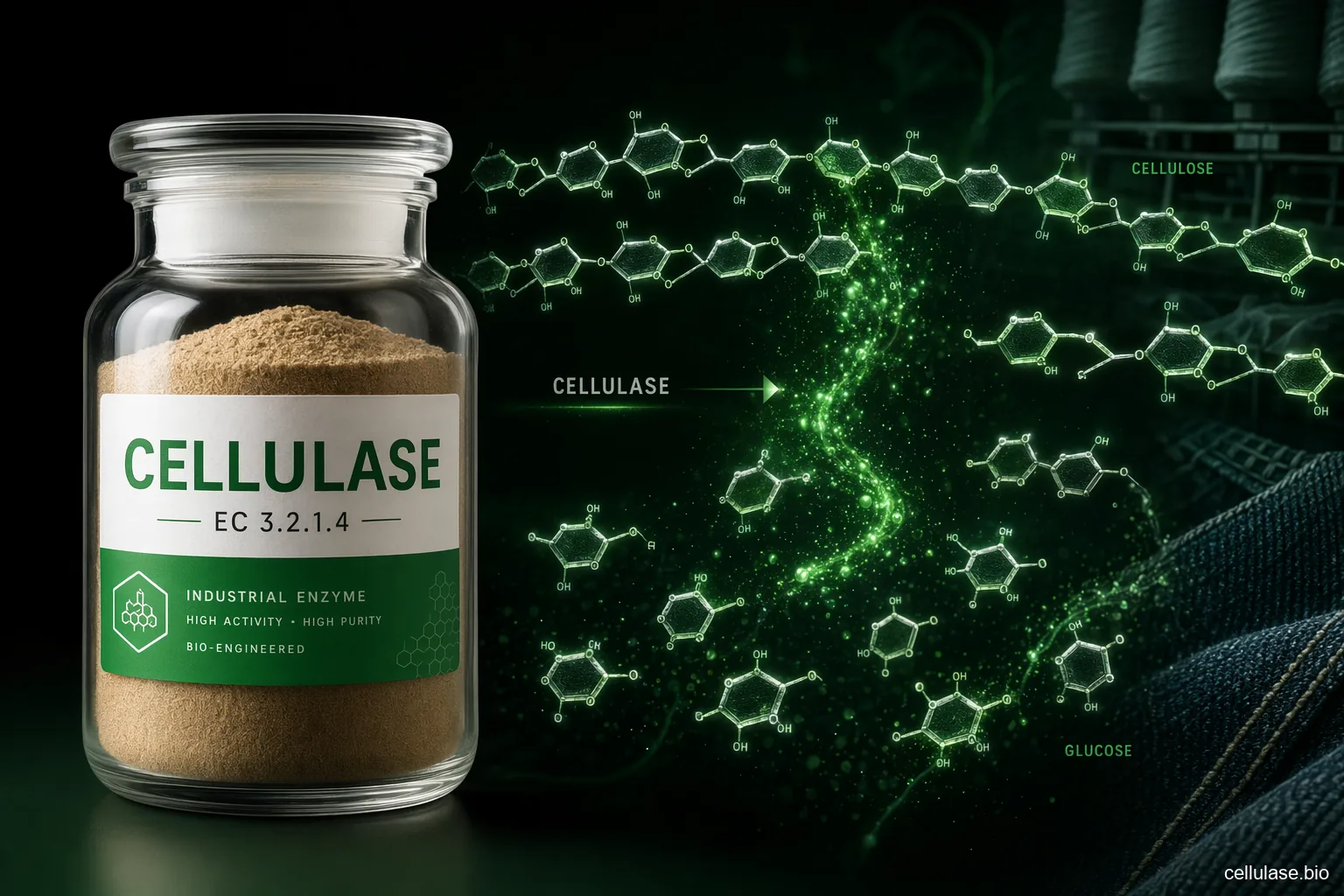
Colour Fade From Detergent Enzymes: Cellulase Dosing and Alkalinity Limits in a Multi-Enzyme Blend
How to dose cellulase in a protease-amylase-lipase detergent blend without fading dark cotton: addition rate, alkalinity and temperature limits, granule or liquid.
| Enzyme Name | Cellulase (EC 3.2.1.4 / EC 3.2.1.91 / EC 3.2.1.21) |
|---|---|
| Activity | Multiple grades (powder & liquid) |
| Optimal pH | 4.0 – 6.0 |
| Optimal Temperature | 45°C – 60°C |
| Appearance | Light brown to brown powder or liquid |
| Source | Trichoderma reesei / Aspergillus niger |
| Shelf Life | 12 months (sealed, cool, dry place) |
| Packaging | 25 kg drums (powder) / 30 kg jerricans (liquid) |
| MOQ | 25 kg |
| Certifications | ISO 9001, HALAL, KOSHER, Food Grade |
Updated · cellulase.bio
Cellulase is the one enzyme in a laundry blend that does not remove a stain, and it is still the one formulators are told is key: it works on the cotton fibre itself, not on the dirt sitting on it. In a four-enzyme system the roles split cleanly: protease takes protein stains without scrubbing, lipase stops yellowing and odour at low temperature, amylase dissolves starch, and cellulase extends fabric life and keeps colour looking fresh. Get the cellulase part wrong and the complaint is not a stain left behind; it is a black garment that came back from the customer faded and was returned as a quality defect.
This page is for the formulator or buyer at a detergent maker or private-label brand choosing a cellulase grade and an addition rate for a powder or liquid base, and for the industrial laundry manager who sees the fade complaints first.
What cellulase does in the wash, and what it does not
Pilling starts as loose fibre ends that abrade and tangle into small balls; a video on the subject draws comments from people whose new sweatsuit came out peppered with pills after a single wash. Other viewers blame the front-loader, or admit the polo went through a normal cycle when the label said gentle: mechanical action is the cause, and the detergent takes the blame. Cellulase shaves off those protruding fibre ends, which is why a wash-trial video from an enzyme producer shows pilling removed and the fabric looking brighter and fresher after the cycle.
Textile finishers reduce the same enzyme to a note: cellulose enzymes equal softness, and enzymes replace harsh solvents. If you load the cellulase to make the fabric-care claim bigger, you create the fade complaint described next.
The fade complaint: what went wrong on the black garment
A customer wore and washed a black garment, it faded, and the item came back as a quality return; the detergent was described as a heavy-cellulase, stacked multi-enzyme formula with strong alkali and AES and MES oil dissolvers. The mechanism is the same one that makes cellulase useful: it cuts surface cellulose, and on dark dyed cotton the removed surface carries dye with it, so dose, alkalinity and mechanical action stack together. Protease in the same bottle wants a mildly alkaline base, pH 10 or below for a liquid and pH 11 or below for a powder; stronger alkali or acid holds the enzyme back.
Cold-water formulas are built around 20-30 C water and keep alkalinity and oxidisers down so the enzymes stay alive. So a formula that stacks heavy cellulase on strong alkali is fighting its own protease and overdosing the one enzyme that touches the fibre.
Addition rate and temperature window
The enzyme pack in a cold-water detergent is dosed in parts per ten thousand of the finished formula, typically 0.01-0.05 %, with the wash at 20-30 C. That low rate is the point: traditional formulas lose about 50 % of their cleaning power in cold water, and the enzyme pack brings it back without more surfactant. The failure mode on the market side is a strong marketing claim, poor cold-water results, bad reviews and no repeat purchase.
Temperature has a hard ceiling: protease activity falls fast above 55 C and is permanently lost at 60 C, so a hot soak wastes the enzyme system. At room temperature a fresh protein stain needs a 15-30 minute soak before the enzyme has done its work, which is the dwell time your instructions should allow. Treat these as the window for the whole blend; cellulase sits inside it, and the cellulase rate is the one you turn down first when dark colours are in the wash load.
One 4-in-1 granule on the market declares 880 U/g cellulase next to 10,200 U/g protease, which shows how small the cellulase share of a blend normally is. Compare products on activity and dose, not on weight: a product used at 1 % can cost more in the formula than one that works at 0.25 %.
Granule or liquid, single enzyme or blend
Single cellulase concentrate. What you get: Cellulase alone, packed for detergent makers and industrial laundries in 25 kg or 1000 L. Where it fits: You already run protease, amylase and lipase and want to set the fabric-care dose on its own. Watch-out: The easiest grade to overdose on dark cotton.
3-in-1 blend (protease, amylase, lipase). What you get: Stain removal only: protein, starch and fat, no fibre action. Where it fits: Boosters and liquids where fabric care is not a claim; a private-label booster spec lists exactly these three with cellulase only as an option. Watch-out: No pilling or colour-brightness claim possible.
4-in-1 blend (adds cellulase). What you get: Stain removal plus fabric life and colour retention in one granule. Where it fits: Powder detergents. Watch-out: The cellulase share is fixed by the blender, so you cannot turn it down for a colour-care variant.
5-in-1 blend (adds mannanase). What you get: Covers thickener and gum stains as well. Where it fits: Premium liquids; verify activity and quality control before trusting the enzyme count. Watch-out: More enzymes means more stability work in a liquid.
Powder detergent enzymes are coated granules: the enzyme is built onto a starch carrier and coated so the strong alkali in a powder cannot kill it in storage, while liquid detergent takes the liquid enzyme. German-market formulators rank a granule on three things beyond its cost: low dust, because granulation is the worker-protection and allergy control, storage stability, and activity density quoted per gram of granule. They are also told to check particle size distribution and residual dust on every granulated lot.
Industrial laundry buyers are pointed at granulated cellulase made specifically for powder detergent, and at suppliers who can show scale and delivery, not only a datasheet. Across the cellulase orders we have shipped, buyers commonly add neutral protease, lipase and alpha-amylase, and laundry detergent is rarely named as the application: most blend buyers build the system themselves and do not say so. Most of those buyers are in the US, with Germany, Canada and France next.
Four causes of a fade complaint, in the order to check them
1. Cellulase too high for the load. The returned black garment was washed in a heavy-cellulase, stacked multi-enzyme formula; cut the cellulase share before touching anything else.
2. Alkalinity too strong. The same formula ran strong alkali; protease itself only wants pH 10 or below in a liquid and pH 11 or below in a powder, and the fibre takes the extra.
3. Wrong cycle, wrong machine. The pilling thread is full of front-loader and normal-cycle confessions; mechanical action plus cellulase removes more surface than either alone.
4. Hot wash. Above 55 C the protease is fading and at 60 C it is gone, so the user who hot-washes to compensate for a weak detergent is cooking the enzyme system and abrading the fabric for longer.
What to specify when you ask a supplier
Bulk enzyme pricing is not on a spot list; it moves with activity units, form (liquid versus microgranulate or powder) and minimum order quantity, so a quote request without those three is a quote you cannot compare. Ask every supplier to quote against one specification: declared activity in U/g with the assay method, a batch-to-batch tolerance such as ±10 %, minimum guaranteed activity rather than nominal, particle size, dusting, bulk density, moisture, storage stability, and compatibility with your bleach, builders, surfactants and optical brighteners. Ask for the recommended dose in grams of enzyme per ton of finished detergent, the MOQ and annual capacity, and whether it ships in drums or supersacks; one distributor lists 88-lb drums and 2,205-lb supersacks for granular laundry enzymes.
Minimum orders for 4-in-1 granules are quoted at 500 kg and 1,000 kg, which is why a private-label start-up planning a 500, 2,000 or 10,000 unit first run usually starts with a blend rather than four separate enzymes. That start-up spec reads: protease, amylase and lipase, cellulase or mannanase as an option, fragrance-free, cold-water performance, no chlorine bleach, and the actual enzyme activity declared rather than a line saying it contains enzymes. Cellulase concentrates for detergent makers and industrial laundries come in 25 kg and 1000 L packs; for a trial, ask for the smallest pack the supplier will split.
Enzymes are proteins, not chemical additives, and the quality of the enzyme preparation decides the cleaning power you can claim, so a cheaper granule with a lower declared activity is not a saving.
Cellulase for Research & Industry
Need Cellulase for your lab or production process?
ISO 9001 certified · Food-grade & research-grade · Ships to 80+ countries
Next step: email your base for a dosing worksheet
Email us your base for a dosing worksheet: liquid or powder, its pH, the wash temperature you design for, and whether dark cotton is in scope. We send back the enzyme-pack rate, a cellulase share for a colour-care variant, the alkalinity and temperature limits above, and a sample request form for the cellulase grade that fits your base.
Get a Free Sample & Quotehello@mail.cellulase.bio