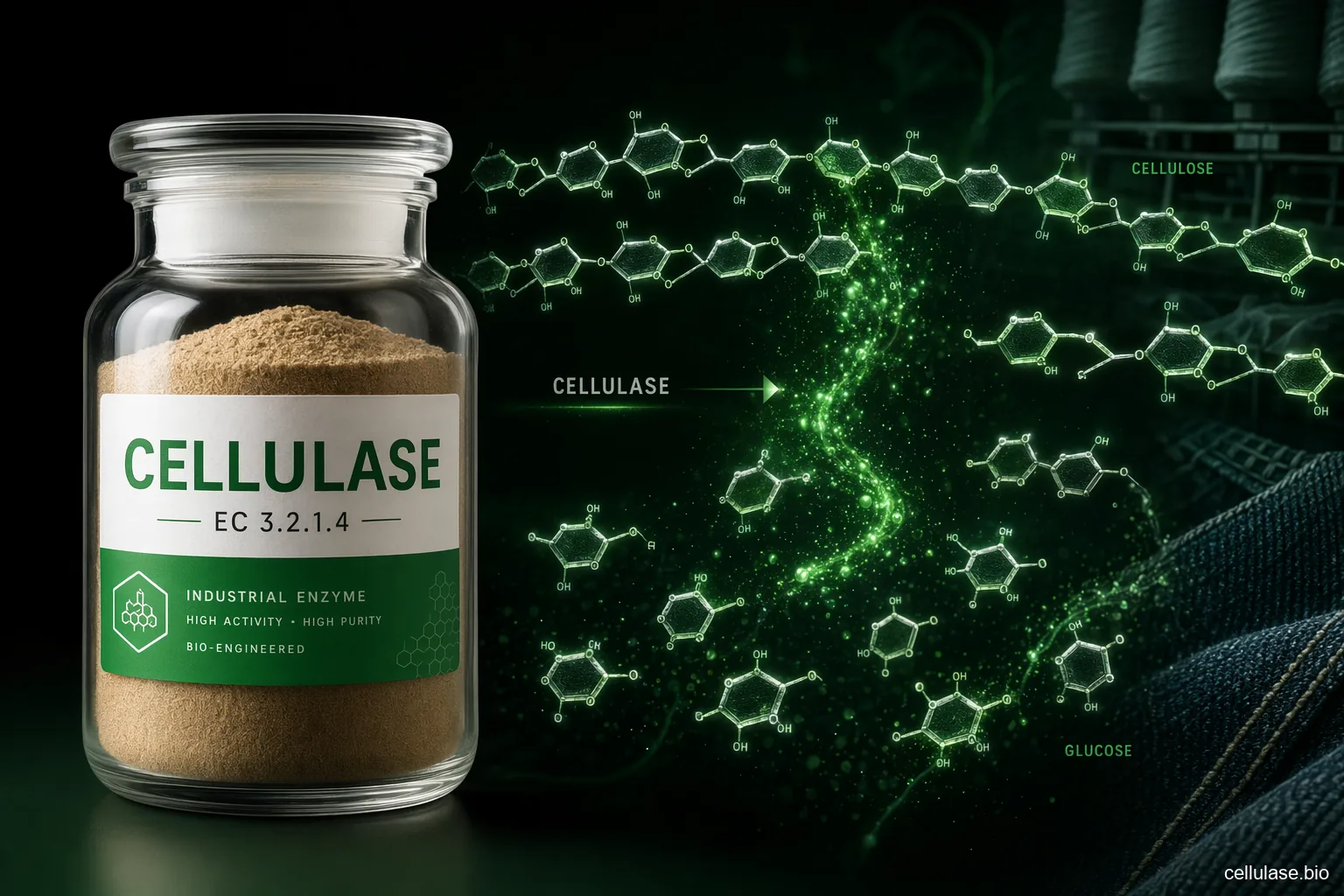
Lignocellulose Saccharification: Enzyme Loading and the Silent Losses That Eat Your Sugar Yield
Where cellulase goes before it cuts cellulose: lignin binding, phenol and oxygen losses, the cocktail window, and how to run a loading-rate trial on your own biomass.
| Enzyme Name | Cellulase (EC 3.2.1.4 / EC 3.2.1.91 / EC 3.2.1.21) |
|---|---|
| Activity | Multiple grades (powder & liquid) |
| Optimal pH | 4.0 – 6.0 |
| Optimal Temperature | 45°C – 60°C |
| Appearance | Light brown to brown powder or liquid |
| Source | Trichoderma reesei / Aspergillus niger |
| Shelf Life | 12 months (sealed, cool, dry place) |
| Packaging | 25 kg drums (powder) / 30 kg jerricans (liquid) |
| MOQ | 25 kg |
| Certifications | ISO 9001, HALAL, KOSHER, Food Grade |
Updated · cellulase.bio
Pilot teams running pretreated corn stover, bagasse or straw through a cellulase tank tend to hit the same wall: glucose release stalls short of target, somebody adds more enzyme, and the enzyme line becomes the biggest running cost in the plant. This page is about the three places that enzyme actually goes before it ever touches cellulose, and how to size a loading trial so you stop paying for enzyme that is parked on lignin.
Where the enzyme goes before it cuts cellulose
Residual lignin left in pretreated biomass adsorbs cellulase non-productively, so a share of every dose sits on lignin instead of working on the fibre, and the loading you need rises to compensate. In a lab study on exactly this binding, a sulfonated polystyrene additive reduced the non-productive adsorption, and the additive dose correlated 0.87 with final hydrolysis efficiency across runs made between 25-50 C. More enzyme is therefore not the only lever: a lignin-blocking additive or a less lignin-rich pretreated solid can buy back loading that extra cellulase cannot.
Phenolics released from lignin are the second drain. In the presence of oxygen they cross-link cellulase covalently, and the measured enzyme activity fell about 50 % through that cross-linking alone. The cross-linking is oxygen-dependent, so keeping the hydrolysis stage anaerobic, or scavenging oxygen, reduces it, and some glycoside hydrolase families tolerated phenolics far better than others, which is a good reason to ask which organism and which enzyme families a cocktail is built from.
Pretreatment is what opens the lignin shield. On untreated biomass the crystalline cellulose hydrolyses very slowly because tight hemicellulose-cellulose associations, cellulose crystallinity and a lignin barrier around the fibres all block enzyme access, which is why nearly every process removes hemicellulose and/or lignin before the cellulase step. The catch is that a pretreatment severe enough to free glucose from cellulose can degrade the sugars already liberated from hemicellulose, so severity is a dial you tune to the feedstock, not a setting you maximise.
The window the cocktail works in
Across industrial enzyme applications the typical operating window is pH 5.0-8.5 and 37-55 C, and inside that window the cellulase's job in a biorefinery is to break plant fibre into fermentable sugars. That is a broad industrial window, not a cellulase optimum. The leading commercial saccharification cocktails are reported running near pH 5 and 50-55 C, with the standing advice to establish your own optimum on your own pretreated substrate rather than copy the literature point.
Benchmark blends are formulated to handle 15-30 % insoluble solids after chemical or thermal pretreatment, and they combine endoglucanase, exoglucanase and beta-glucosidase so glucose is released without severe end-product inhibition. Which blend fits depends on the feedstock (corn stover, sugarcane bagasse, wood chips) and on whether you run separate hydrolysis and fermentation (SHF) or simultaneous saccharification and fermentation (SSF). For pretreated rice straw or bagasse, the current-generation cocktail carrying beta-glucosidase and hemicellulase side activities is the default pilot benchmark, and the older cocktail it was compared against released less sugar.
Hemicellulase earns its place because xylan left in the pretreated solid both hides cellulose and soaks up enzyme. The pairing shows up on the buying side too: across our cellulase orders, xylanase and hemicellulase are common add-ons, mostly from the same small-lot process buyers.
Three ways to load the tank
Single cellulase (endo + exo activity). What it does well: Lowest cost per kilo of enzyme; fine on clean, low-lignin pulp. Where it fails: Cellobiose accumulates and inhibits the enzyme, so glucose release stalls before target. Who it suits: Paper pulp, lab demonstrations.
Cellulase + beta-glucosidase. What it does well: Converts cellobiose to glucose and lifts final yield without adding more cellulase. Where it fails: Still blind to xylan; still parks enzyme on residual lignin. Who it suits: Low-hemicellulose, well-pretreated feedstock.
Full cocktail with hemicellulase, rated for 15-30 % solids. What it does well: Handles high solids after pretreatment; frees cellulose hidden behind xylan. Where it fails: Highest cost per kilo; still loses activity to phenolics unless oxygen is controlled. Who it suits: Corn stover, bagasse and straw pilots.
Measuring what you actually bought
Activity units are only comparable when the assay is the same, which is why a published spectrophotometric standard method for cellulase activity exists: producers, buyers and testing labs need to measure one thing the same way. Ask every supplier which method their unit refers to before you compare two quotes.
The pilot-procurement rule is blunter still: never compare suppliers on dollars per kilo of enzyme, compare them on cost per kilo of fermentable glucose actually released from your pretreated feedstock, because cocktail performance shifts with substrate, pretreatment, solids loading and dose.
Small teams copying a lab protocol trip on the read-out as well. Under one saccharification walkthrough a viewer asked whether a glucose meter is acceptable when the DNSA reducing-sugar method is the norm, and another doubted that 19 mL of water in the recipe was really needed. The same thread asked which enzyme was used and whether one enzyme works on all lignocellulosic biomass, which is the wrong way round: feedstock and pretreatment choose the cocktail, not the reverse. Under a pretreatment demonstration the questions were which buffer to use, whether an autoclave can stand in for a pressurised reactor, and one engineer's plain problem: "I cant find cellulase enzyme for biomass hydrolysis". On an overview clip the most-liked question was "what happened to the enzyme after the reaction?" It leaves with the sugar stream as soluble protein unless you immobilise or recycle it, which is exactly why enzyme loading is a running cost and not a capital one.
"Yield is low" checklist
1. Check pretreatment severity before touching the enzyme dose: if lignin is still shielding the fibre, extra cellulase mostly adsorbs onto it.
2. Check oxygen in the tank: phenolics plus oxygen cross-link cellulase and cost about 50 % of activity, so blanket the vessel or run the stage anaerobic.
3. Check pH and temperature drift against the cocktail's own point, near pH 5 and 50-55 C for benchmark blends, and never mistake the broad industrial window of pH 5.0-8.5 and 37-55 C for a cellulase optimum.
4. Check solids loading: benchmark blends are rated for 15-30 % insoluble solids, and above that range viscosity and mixing behaviour limit yield before enzyme chemistry does.
5. Check for beta-glucosidase: without it cellobiose builds up and end-product inhibition stalls glucose release.
6. Check for hemicellulase: a cocktail that combines cellulase with beta-glucosidase and hemicellulase activities is the benchmark for lignocellulosic ethanol, and a cellulase-only product on xylan-rich solids underperforms.
7. Check the read-out: a glucose meter and the DNSA method do not read the same, and the number that matters is glucose released per kilo of pretreated feedstock.
8. Check the activity assay behind each supplier's unit; two quotes in different units are two different products until the method is named.
How to run the loading-rate trial
Run a side-by-side screening on your actual pretreated biomass, never on pure cellulose, and measure glucose yield, residual cellulose, enzyme dose, hydrolysis time, viscosity and mixing behaviour, and finally ethanol per kilo of dry feedstock. Put a lignin-blocking additive into the same matrix: the additive work was run between 25-50 C, overlapping the hydrolysis range, so it can be screened at process temperature instead of in a separate step. Treat the supplier conversation as a spec conversation: the questions a pilot buyer is told to ask are the recommended loading range per tonne of dry solids, which variant fits corn stover versus bagasse versus straw, and how activity units and minimum order quantity are defined. Pilot operations often prefer a stable dry powder over a liquid for easier handling, precise dosing and a longer shelf life.
Our own order book shows the same pilot-scale pattern: the cellulase powder for bioethanol and the acid cellulase liquid for fibre hydrolysis are bought nearly always in single-pack quantities.
Cellulase for Research & Industry
Need Cellulase for your lab or production process?
ISO 9001 certified · Food-grade & research-grade · Ships to 80+ countries
Next step
Email us your feedstock, pretreatment and solids percentage for a trial-sample plan and a loading estimate. Add your target sugar concentration and whether you run SHF or SSF, and we return a spec checklist you can put in front of any supplier, including the activity-assay question.
Get a Free Sample & Quotehello@mail.cellulase.bio