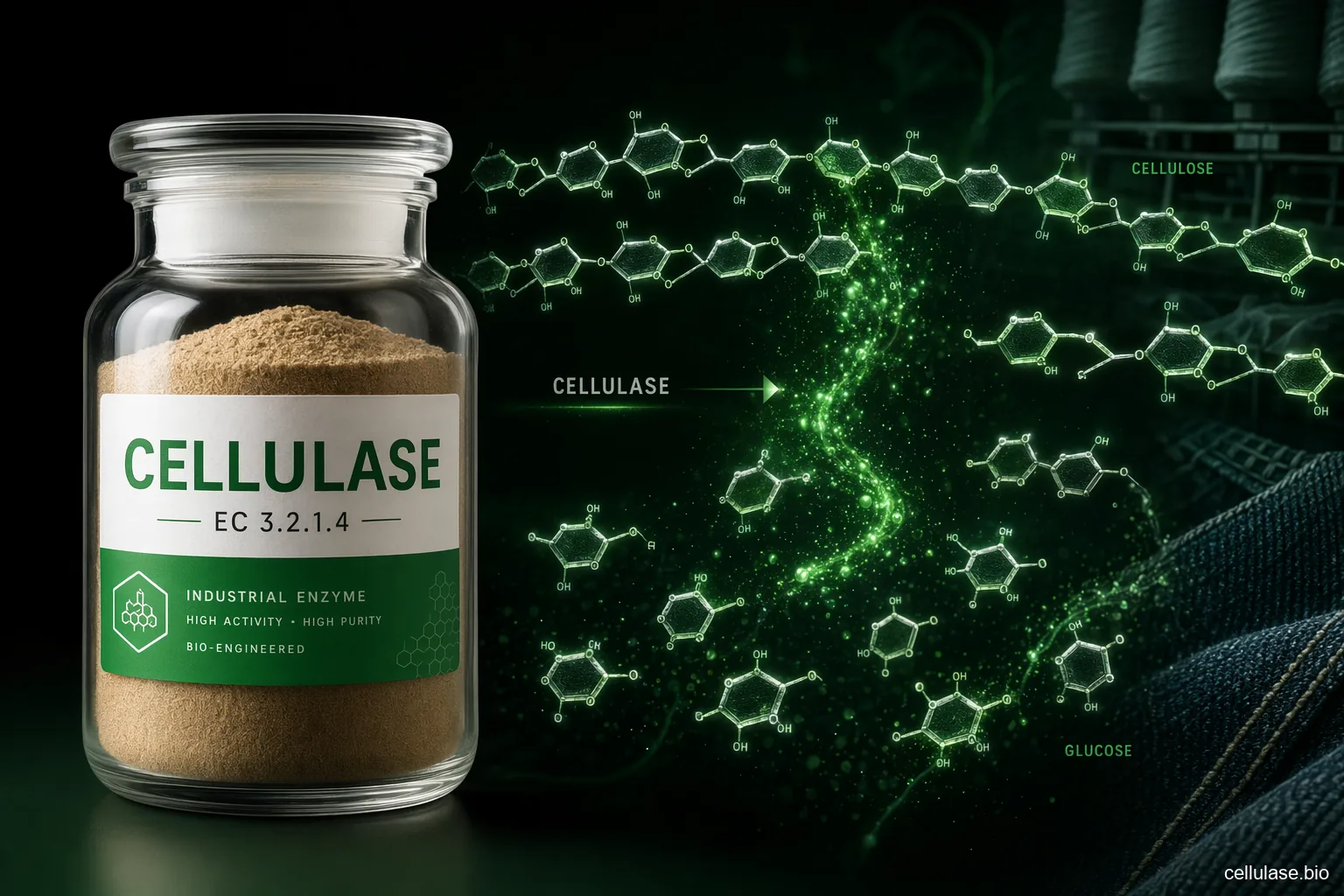
Enzyme Cellulase Detergent for Industrial Laundry Formulation
Formulate laundry detergent with enzyme cellulase: pH, temperature, dosage, QC, COA/TDS/SDS review, pilot validation, and supplier qualification.
Short answer
Cellulase in industrial laundry detergent targets the damaged surface fibres on cotton that trap soil and dull colour. The formulator's job is to match the enzyme's working pH and temperature to the wash programme, confirm it stays active in the detergent base across shelf life, and check compatibility with the surfactants, builders and any bleach system in the formulation.
| Enzyme Name | Cellulase (EC 3.2.1.4 / EC 3.2.1.91 / EC 3.2.1.21) |
|---|---|
| Activity | Multiple grades (powder & liquid) |
| Optimal pH | 4.0 – 6.0 |
| Optimal Temperature | 45°C – 60°C |
| Appearance | Light brown to brown powder or liquid |
| Source | Trichoderma reesei / Aspergillus niger |
| Shelf Life | 12 months (sealed, cool, dry place) |
| Packaging | 25 kg drums (powder) / 30 kg jerricans (liquid) |
| MOQ | 25 kg |
| Certifications | ISO 9001, HALAL, KOSHER, Food Grade |
Updated · cellulase.bio
A practical guide for detergent manufacturers evaluating cellulase enzyme systems for fabric care, cleaning performance, process stability, and cost-in-use. Bulk grades are quoted per order: send product, quantity and destination.
Why is cellulase used in detergent?
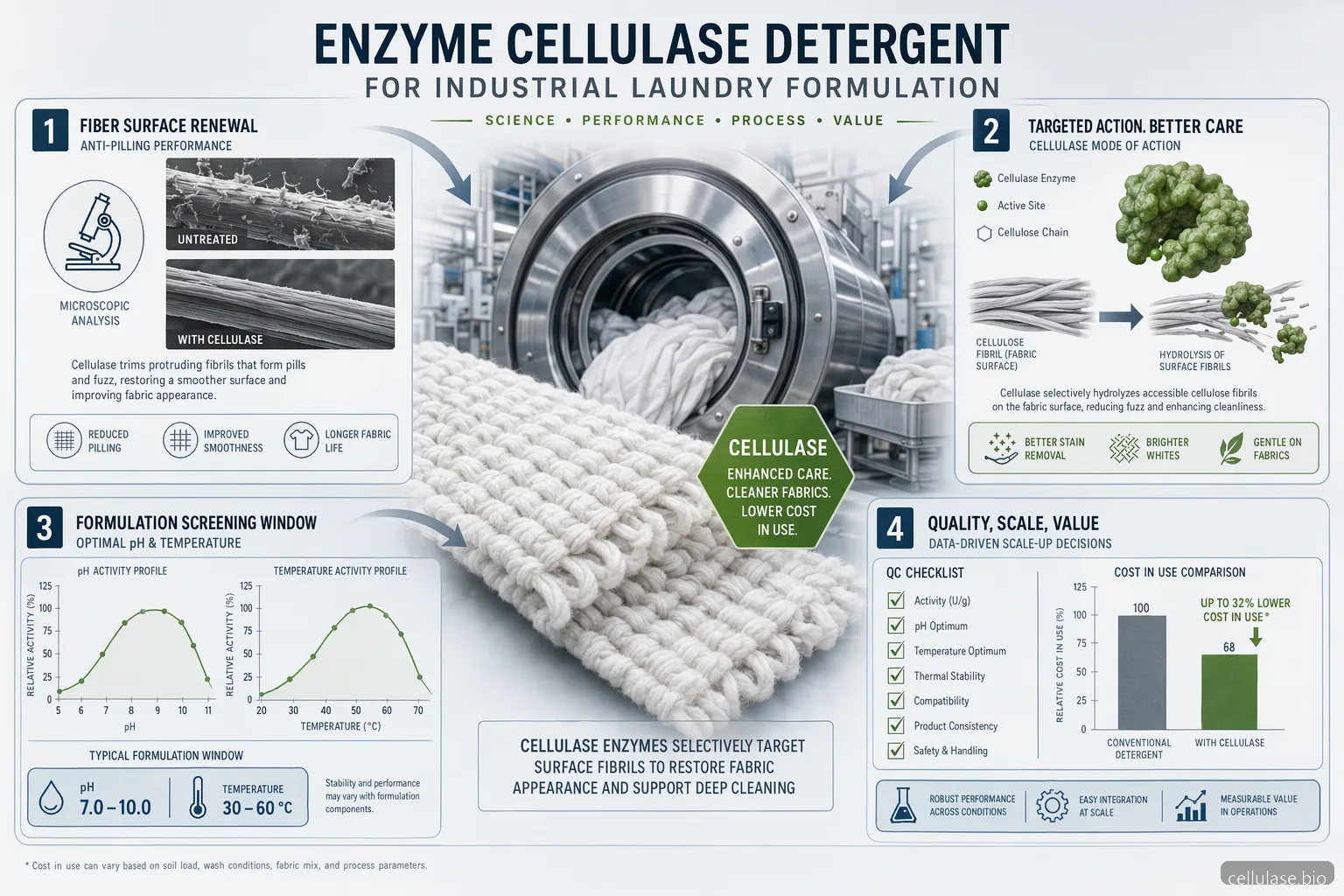
Enzyme cellulase detergent formulations are designed for cotton and cellulose-rich fabrics where surface fibrils, lint, and redeposited soil can reduce fabric appearance. A cellulase enzyme hydrolyzes exposed cellulose microfibrils under controlled wash conditions, helping release particulate soil and smooth the fabric surface. In laundry detergent with enzyme cellulase, the objective is not aggressive fiber degradation; it is balanced activity that supports cleaning and fabric-care benefits within a normal consumer or institutional wash cycle. For B2B formulators, the key decision is matching enzyme cellulase activity to the detergent format, target pH, surfactant system, builder package, and expected storage conditions. Powder, liquid, unit-dose, and institutional products can each require different enzyme forms and stabilizer strategies. Application testing should include local water hardness, wash time, temperature, textile blend, and soil type to avoid overestimating performance from simplified lab screens.
Primary use: cotton fabric appearance and soil-release support • Common formats: liquid, powder, unit-dose, and institutional detergent • Critical variables: pH, temperature, water hardness, surfactants, and storage time
See denim finishing with cellulase for the full picture.
See what cellulase does to clothes in laundry detergent for the full picture.
What process conditions should formulation screening use?
A practical starting window for cellulase enzyme detergent development is pH 6.0-9.0, with many detergent-relevant cellulases screened around pH 7.0-8.5. Wash-temperature studies commonly cover 20-60°C, depending on the market and machine cycle. Initial dosage should be expressed in supplier-defined activity units per kilogram of finished detergent or per wash dose, then converted to cost-in-use after performance testing. In early screening, evaluate low, medium, and high dosage bands rather than a single point, because surfactants, chelants, builders, and optical systems can shift apparent enzyme efficiency. Liquid formulations often require attention to water activity, preservatives, polyols, salts, and protease compatibility. Powder products require assessment of granule robustness, dust control, segregation, and moisture exposure. Always confirm that the cellulase enzyme supplier for detergent provides formulation guidance based on the specific enzyme grade, not generic cellulase assumptions.
Screen pH: commonly 6.0-9.0 • Screen temperature: commonly 20-60°C • Use activity-based dosing, then calculate cost-in-use • Check compatibility with surfactants, builders, preservatives, and other enzymes
Which QC checks come before commercial scale-up?
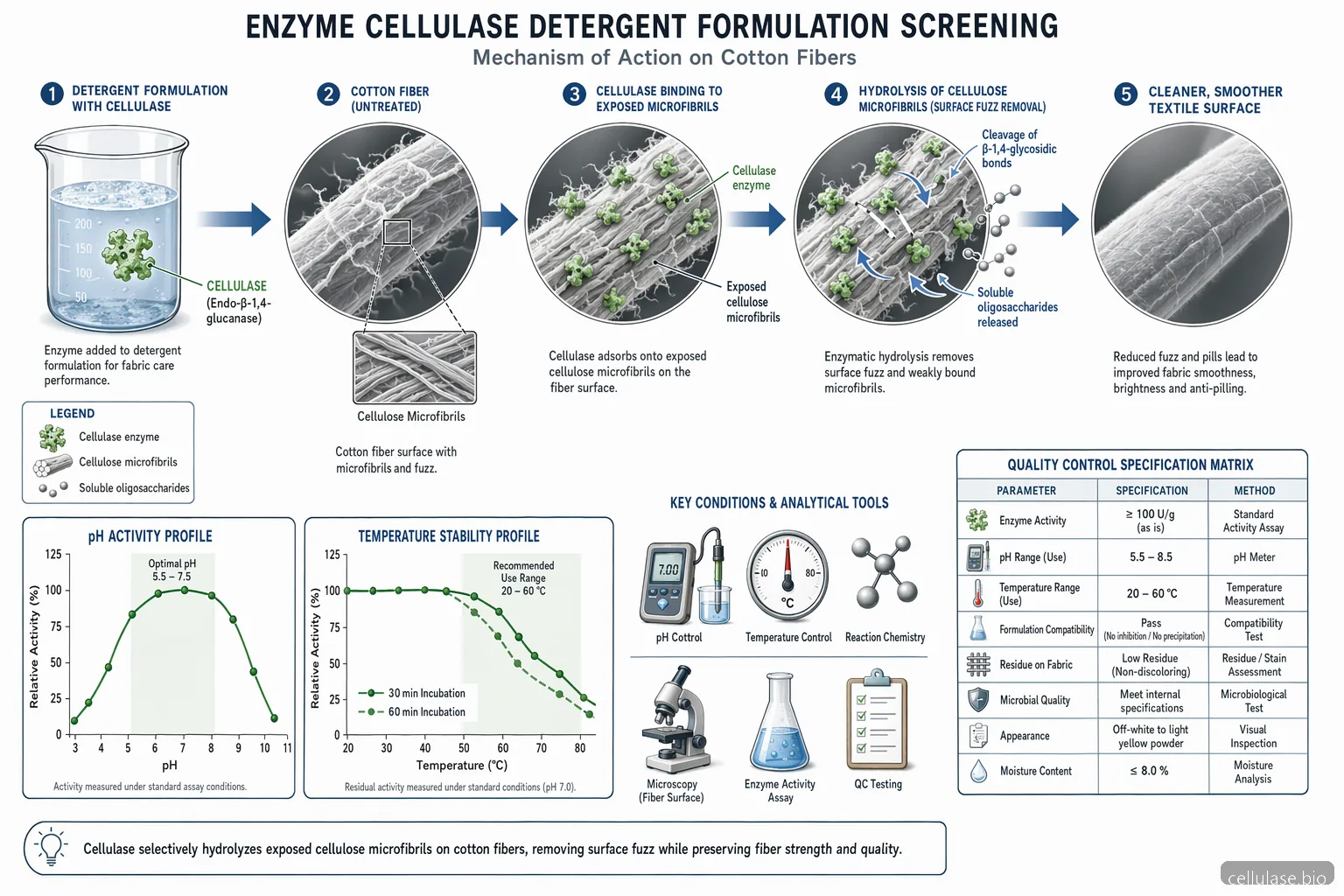
Quality control for industrial cellulase enzyme detergent projects should connect analytical data with application performance. Incoming material review normally includes COA comparison to purchase specification, appearance, activity, moisture or solids where relevant, microbial limits where specified, and packaging integrity. The TDS should define activity method, recommended pH and temperature range, storage guidance, and handling precautions, while the SDS should support safe warehouse and plant handling. Formulators should also run retained-sample studies to compare new lots against an approved reference lot in the same detergent base. Performance QC may include swatch washing, reflectance or color measurements, pilling or fuzz assessment, tensile-strength monitoring for selected fabrics, and residual enzyme activity after storage. For liquids, accelerated stability at elevated temperature can be useful, but it should be correlated with real-time storage because enzymes and detergent matrices do not always age linearly.
Review COA, TDS, SDS, activity method, and batch traceability • Compare new lots against an approved reference sample • Use fabric performance tests, not activity numbers alone • Correlate accelerated stability with real-time storage data
How do I run pilot validation and cost-in-use analysis?
Pilot validation should reproduce the intended consumer, commercial, or institutional washing conditions as closely as possible. A useful protocol defines wash liquor concentration, detergent dose, water hardness, textile type, soil set, cycle time, temperature, rinse conditions, and drying method. For enzyme cellulase laundry detergent, include both performance and fabric-care endpoints: soil removal, whiteness or color maintenance, lint or fuzz reduction, fabric hand, and any measurable strength loss over repeated washes. Cost-in-use should compare enzyme dosage levels against the incremental performance delivered, not simply the enzyme price per kilogram. The most economical grade may be the one that remains stable in the chosen formulation and performs at a lower activity dose. Before scale-up, run pilot batches through normal mixing, holding, filling, and packaging steps to confirm that shear, temperature, and processing time do not reduce enzyme performance.
Validate in the actual detergent base and target wash conditions • Include repeated-wash fabric-care assessments • Calculate cost per wash or per metric ton of finished detergent • Confirm enzyme stability through mixing, filling, and storage
How do I qualify a cellulase supplier?
A qualified cellulase enzyme supplier for detergent should provide consistent technical documentation, responsive formulation support, and reliable batch-to-batch control. Request a current COA for each lot, a TDS with activity definition and application guidance, an SDS, shelf-life information, recommended storage conditions, and packaging options suitable for your plant. Supplier evaluation should also cover manufacturing consistency, change-notification practices, lead times, sample availability, and the ability to support pilot trials. For industrial cellulase enzyme detergent use, ask how activity is measured, whether the method is suitable for your internal QC, and how performance is expected to change under your pH, temperature, and surfactant conditions. Avoid relying only on headline activity values, because different assay methods may not be directly comparable. A strong supplier relationship should reduce trial cycles, improve scale-up confidence, and support predictable cost-in-use.
Require COA, TDS, SDS, traceability, and retained-sample support • Ask for change-notification and shelf-life practices • Confirm assay method and application relevance • Evaluate technical support, lead time, and pilot-trial responsiveness
What should I check before buying cellulase?
What do buyers usually ask about cellulase?
A cellulase enzyme detergent system acts on exposed cellulose microfibrils on cotton and similar fabrics. Under controlled wash conditions, it can help release trapped soil and reduce surface fuzz that affects appearance. The target is balanced fabric care, not excessive cellulose breakdown. Performance depends on enzyme grade, pH, wash temperature, surfactants, water hardness, dosage, and the textile being tested.
Many detergent projects begin screening cellulase enzyme performance across pH 6.0-9.0, often with closer evaluation around pH 7.0-8.5 for laundry systems. The correct range depends on the enzyme grade and the finished detergent matrix. Always confirm the supplier TDS, then run application tests in the actual detergent base because surfactants, builders, and chelants can affect practical activity.
Set dosage by activity units and application performance, not only by enzyme weight. Start with low, medium, and high dosage bands recommended by the supplier, then test in the intended wash protocol. Compare soil removal, fabric appearance, repeated-wash effects, storage stability, and cost per wash. The best dosage is the lowest level that delivers the required performance with acceptable stability and fabric safety.
Yes, cellulase is often evaluated alongside other detergent enzymes, but compatibility must be proven in the actual formula. Proteases, surfactants, preservatives, salts, and pH can affect retained cellulase activity, especially in liquid detergents. Use stability studies, retained activity testing, and wash-performance trials to confirm that the enzyme cellulase laundry detergent system remains effective through storage and normal consumer use.
Industrial buyers should request a COA for each batch, a TDS with activity method and application guidance, an SDS for handling, shelf-life and storage recommendations, packaging details, and traceability information. For supplier qualification, also ask about change-notification procedures, retained samples, pilot support, and lot-to-lot performance controls. These documents help connect procurement, QC, EHS, and formulation requirements.
Cellulase for Research & Industry
Need Cellulase for your lab or production process?
ISO 9001 certified · Food-grade & research-grade · Ships to 80+ countries
Frequently Asked Questions
Related: Cellulase for Industrial Production and Activity Control
Turn This Guide Into a Supplier Brief Request a detergent-grade cellulase sample, TDS, SDS, and pilot formulation review. See our application page for Cellulase for Industrial Production and Activity Control at /applications/cellulase-production-activity/ for specs, MOQ, and a free 50 g sample.
Get a Free Sample & Quotehello@mail.cellulase.bio