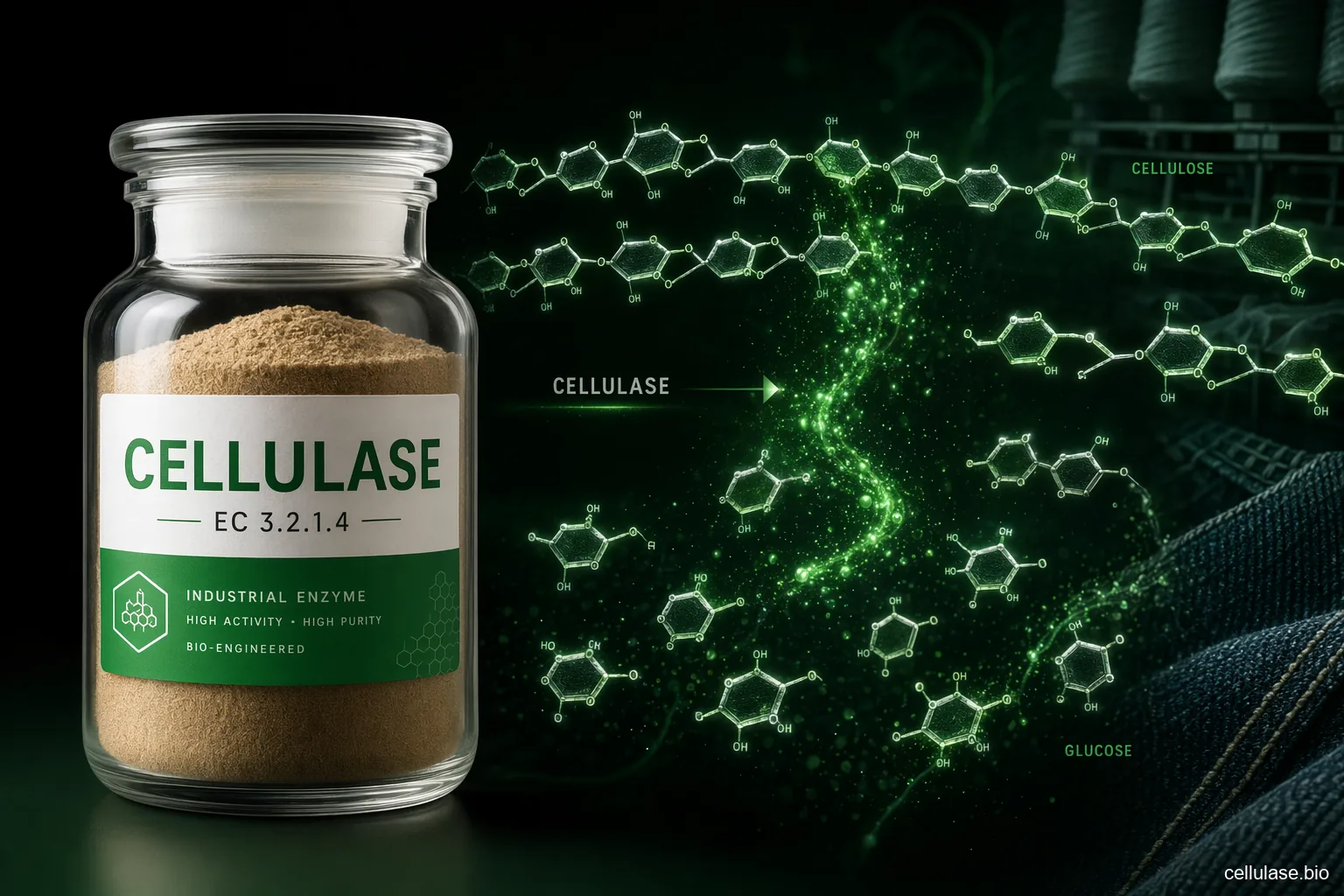
Cellulase Biopolishing for Cotton Knits: Stop Pilling Without Losing Strength
Acid or neutral cellulase for cotton knits: pH and temperature windows, dose on weight of fabric, the order of steps, the kill step and the mistakes that cost strength.
| Enzyme Name | Cellulase (EC 3.2.1.4 / EC 3.2.1.91 / EC 3.2.1.21) |
|---|---|
| Activity | Multiple grades (powder & liquid) |
| Optimal pH | 4.0 – 6.0 |
| Optimal Temperature | 45°C – 60°C |
| Appearance | Light brown to brown powder or liquid |
| Source | Trichoderma reesei / Aspergillus niger |
| Shelf Life | 12 months (sealed, cool, dry place) |
| Packaging | 25 kg drums (powder) / 30 kg jerricans (liquid) |
| MOQ | 25 kg |
| Certifications | ISO 9001, HALAL, KOSHER, Food Grade |
Updated · cellulase.bio
A biopolishing enzyme bath is the only finishing step that removes the cause of pilling instead of hiding it: cellulase clips the loose microfibrils standing off the fibre surface, so there is nothing left to roll into a pill. The same shave is what people see as a softer, cleaner hand on T-shirts, polos and fleece, which is why finishers talk about cellulase for pilling and softness in the same breath. This page is for the knitwear mill technician, the garment wash house and the small finisher who gets the complaint "it pilled after one wash" and has to fix it in the next lot. It gives the grade choice, the pH and temperature windows, dose ranges, the order of steps, and the mistakes that cost strength or shade.
Why knits pill, and what the enzyme actually does
Under a pilling explainer, the top comment complains that T-shirts, jeans and sweaters that used to last years now pill, and that shirts pill on the rack before they are sold. Another viewer washed a brand-new sweat suit once and found it "absolutely peppered with pills". Consumers blame the machine or the detergent, but pills are fibre ends that abrasion pulls out and twists together; the loose ends were there when the garment left the mill.
Cellulase works because it hydrolyses the fibres that protrude from the surface first, and only then starts on the yarn body inside the fabric. In a controlled wash trial, cellulase removed existing pills and left the fabric looking more vibrant and fresh. In a laundry blend the same enzyme is sold as the fabric-care component that "does not remove stains but is key", because it keeps the surface clean of fuzz wash after wash. In finishing it replaces the pumice stones that were used to abrade the surface, and because it attacks only the microfibrils it spares both the machine and the fibre. The flip side is that the enzyme does not know when to stop: run it too long or too hot and it keeps hydrolysing into the yarn, which is where weight loss and strength loss come from.
Acid or neutral: pick the grade before you pick the dose
Two families do this job, and they are not interchangeable. Acid cellulase works faster; neutral cellulase protects the shade contrast and lowers backstaining of released dye onto pale areas. Neutral variants also give less weight and strength loss, which matters more on a light single jersey than on a heavy twill. Neutral formulations often come with dispersants and backstaining inhibitors already built in, and the published working range for the neutral type is 30-55 C. For textile cellulases, the pH bands cluster at 4.5-5.5 and 4.5-6.0 for the acid grades and at 5.5-7.5 and 6.0-7.0 for the neutral ones, and 40-55 C is the most common temperature band. Alkaline grades with a 7.0-11.0 band exist, but they are detergent enzymes for the consumer wash, not finishing enzymes for a jet or a drum.
Acid cellulase. pH window: 4.5-5.5 (some sheets 4.5-6.0). Bath temperature: 40-55 C. Strength and weight loss: Highest if over-run; fastest action. Backstaining risk: Higher: released dye redeposits unless a dispersant is added. Usual form and pack: Liquid or powder, 1 kg and 25 kg. Best fit: Heavy cotton, fast cycle, deep abrasion wanted.
Neutral cellulase. pH window: 5.5-7.5 or 6.0-7.0. Bath temperature: 30-55 C. Strength and weight loss: Lower; gentler on light knits. Backstaining risk: Lower; usually formulated with dispersants and backstain inhibitors. Usual form and pack: Granule, powder or liquid, 1 kg and 25 kg. Best fit: Light knits, pale shades, garments with contrast trims.
Low-temperature powder (cold-active). pH window: 4.5-7.0. Bath temperature: 25-45 C. Strength and weight loss: Lowest per minute, needs longer time. Backstaining risk: Low. Usual form and pack: Powder, 1 kg. Best fit: Delicate blends, small machines without steady heating.
Stone wash with pumice (for comparison). pH window: n/a. Bath temperature: ambient to warm. Strength and weight loss: Mechanical damage, pocket and seam wear. Backstaining risk: Needs diatomaceous earth or perlite as anti-backstain aid. Usual form and pack: Stones, not enzyme. Best fit: Heavy indigo abrasion only.
Acid grades get you there in less time, which is why a busy wash house with a fixed machine schedule often reaches for them. Neutral grades are the safer default for a knit that must still pass a bursting-strength check after finishing. If you only ever buy one drum, make it neutral, and keep an acid grade for the heavy cotton lots.
The recipe skeleton that works
Desize first. The most common question under a garment enzyme-wash recipe is "What will happen if you don't use desizing?", and the honest answer is that size on the fabric blocks the enzyme and the lot comes out patchy. On knits there is usually no woven size, but knitting oils, waxes and dyehouse residues do the same job of keeping the enzyme off the fibre, so a pre-wash is still required. Factory sequences run a pre-wash with dispersants and lubricants, then the abrasion step, then bleach, then a final wash with softeners and silicone. Keep that order: enzyme before any bleach, softener after the enzyme is killed, never the other way round.
Set the bath to the grade's window: pH 4.5-5.5 for acid, 6.0-7.0 for neutral, and 40-55 C for most products on the market. The dose bands printed on textile cellulase sheets are 0.3-1.0 % and 0.2-0.8 %, and most sheets quote them on weight of fabric, so weigh the load, not the water. Enzyme producers point out that the amount used per wash is a fraction of the textile weight, often in the per-mille range, so the material cost per batch stays small even when the enzyme price per kilogram looks high. The buyer's number that matters is the cost per kilogram of finished garment, not per kilogram of enzyme, and a supplier can only give you a dose per kilogram of fabric if you tell them the effect you want, the machine type, the liquor ratio, the wash temperature and the pH range.
Time is your control lever. Start a new fabric at 30 to 45 minutes and pull a swatch every 10 minutes for pilling, hand and a quick strip test; keep extending only until the pills are gone, because every extra minute after that is strength you are giving away. Kill the enzyme on purpose: take the bath above the 40-55 C working band or push the pH alkaline before draining, then rinse. If you skip the kill and go straight to softener, residual cellulase keeps working through the softener bath and in the dryer.
Failure cases we see again and again
Under one enzyme-wash walkthrough, the comments are a list of what buyers do not know: "What strand of cellulase is this?", "Enzymes mixed with bleach?", "Do they thicken the fabric after wash?" and "How to soft the hard cotton clothes?". Every one of those is a recipe problem, not an enzyme problem.
Mixing enzyme and bleach in one bath is the classic mistake. A dark "enzyme and bleach" wash looks like one step on video, but it is two baths with a rinse between, because chlorine or peroxide at high pH destroys the enzyme in minutes and you pay for a dead bath. A hobbyist under a complete washing walkthrough asks for the optimum water-to-bleach ratio, temperature and time to take indigo to ice blue, which is exactly the recipe card a finisher should get from the enzyme supplier, not from a comment thread.
Over-treatment on dark cotton is the second failure. A shopper's black garment faded after washing with a product described as heavy cellulase in a stacked multi-enzyme formula with strong alkali and AES/MES oil dissolvers; the garment went back as a quality defect. That is a consumer wash, but the chemistry is the same one that fades a black knit in your machine: too much cellulase, pH outside the enzyme's comfort zone, and mechanical action together strip surface dye. Backstaining is the third: the dye you release has to go somewhere, and without a dispersant it lands on pockets, labels and pale panels; stone washers add diatomaceous earth or perlite to catch it.
Scale expectations are the fourth. A small maker producing 300 pieces a month asks whether enzyme washing can be done at home, and the thread's conclusion is that it cannot. Enzyme finishing needs a machine that holds temperature and pH for the full cycle and a way to kill and rinse; a domestic washer does neither. The water question is real too: the top comment under a factory fading sequence says the processes are harmful for the local water supply, and one of the arguments for cellulase over pumice is that the effluent carries protein and cellulose fragments instead of stone sludge.
Troubleshooting list
1. Pills still there after the cycle. Check desizing or pre-wash first, then dose on weight of fabric against the 0.2-0.8 % or 0.3-1.0 % band on your sheet, then time; raise one variable per trial.
2. Strength or weight loss above spec. You over-ran the enzyme or used an acid grade where a neutral one was due; neutral grades give less weight and strength loss.
3. Patchy or uneven surface. Size, oil or wax blocked the enzyme in places; the pre-wash with dispersants and lubricants that factories run before abrasion is not optional.
4. Hard, boardy hand after finishing. The enzyme was not killed before softener, or no softener and silicone finish followed; finishers end on softener and silicone for a reason.
5. Backstaining on pale panels and pockets. Switch to a neutral grade with built-in dispersants and backstaining inhibitors, or add an anti-backstain aid.
6. Dark shade faded more than wanted. Cut the dose, bring the pH back into the grade's window, and shorten time; heavy cellulase with strong alkali and mechanical action is the exact combination that faded the returned black garment.
7. Enzyme "did nothing" after a bleach step. It was dead on arrival; bleach and enzyme are separate baths with a rinse between.
What to ask a supplier before you buy a drum
Activity numbers are not comparable between makers. One quotes above 50 U/ml and another quotes in CMC units, and the units and assays cannot be compared directly, so ask for the assay method and a dose per kilogram of fabric instead of a bare number. Textile cellulases on the market span 1,500 to 40,000 U/g in the powder forms and 8,000 to 11,000 U/mL in liquids; a high-activity drum is not better, it just needs a smaller scoop and a tighter scale. Most sheets give a 12-month shelf life, a few 18 months, and they want the drum cool, dry and out of sunlight; a liquid left in a hot wash house loses activity before you open it. Neutral grades dominate the textile listings, with granule and liquid as the common forms and 1 kg and 25 kg as the usual packs, so a small finisher can trial a kilogram before committing to a drum.
Small operations report that a public price and a small pack matter more than the per-kilogram figure, because a sample, recipe help and a short lead time decide the real cost; a maker using 10-50 kg a year is in that bracket. Among the cellulase orders we have shipped, the stone-wash powder and the neutral powder for garment washing are the two textile grades, textile use is a steady share of the orders, and the same buyers commonly pair cellulase with alpha-amylase for the desizing step.
Cellulase for Research & Industry
Need Cellulase for your lab or production process?
ISO 9001 certified · Food-grade & research-grade · Ships to 80+ countries
Get a recipe card for your fabric
Email us for a sample and a recipe card: send the fabric type and weight, the bath ratio, the pH and temperature your machine can hold, and the cycle time you have. We reply with a grade recommendation, a dose window on weight of fabric and a kill step, so your first trial lot comes out with the pills gone and the strength still there.
Get a Free Sample & Quotehello@mail.cellulase.bio