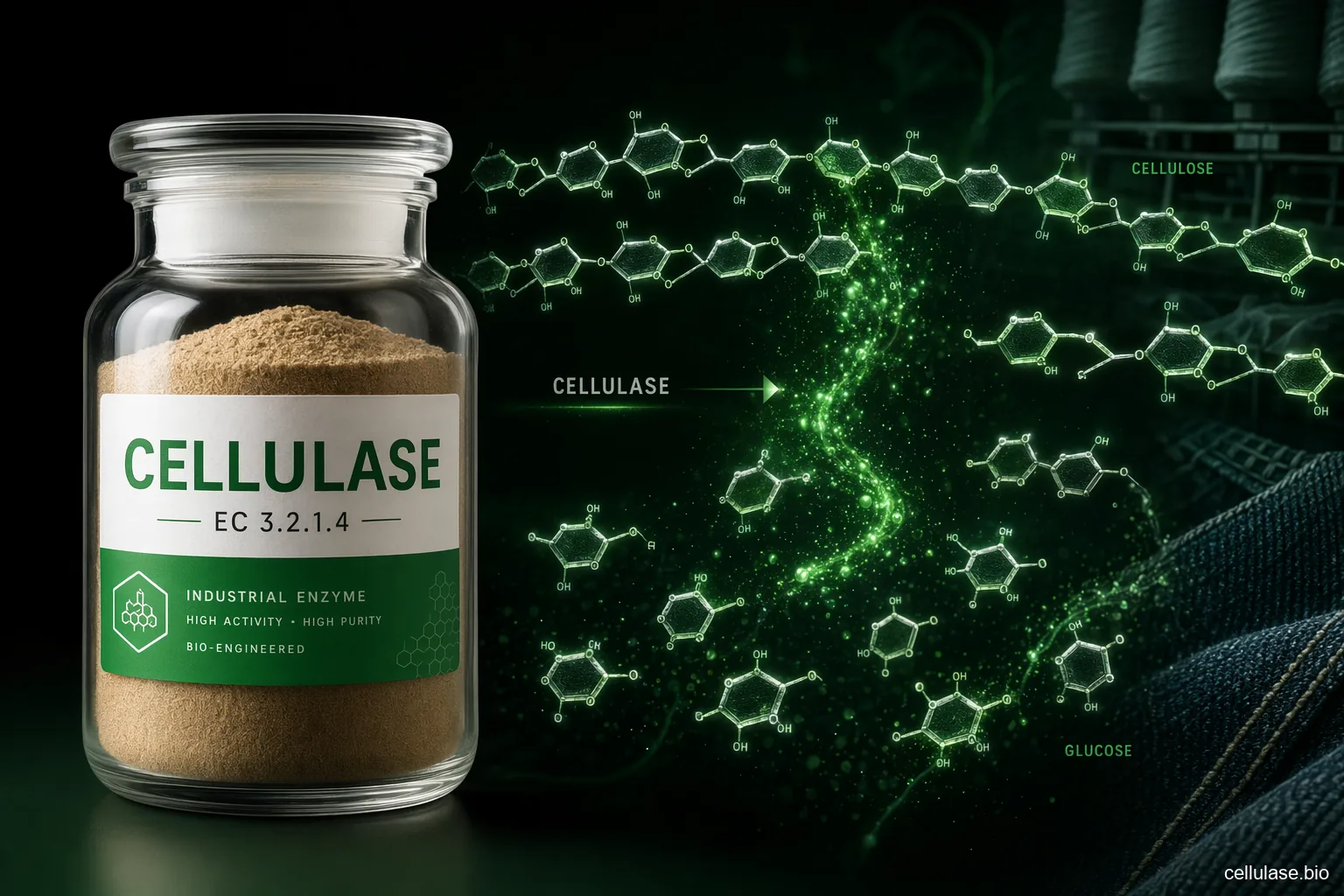
Cellulase for Bioethanol — Saccharification of Agricultural Residues for Second-Generation Cellulosic Ethanol
Convert lignocellulosic biomass — corn stover, bagasse, wheat straw, and wood chips — to fermentable glucose using high-activity cellulase enzyme for second-generation bioethanol saccharification.
Short answer
Second-generation ethanol needs cellulase because its feedstock is cellulose, not starch. Once pretreatment has opened up the lignin-hemicellulose matrix, a cellulase complex — endoglucanase, cellobiohydrolase and beta-glucosidase acting together — hydrolyses cellulose to glucose for fermentation. Enzyme loading and pretreatment severity trade off against each other and set plant economics.
Second-generation (2G) bioethanol — produced from lignocellulosic agricultural residues and energy crops rather than food-competing starch or sugar crops — depends fundamentally on cellulase enzyme to convert cellulose into fermentable glucose. The lignocellulosic feedstocks used in 2G bioethanol production — corn stover, sugarcane bagasse, wheat straw, rice straw, switchgrass, and woody biomass — contain 30–50% cellulose by dry weight, which represents the dominant fermentable substrate. But this cellulose is embedded in a matrix of hemicellulose and lignin that physically shields it from enzymatic attack, requiring a pretreatment step (dilute acid, steam explosion, alkaline, or organosolv) before enzymatic saccharification. After pretreatment, which disrupts the lignin-hemicellulose matrix and increases cellulose surface accessibility, cellulase enzyme is applied in the saccharification step to hydrolyze cellulose chains to glucose monomers. This hydrolyzed glucose stream is then fermented by Saccharomyces cerevisiae or other organisms to produce ethanol. The cellulase enzyme system required for effective lignocellulosic saccharification is a multi-component complex including endoglucanase (EC 3.2.1.4), cellobiohydrolase (EC 3.2.1.91), and beta-glucosidase (EC 3.2.1.21) — together acting synergistically to depolymerize crystalline cellulose to cellobiose and glucose. Cellulase from Trichoderma reesei is the industry standard for 2G bioethanol because T. reesei produces a well-balanced cellulase complex with high cellobiohydrolase content and strong synergism between complex components. Saccharification conditions are typically pH 4.5–5.5 and 45–55°C, with enzyme loading set against the cellulose content of the pretreated substrate, depending on pretreatment severity, cellulose crystallinity, and target glucose yield. For industrial bioethanol plants and biorefineries, enzyme cost is a major factor in the economics of 2G ethanol — enzyme cost per liter of ethanol must be minimized through high specific activity, matched loading to pretreatment severity, and glucose yield optimization at commercially viable enzyme doses. Technical buyers and biorefinery procurement teams specify cellulase by the hydrolysis performance it achieves on their own pretreated substrate, the level of beta-glucosidase supplementation required, protein content, and thermal stability at process temperature; send those details with your feedstock, annual volume and destination for a bulk quote.
See what cellulase is and how it breaks down cellulose for the full picture.
Updated · Cellulase Enzyme Solutions
Applications
Corn stover saccharification for lignocellulosic ethanol
Corn stover pretreated by dilute acid or steam explosion at high solids (15–25% dry matter) is saccharified with cellulase enzyme at the loading matched to the pretreatment, supplemented with beta-glucosidase, at pH 4.8–5.2 and 50°C for 48–72 hours. Glucose yields of 80–92% of theoretical cellulose conversion are achievable at these conditions, providing the fermentable substrate for ethanol fermentation at 50–60 g/L glucose in the hydrolysate. The hydrolysis is typically conducted at high solids to minimize water use and maximize glucose concentration for downstream fermentation.
Sugarcane bagasse cellulase hydrolysis for ethanol and glucose
Sugarcane bagasse, the fibrous residue from juice extraction, contains 35–45% cellulose and is the primary feedstock for 2G ethanol in sugarcane-producing regions. After pretreatment by dilute acid or alkaline/steam at 180–200°C, bagasse is saccharified with cellulase at the loading matched to the pretreatment, at pH 4.8–5.0 and 48–50°C for 48–72 hours. A high-concentration Trichoderma reesei cellulase grade provides the endoglucanase and cellobiohydrolase activity needed for efficient crystalline cellulose hydrolysis in the bagasse matrix.
Wheat straw and agricultural residue saccharification
Wheat straw, rice straw, and other agricultural cereal residues pretreated by alkaline hydrogen peroxide, organosolv, or steam explosion at 10–20% dry matter solids are saccharified with cellulase at the loading matched to the pretreatment, pH 5.0–5.5, 50°C, for 48–96 hours. Agricultural straws have lower cellulose crystallinity than woody biomass and typically achieve 75–90% cellulose conversion at these conditions with T. reesei cellulase enzyme, providing glucose concentrations of 40–70 g/L in the saccharification liquor depending on initial dry matter loading.
Simultaneous saccharification and fermentation (SSF) process
In simultaneous saccharification and fermentation (SSF), cellulase enzyme and fermentation yeast are added together to pretreated biomass, with glucose consumed by yeast as fast as it is produced by the enzyme, reducing product inhibition of cellulase by cellobiose and glucose. SSF conditions are typically pH 5.0–5.5 and 37–39°C — a compromise between the cellulase optimum (50°C) and the yeast fermentation optimum (30–35°C). Cellulase enzyme at the loading matched to the pretreatment in SSF achieves 70–85% cellulose conversion within 72–120 hours, with simultaneous ethanol production reducing the need for a separate fermentation vessel.
Product Specifications
Frequently Asked Questions
Bulk Cellulase for Bioethanol Plants and Biorefineries
Share your application and volume requirements. Receive a free sample, COA, and pricing within 24 hours to support procurement decisions.
Get Quote