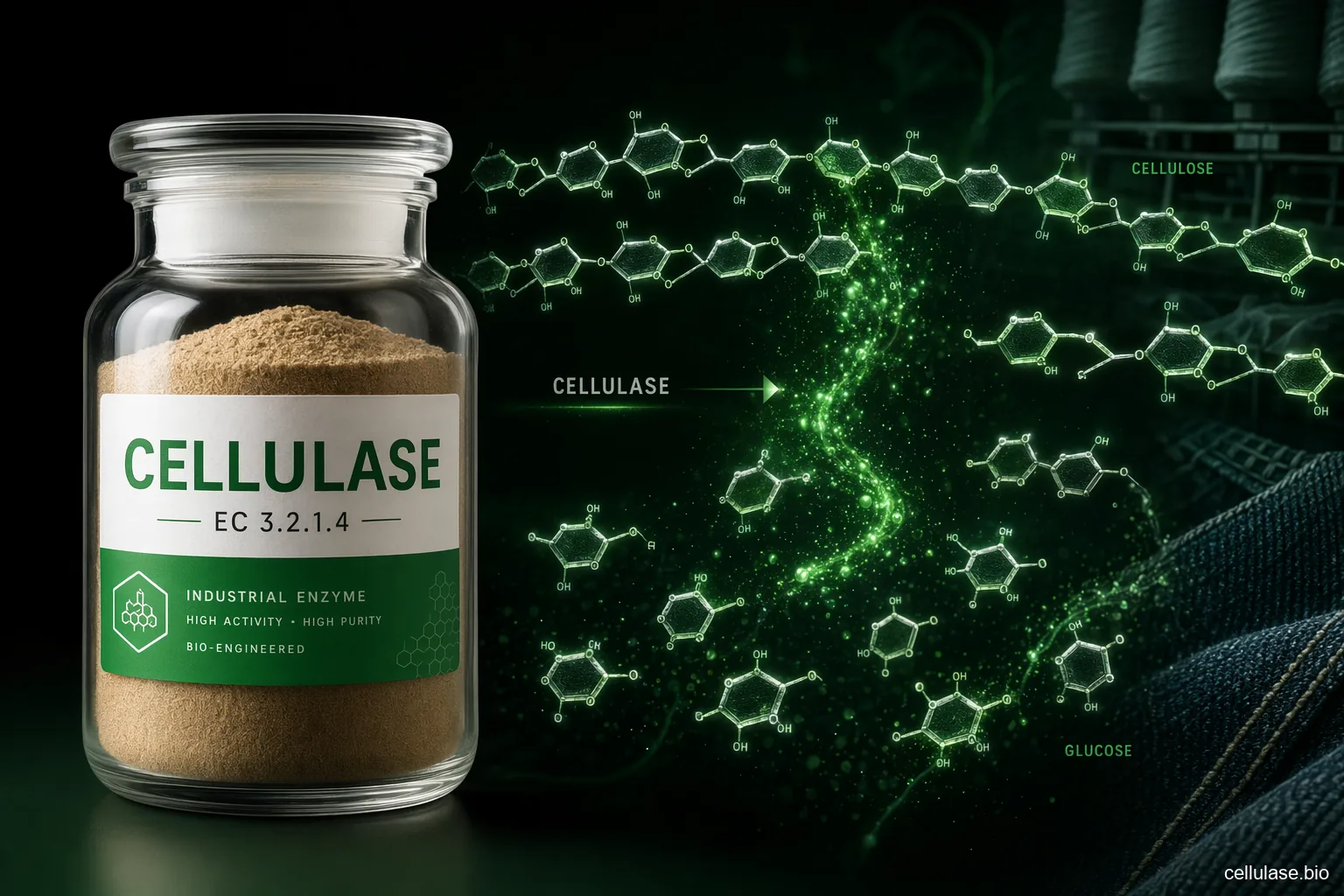
Cellulase for Industrial Production and Activity Control
Improve production efficiency with a cellulase enzyme designed for controlled activity in textiles, feed, pulp, and biomass processing.
Short answer
Consistent industrial results come from controlling the process window, not from chasing a headline figure. Cellulase is supplied in several concentration grades as powder or liquid; the right one is whichever delivers your target effect inside your existing pH, temperature and contact-time window, confirmed on your own substrate.
In industrial sectors where cellulose breakdown is essential, predictable cellulase production and activity make the difference between consistent output and costly variability. Unstable enzyme activity leads to uneven material treatment, diminished yields, and higher energy consumption across applications from textiles and denim to feed, pulp, paper, and biofuels. By combining reliable fermentation of Trichoderma reesei or Aspergillus niger with precise activity measurement, this industrial cellulase delivers targeted hydrolysis under optimal pH and temperature parameters. High-activity grades facilitate faster reactions at lower doses, cutting process time and operational costs while protecting product quality. In textiles, cellulase removes surface microfibrils for smoother finishes; in denim, it enables stone-free fading; in pulp and paper, it improves drainage and fiber modification; in feed and biomass conversion, it unlocks nutrients and fermentable sugars. Selecting the right grade—aligned with your process window, substrate load, and target profile—ensures reproducible performance whether in batch or continuous systems. Available in powder or liquid form, packaged in scalable industrial sizes, this enzyme retains full activity for up to 12 months when stored appropriately. With optimal performance in mildly acidic conditions (pH 4.0–6.0) and temperatures of 45°C–60°C, it integrates into existing workflows to stabilize production, reduce waste, and enhance process economics; manufacturers and distributors can send the application, quantity and destination for a bulk quote.
See cellulase for cellulosic ethanol and biomass saccharification for the full picture.
See cellulase pH and temperature windows for the full picture.
Updated · Cellulase Enzyme Solutions
Applications
Textile Biopolishing
In cotton finishing, excess surface microfibrils cause pilling, dullness, and inconsistent hand feel. A cellulase enzyme provides controlled hydrolysis of exposed cellulose on the fabric surface, helping create a smoother, cleaner finish with less chemical stress than aggressive mechanical methods. Typical processing is carried out at pH 4.5 to 5.5 and 45°C to 55°C, with dose adjusted to fabric weight and desired effect.
Denim Finishing
Denim processors use cellulase enzyme systems to replace or reduce pumice stone washing. The enzyme selectively acts on protruding cotton fibers, generating abrasion-like fading while reducing equipment wear, sludge, and fabric damage. This supports more consistent wash appearance and better production control. Typical use is around pH 4.5 to 5.5 and 50°C to 55°C, with dosage tuned to garment load and shade target.
Pulp and Paper Processing
In recycled and virgin fiber operations, cellulase enzymes can improve drainage, refine fiber structure, and support deinking performance. The objective is not full cellulose destruction, but targeted fiber modification that lowers energy demand and improves runnability. Processors typically work near pH 4.5 to 6.0 and 45°C to 55°C, using trial-based dosing to balance strength retention with process gain.
Cellulosic Biofuel and Feed Applications
For biomass and feed applications, cellulase enzyme activity helps break down plant cell walls so more sugars or nutrients become available. In lignocellulosic hydrolysis, it supports release of fermentable sugars from corn stover, bagasse, and wood-derived feedstocks. In feed, it helps improve digestibility of fibrous ingredients. Operating ranges are usually pH 4.0 to 5.5 and 45°C to 60°C, with dosage set by substrate loading and residence time.
Product Specifications
Frequently Asked Questions
Wholesale cellulase for manufacturers and distributors
Share your application and volume requirements. Receive a free sample, COA, and pricing within 24 hours to support procurement decisions.
Get Quote